It shocked me to learn that it has been six years since I last reviewed an edition of Paranoia; back in 2017 I did a System Split comparison between Paranoia Red Clearance Edition and Paranoia XP, two editions of the game which had significant mechanical departures from each other. At the time, my conclusion was that while Red Clearance Edition was a better game, XP was the better Paranoia. Apparently someone over at Mongoose read my review, because the new edition of Paranoia (called The Perfect Edition while on Kickstarter) takes my conclusions to an unsettling tee: the slicker rules are kept, the setting is rolled back to more reflect a throughline from the older editions, and the cards, which worked way better in theory than in practice, were removed. The result is remarkably close to a version using Red Clearance Edition rules with XP-style fluff, and (unsurprisingly) it turns out that yes, I really do like the version of the game made seemingly in direct response to my critiques. That all said, the new edition of Paranoia is still an edition of Paranoia made in 2023, and that alone has gotten me thinking about this. So let’s set aside the goofy clearance warnings, fake redactions, and admonishments to self-terminate, and talk about how Paranoia, any Paranoia, actually fits into the gaming landscape here in the roaring 2020s.
Continue reading Paranoia The Core Book ReviewCategory Archives: Editorial
Reviews, opinions, and whatever else strikes our fancy!
Give us more devastating games
What do you do?
The call to action within a tabletop RPG implies freedom. When all is said and done, when the cards are down, the GM asks the players ‘what do you do?’ and they go forth as they see fit. Not bound by rules or procedures, only by their imagination of the game world; the rules are there to help explain what happens, not to limit what can be done. This is the siren’s song of the roleplaying game, the freedom to do, and to be, whatever and whoever you want. There are many roads to a roleplaying game, and most traditional games (and many popular non-traditional ones) are built around this question. There is another question, though, that a game can ask, and for me, games which ask this second question have been the ones providing the most affecting, engrossing experiences.
How do you feel?
While games don’t literally ask this question outright (with a few exceptions), it is the key to another layer of character development, of narrative, even of mere in-game consequences. Once a game makes you think about how your character is feeling, you’re inhabiting that character on a whole other level. The problem with this should essentially go without saying: Rules can’t make you feel things. Game procedures can’t make you feel things. If a game wants to make you feel things, and more specifically feel the things your character would feel, the designer has to be a lot more inventive in how they go about this task than they would be, say, determining the probability that you hit a target with an arrow. But there are designers who have succeeded in this, delivering gut punches, heart wrenching decisions, and a sprinkling of light trauma. To them, I have only one thing to say: I want more of it.
Continue reading Give us more devastating gamesMystery Dice Goblins Review
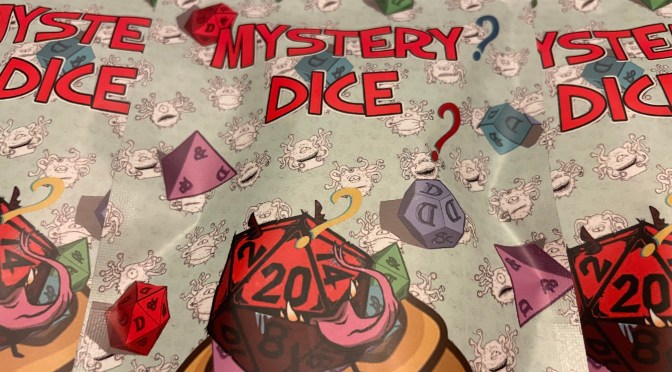
Ah, yes, the shiny click-clack math rocks. While many games now do great things using playing cards, tarot, tokens, or sheer narrative oomph, there’s still something to be said about rolling the bones. Digital dice rollers may make forgetting your bag at home survivable, and enable playing above board across vast distances, and may even make resolving a roll much easier. The die-loving audience doesn’t take pride and joy in the different apps, discord bots, and VTTs, however. No, they enjoy the physical product, and often claim the moniker of dice goblins gladly. Here’s something a little different for us: a vendor that’s honest about what their clientele want, and who introduces a little mystery to it.
Shared Fantasy Review
The era of the RPG historian started in the 21st century, but that’s not when the RPG history has its roots. In the last decade or so, Jon Peterson, Shannon Appelcline and Ben Riggs, among others, have released volumes about how the tabletop RPG came to be. Though the RPG historians of today have different writing styles and research approaches, they share the perspective of being twenty-first century gamers looking back into the twentieth century through the lens of the hobby’s accumulated history, theory, and perspective. It is the very limitation of this twenty-first century perspective that illuminates the value of the few scholarly texts written about tabletop gaming in the time of its ascendancy. That’s why today I want to discuss Shared Fantasy by Gary Alan Fine.
Continue reading Shared Fantasy ReviewDIE the RPG: In-Depth Review
You’re dragged into a treacherous fantasy world made from your own fears, doubts and desires. There’s only one way to escape – but with limitless adventure within your grasp, would you even want to? You might very well have heard our first experience with DIE the RPG, based on the comic of the same name, when we featured it on Cannibal Halfling Radio: Now Playing! Jay, Evelyn, Fitz, and Max came back together to play one more roleplaying game and found themselves in the Fields of the Lost, facing down their own troubles. Well, last weekend I grabbed the d20 of the Master myself and ran a marathon session, ten hours long, and it was just as much of an emotional rollercoaster. With the book in hand and experience on both sides of the screen, let’s dive in for a proper review!
On Modules
My gaming group consists of roughly 10 adults, each able to commit to any given gaming session only when the vagaries of their schedule allows. We run two campaigns at a time, taking into account the availability of two GMs and whichever player has a character who is a ‘hinge’ to the upcoming session. Sometimes, we cannot get a session of either campaign together but still have 3 or 4 players. In the last year or so, I’ve finally acknowledged that the only effective way to pull out some quick gaming when such an attendance squeeze arises is to pick a backup system and pull out a module.
Continue reading On ModulesFantasy World Review
While Apocalypse World was the starting line for Powered by the Apocalypse, Dungeon World was what got the ruleset to really take off. By adapting the rules of the perennially popular Dungeons and Dragons as well as showing gamers what it looked like when Apocalypse World was hacked, Dungeon World not only moved significantly more copies than Apocalypse World but also kickstarted the popularity of PbtA in general. Now, years later, Dungeon World’s somewhat inartful mushing of Apocalypse World and D&D together is looked upon less fondly, given years of innovation and expansion of the PbtA ruleset. When you combine that with the checkered behavior of one of its authors, Dungeon World is a game that has sent many of its fans looking for a replacement.
Oddly, straight-up fantasy has not seen a lot of entrants into PbtA. There is Fellowship, but that is designed around a specific Tolkienesque sort of story. There is The Sword, The Crown, and the Unspeakable Power, but while that plays to Game of Thrones and popular dark fantasy themes, actually playing the game demands engaging in a unique and quite adversarial experience. No, the sort of fantasy romp typified by D&D but also offered in games like Forbidden Lands, RuneQuest, and even GURPS Dungeon Fantasy, is not really present to the same degree in PbtA as it is in other places. Maybe it’s the OSR attracting the sort of small press hackers and designers who want to write fantasy, or maybe Dungeon World’s shadow is too long. Either way, there’s a new fantasy PbtA game in town.
Continue reading Fantasy World ReviewWhat GMs Want
Starting last year and continuing into this one, there have been stories about a “dungeon master shortage” in the TTRPG hobby, specifically meaning D&D Fifth Edition. D&D rocketed up in popularity in the last decade or so since Fifth Edition was first released, but that means that some of the game’s liabilities have finally caught up with it. D&D was never great on rules clarity, but Fifth Edition, while aiming for simplicity on the player side of things, finally and completely left the DM in the lurch as the rules for that side of the screen were either executed poorly or, in many cases, removed entirely. Given the edition’s rise in popularity, the demand for DMs has completely outstripped the pool of game veterans who cut their teeth on earlier editions and could use their experience to fill in the gaps left in the 5e Dungeon Master’s Guide.
While there is no acute GM shortage across the rest of the hobby, the travails of D&D have brought the game-running role back into focus. Many indie games over the last decade have eschewed having a single player take on running the game (called both GMless, implying no need for any facilitation, and GMful, implying there is still a need for facilitation but it is split amongst multiple players), but the traditional “one GM-many players” paradigm still rules the roost across the spectrum of popular RPG designs. As the D&D hobby is finding out quite painfully, if you’re singling out one player to take on more responsibility, you’ve got to help them out.
Continue reading What GMs WantThe Ink That Bleeds Review – An Immersive Dive Into Immersive Journaling
“My friend Adam feel that bleed, and games that aim for it, are ‘comparatively cheap, short-term pleasures… a bit like jump scares.’ My experience is so the opposite.
I think immersive, bleedy journaling games are act of purging ourselves of narratives that aren’t in our interests and enlivening ourselves for the temporal world.
I’m totally going to show you how.”
So writes Paul Czege in The Ink That Bleeds – How To Play Immersive Journaling Games, and I’m going to show you some of what’s inside and what it made me think.
Continue reading The Ink That Bleeds Review – An Immersive Dive Into Immersive Journaling
Cowboy Bebop RPG Review
Adaptations are dangerous business, and that’s true no matter what medium you’re working in. Licensed RPG adaptations fall all over the map; for every The One Ring you get rules for Power Rangers contracting tetanus, and for every Star Wars there’s a Fallout. Reimagining old properties stays risky even if you’re staying in the same medium; the live-action reboot of Cowboy Bebop was a cautionary tale, albeit not quite as badly panned as live-action Death Note or live-action Ghost in the Shell. But what happens if you take Cowboy Bebop, the celebrated anime, and make it into an RPG? Well, in this case, something kind of magical.
The Cowboy Bebop Roleplaying Game was developed by designers from Italian company Fumble GDR and published by (also Italian) Mana Project Studio. While Mana Project is mostly known for publishing 5e settings, Fumble has a fairly impressive list of original games, including Not the End, a heroic game using an original ruleset called HexSys. A variant of HexSys powers Cowboy Bebop and, while it employs elements from games you likely know, it is completely original. The result is a game that feels like jazz; there is structure, rules, and even system mastery, but the mechanics create a loose, free environment to tell stories. And, because this is Cowboy Bebop, the stories center around bounty hunters, the bounties they’re chasing, and the memories from their past that haunt them.
Continue reading Cowboy Bebop RPG Review