
Welcome to the Cannibal Halfling Weekend Update! Start your weekend with a chunk of RPG news from the past week. We have the week’s top sellers, industry news stories, something from the archives, and discussions from elsewhere online.
Continue reading Weekend Update: 7/26/2025
itch.io Meddled by Payment Processors
Something terrible happened on the night of July 23rd; itch.io began clamping down on NSFW materials on their site. This is, unfortunately, something that was a long time coming.
Continue reading itch.io Meddled by Payment Processors
On Specificity
Why is Mothership, well, Mothership? Put another way, why isn’t it Basic Roleplaying, or Call of Cthulhu? The core mechanics are all very similar; basically everything in Mothership that isn’t specifically about starships is adapted from Call of Cthulhu in one way or another. And that little starship aside does point to the answer: The reason Mothership is Mothership, Call of Cthulhu is Call of Cthulhu, and neither of them are BRP has to do with the specificity of their missions. Both Call of Cthulhu and Mothership frame their ideal game experience as horror, which lends itself to specific mechanics in the designers’ eyes. Mothership more specifically is science fiction horror, so the designer adds rules about spaceships and space travel. Specificity isn’t limited to genre, though. Mothership is also intended to be light on mechanics; famously the game has no mechanics for things like stealth which means that the adjudication of things like hiding and following are circumstantial and entirely in the lap of the GM. Whether you agree with this mechanical decision or not, it is deliberate and it is specific.
While specificity of game outcomes is produced by having more and more concrete rules (Mothership’s take on stealth is completely non-specific, while a game with one or more stealth skills and a laundry list of modifiers would be much more specific), specificity of game design is much more interesting, especially as there’s an entire class of games that deliberately avoids it. When I looked at QuestWorlds, I saw a game designed to try and do everything, at the expense of doing anything in a particularly interesting or engaging way. It’s hardly the only generic game, and one could make the same complaint and direct it at Fate, or GURPS, or Savage Worlds.
But hold on. If we go back and look at Mothership again we have, broadly, a fairly non-specific game. Yes, it’s about space horror, and the character options are tuned to space horror. The GMing advice is very good. The layout is very good. The game, though? It’s, outside of the space horror part, stripped down Call of Cthulhu. So where does that Mothership ‘vibe’ come through besides the design ethos? A good part of it is the modules (hardly a controversial opinion), but I think a specific and interesting point is that the modules bring with them hyper-specific mechanics. While GURPS has mechanics meant to be at the level of physics and D&D has mechanics which reinforce genre, Mothership has a good chunk of its mechanics corpus supporting specific stories, designed for and included in the pages of modules like Gradient Descent and Another Bug Hunt. And this is kind of important: While Mothership clearly takes inspiration from the DIY and hack-and-borrow ethos of the OSR, it’s presented a bit differently. The modules, in addition to providing the setting and conflict and everything else for a solid few sessions of adventure, also provide the hacked/modified rules to make that adventure feel different or play different than the base game. It does make me think, though: If you’re hacking the rules (or using the designer’s hacks) for every module, how truly different is that from using a generic game? Put another way, what really makes Mothership different from BRP, really? It’s not rules, after all.
Continue reading On SpecificityWeekend Update: 7/19/2025
Apologies for the lack of update last week! Aaron moved house and it sent the entropy levels off of the dial. We’re back to our regularly scheduled update here.
Welcome to the Cannibal Halfling Weekend Update! Start your weekend with a chunk of RPG news from the past week. We have the week’s top sellers, industry news stories, something from the archives, and discussions from elsewhere online.
Continue reading Weekend Update: 7/19/2025
System Hack: Colony Sim Cortex Inspiration
Video games don’t make for easy translations to RPGs, especially if the video game isn’t really an RPG itself. For this continuing System Hack I’m aiming to put together a tabletop RPG that plays like a Colony Sim, and hopefully using Cortex Prime to do it. Before we get into any rules design, though, it’s time to look at my core inspiration for taking this project on in the first place.
RimWorld is a colony sim video game designed by Tynan Sylvester, and now supported and expanded through an entire team at Sylvester’s studio Ludeon Studios. The game was released in 2018 but had been in Early Access for five years at that point, and it continues to see frequent updates and support, including several large DLCs.
So how do we take that concept and translate it into a TTRPG? It’s not about the exact setting of RimWorld, though certain hard sci-fi conceits are going to port over. It’s more about understanding what experience the game produces, and then figuring out which elements of that experience could be employed to good effect in a tabletop game. With that in mind, let’s take a look at RimWorld’s premise and its mechanics, and get in the mood for some reverse engineering.
Continue reading System Hack: Colony Sim Cortex InspirationWeekend Update: 7/5/2025
Welcome to the Cannibal Halfling Weekend Update! Start your weekend with a chunk of RPG news from the past week. We have the week’s top sellers, industry news stories, something from the archives, and discussions from elsewhere online.
Crowdfunding Carnival: July, 2025
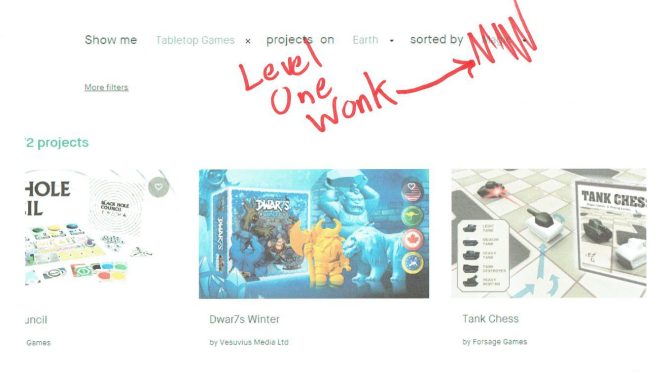
Welcome to the Crowdfunding Carnival for July! Just like every year, July is a lull prior to GenCon really revving everything up. Most larger publishers will hold announcements until the con, making July a little bit sparse in comparison. That said, this month may not have any major publisher campaigns but it does have a number of interesting entries. Interested in archaeology, cosmic horror, or making deals with the devil? Come right this way, we may have something for you.
Continue reading Crowdfunding Carnival: July, 2025Weekend Update: 6/28/2025
Welcome to the Cannibal Halfling Weekend Update! Start your weekend with a chunk of RPG news from the past week. We have the week’s top sellers, industry news stories, something from the archives, and discussions from elsewhere online.
Continue reading Weekend Update: 6/28/2025
Cannibal Halfling Radio Ep. 25 – Finely Aged Business
Well, we didn’t want to call it ‘stale’… because it’s not, not really! This chat episode was recorded last year, so a lot has happened since, but there’s still some good stuff here about licenses, bundles, system reference documents, digital storefronts, and other aspects of the tabletop world as viewed through the lens of a business.
Featuring: Editor Sloane TVBand, Aaron, and Seamus
You can also drop by the Tavern of our Discord to chat with us.
If you like what we’re doing with CHR, give us a hand and leave us a rating and review on Apple Podcasts and Spotify! You can also support us on Patreon.
Music is Sneaky Adventure by Kevin MacLeod
[License], art by Khairul Hisham! Thanks for listening!
Miseries and Misfortunes: When D&D stands for Dauphins and Defamation
Luke Crane is best known as the designer of The Burning Wheel, an intensely detailed medieval fantasy/Tolkien RPG which aims for a very different fantasy experience than what you find in Dungeons and Dragons and its contemporaries. The Burning Wheel has more and more complex rules than D&D, but it’s also a game with a strong sense of time and place; Crane’s inspiration for the fantasy side of the game was Tolkien outright (which is not the case with D&D), and the rest of the setting was inspired by history nonfiction by the likes of Barbara Tuchman, Desmond Seward, and others. The result is a game heavily steeped in 12th-13th century medievalism, but with the historicity sanded off with some genericization and, oh right, wizards and elves and giant talking rats.
The next biggest non-licensed game from BWHQ (both Mouse Guard and Burning Empires are licensed) is Torchbearer, which is more than anything a direct shot at D&D. While it uses somewhat similar mechanics to Burning Wheel, it is much more focused on dungeon crawling, taking some of the more structured procedures of 0e and Basic D&D and extending them to everything, including not only the dungeons and wilderness exploration but also town visits and social interactions. Torchbearer is a distinct game from Burning Wheel, and while Burning Wheel is known for its complexity Torchbearer is known for being fiendishly difficult due to its constant Grind and aggressive resource management.
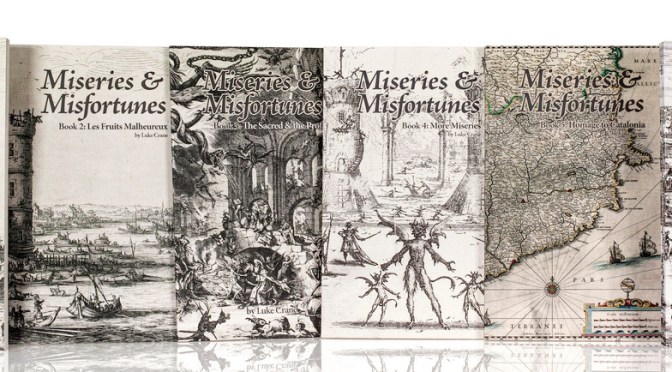
Luke Crane designed another game, more similar to Burning Wheel than the others in BWHQ’s portfolio. What’s truly strange about this game, though, is that it is a hack of Basic D&D. That in itself isn’t that weird, plenty of designers hack D&D for many purposes good and ill. What is weird, though, is that this hack of Basic D&D looks at the trajectory that Torchbearer plots from Burning Wheel and runs straight and fast in the opposite direction, aiming for more intrigue, more historical accuracy, and not a single dungeon to bother with. This game is called Miseries and Misfortunes.
Continue reading Miseries and Misfortunes: When D&D stands for Dauphins and Defamation Cannibal Halfling Gaming