
The RPG theory ship sails on unbidden, even as RPG networks of practice seem to be drifting apart. In November, there was a great post over on The Dododecahedron which bucked the trend and pulled theory work from outside of the author’s primary discipline, the OSR. Starting from a description written by Vincent Baker about the PbtA ‘conversation’, Dododecahedron author Rowan describes OSR play as an onion with four concentric layers: Character on the outside, then working inward to Mechanics, Procedures, and finally Adventure. Adventure is in the middle as the diegetic ‘fiction’ that the players are engaging with is the source of truth for OSR play. From there are Procedures, which describe the rules for how to go about play; that is to say, what travel looks like, or when random encounters occur, or how to track consumables. The next layer out is Mechanics, which describe the “rules” as most RPGs understand them; this is where initiative, ability checks, and all those specific bits live. Finally on the outside is Character, where elements like attributes, experience points, and skill ratings, all the things that make characters unique, sit.
Continue reading Coring the Onion: OSR structuralism and non-OSR gamesTag Archives: Burning Wheel
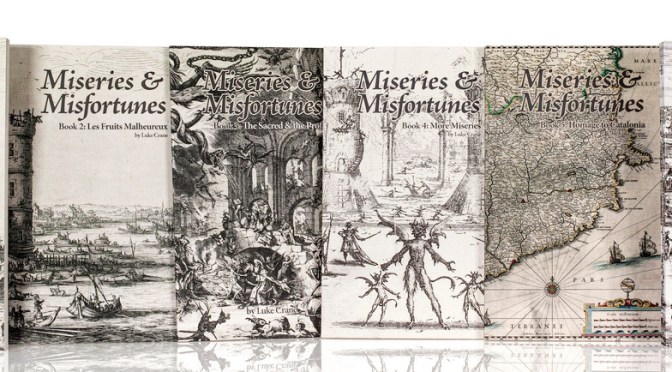
Miseries and Misfortunes: When D&D stands for Dauphins and Defamation
Luke Crane is best known as the designer of The Burning Wheel, an intensely detailed medieval fantasy/Tolkien RPG which aims for a very different fantasy experience than what you find in Dungeons and Dragons and its contemporaries. The Burning Wheel has more and more complex rules than D&D, but it’s also a game with a strong sense of time and place; Crane’s inspiration for the fantasy side of the game was Tolkien outright (which is not the case with D&D), and the rest of the setting was inspired by history nonfiction by the likes of Barbara Tuchman, Desmond Seward, and others. The result is a game heavily steeped in 12th-13th century medievalism, but with the historicity sanded off with some genericization and, oh right, wizards and elves and giant talking rats.
The next biggest non-licensed game from BWHQ (both Mouse Guard and Burning Empires are licensed) is Torchbearer, which is more than anything a direct shot at D&D. While it uses somewhat similar mechanics to Burning Wheel, it is much more focused on dungeon crawling, taking some of the more structured procedures of 0e and Basic D&D and extending them to everything, including not only the dungeons and wilderness exploration but also town visits and social interactions. Torchbearer is a distinct game from Burning Wheel, and while Burning Wheel is known for its complexity Torchbearer is known for being fiendishly difficult due to its constant Grind and aggressive resource management.
Luke Crane designed another game, more similar to Burning Wheel than the others in BWHQ’s portfolio. What’s truly strange about this game, though, is that it is a hack of Basic D&D. That in itself isn’t that weird, plenty of designers hack D&D for many purposes good and ill. What is weird, though, is that this hack of Basic D&D looks at the trajectory that Torchbearer plots from Burning Wheel and runs straight and fast in the opposite direction, aiming for more intrigue, more historical accuracy, and not a single dungeon to bother with. This game is called Miseries and Misfortunes.
Continue reading Miseries and Misfortunes: When D&D stands for Dauphins and Defamation
System Split: Burning Wheel Hacks
Burning Wheel is past its twentieth birthday. The game, a famously complex child of the Forge, is one that everyone seems to either love or hate. I personally love it, but in this week’s System Split I’m extending a fig leaf to those on the other side (or at least those who tried to love it and bounced off).
Burning Wheel is a game predicated on its detail; thanks to its long lists of traits, skills, and lifepaths each one of its mechanics operates in a way that is predicated on its setting, itself a nerd-among-nerd’s joy of medieval history (via Desmond Seward and Barbara Tuchman) and Tolkien (via, well, Tolkien). You can’t really take much out of Burning Wheel and have it remain Burning Wheel…when the designers tried to take things out of Burning Wheel, they ended up with Torchbearer.
That all said, just because Burning Wheel is all layered into itself like an indie RPG biscuit doesn’t mean that there aren’t buttery nuggets we can take out. Those systems, like the mechanics around Beliefs, can certainly stand alone even if we usually see them in the context of something more. With that in mind, I turn to the subjects of today’s pondering. Hot Circle, a clear riff on Burning Wheel, is written by Casper Dudarec and aims to take the core mechanics of Burning Wheel down to a simple and portable core. But wait! The Gold Hack, more of a riff on the recent editions of Burning Wheel (i.e. Burning Wheel Gold), is written by Martin Van Houtte and…aims to take the core mechanics of Burning Wheel down to a simple and portable core. Huh.
Continue reading System Split: Burning Wheel Hacks
Weekend Update: 8/5/2023
Welcome to the Cannibal Halfling Weekend Update! Start your weekend with a chunk of RPG news from the past week. We have the week’s top sellers, industry news stories, and discussions from elsewhere online.
Continue reading Weekend Update: 8/5/2023
Burning Wheel In-Depth
Some RPGs are demanding. While you can’t homebrew D&D into anything, it is still flexible and doesn’t demand that you play it a specific way. Some games do. There is no end of teeth-gnashing about this; for some reason people take more issue with RPGs having set procedures than, say, board games. But, as the entire indie RPG community knows very well, making a game for a specific purpose and experience often nets you a better version of that experience than trying to simulate it with a ruleset designed with breadth in mind. I’ve been having some revelatory experiences with such a targeted game recently; I will say though that when I say “targeted game” and “specific experience”, most are imagining a zine, something small, not a 600 page hardback with red and gold filigree. Yeah, I’m talking about Burning Wheel.

Meet the Party: Burning Wheel
A strange cultist who everyone ignored until he accidentally summoned a lesser demon. A noblewoman, cast to the nunnery for birthing a bastard and now on the run from a coup. A rebellious participant in said coup, who found his true god within the Cult of the Dead Stars. Meet the Party is jumping systems again, this time generating a trio of unlikely heroes for Burning Wheel!
System Split: Burning Wheel and Torchbearer
Welcome to System Split! Today, our very own Level One Wonk will examine two very similar systems to see what sets them apart. When the genre, complexity, and even rules system are exactly the same, what makes a game unique? Today we look at two fantasy RPGs from the twisted and brilliant mind of Luke Crane: Burning Wheel and Torchbearer! Despite one being based on the other, they offer very different experiences. How different? Read on!
Continue reading System Split: Burning Wheel and Torchbearer
 Cannibal Halfling Gaming