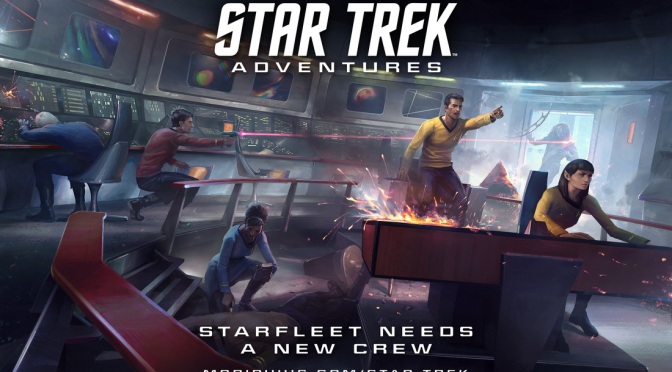
Gamemaster’s Log, Stardate 57252.7. It has been several months since the launch of the New Orleans-class starship U.S.S. Verrazzano, NCC-07302, from the Foggy Peak system. Since that time, I have seen her crew serve with distinction in accordance with the finest traditions of Starfleet. I have also seen them called before a board of Admirals to review their actions and directive violations, and while impressive the fact that no fewer than three starbases have had to be commissioned to deal with the discoveries from their missions is beginning to put a notable dent in the power requirements for the local sector’s industrial replicators. As the Verrazzano is currently away, responding to a distress call from a Vulcan Expeditionary Group, I have decided that this is a fine opportunity to review their so-called ‘Star Trek Adventures’ in-depth, to better understand how they have and will continue to boldly go where no one, not even the rest of Starfleet, has gone before.
Tag Archives: Opinion
System Split: Worlds Without Number and D&D Fifth Edition
It’s never been a better time to be a dungeon crawler. Dungeons and Dragons Fifth Edition and Pathfinder, two versions of the same underlying D&D ruleset, are bestsellers 1 and 2 in the RPG world, and have been for some time. Pathfinder is built for detail and breadth of options, while D&D’s Fifth Edition is built for accessibility and continuity with earlier versions and settings. They offer two versions of a fairly modern D&D experience, where GMs run story arc-based campaigns built around fighting monsters and exploring dungeons. Characters are treated like protagonists, and death is relatively rare. At the same time, we’ve seen a resurgence in “old-school” playstyles, usually represented within the D&D ecosystem by the OSR. Old-school games tend to have fewer rules, presenting challenges and decisions to the players rather than the characters. They tend to have weaker characters who aren’t treated like protagonists, and they need not be organized around a story.
There is a middle ground, though, and a new entrant in the middle ground has stormed into the DriveThruRPG sales charts. Worlds Without Number presents a dangerous old-school world, but uses rules innovations from later versions of D&D (and other role-playing games) to make the game more accessible and make the characters feel a bit more heroic. On top of all that, it provides tons of tools to help GMs run interesting game worlds with or without a driving story. Although many people will simply call Worlds Without Number an OSR game (and there are fair reasons for that), I think that it deserves to be examined against the current state of the art. That’s why this System Split pits Worlds Without Number against Dungeons and Dragons Fifth Edition.
Continue reading System Split: Worlds Without Number and D&D Fifth EditionRPGs Have Two Sets Of Rules
Role-playing games are different from any other type of analog game because of their relationship with rules and procedures. When you sit down to play a board game, or a card game, or even a game of darts, you follow a set procedure to determine an outcome. Wargames took half the steps away from board games by introducing rulesets which could be adapted to a wide range of scenarios, the only limits being how many minis you had and how big your sand table was. The early ‘Braunstein’ campaigns started the other half, walking away from simple win/lose conditions in scenarios. For the role-playing game to turn from a weirdo version of wargaming a couple nerds were running to a repeatable, salable product, existing wargaming rules had to be supplemented with rules for writing and executing free-form scenarios which very much didn’t resemble battles any more. Every traditional role-playing game, from the first edition of Dungeons and Dragons onward, has rules for players and rules for the person running the game.
The Independents: Facing The Titan
I’m a fan of games with some heft to them. Rules and procedures are the elements of role-playing games which enable them to generate bigger, more interesting stories than the players could have come up with themselves. Unfortunately, rules-heavy and procedure-heavy games are stuck with a long history of taking up the mechanics of their wargame-based forebears without a great reason to do so. Rules and procedures can be so much more than physics engines and combat mechanics, after all. What if your game built out rules and procedures that were distinctly literary in origin? Imagine that the game not only traces out the course of your story, but also gives you procedures for establishing your own symbolism within the story. It’s quite possible that the game you’re imagining looks a lot like Nicolas ‘Gulix’ Ronvel’s Facing the Titan.
Revisiting Blacow’s Model
As soon as a role-playing game had been run in at least two places, the attempts to categorize and catalogue gaming styles began. Even in the 1970s, when most of the market only knew D&D, foundational work in understanding how and why role-players play had already started. One of the most influential early theorists was Glenn Blacow. Originally exposed to D&D at MIT, Blacow published an early typology of gamers in the small gaming zine The Wild Hunt. This typology, after being expanded for publication in another, larger zine, Different Worlds, became one of the first and most influential classifications of RPG playstyles. Among other things, Blacow is credited, through the Different Worlds version of his essay, coining the term ‘power-gamer’.
Although one might guess that Blacow’s model has declined in relevance somewhat since its original publication in 1980, in reality it still serves as a foundation for many player and play style classifications in wide use. GNS Theory owes its start point to Blacow’s Power Gamer and Storytelling archetypes, and D&D’s seven player types start from Blacow’s four play styles as well. As much as we still see story and optimization as driving forces among gamers, the dichotomy of fantasy and wargaming is a concept that has slid from relevance as the days of the wargamer/fantasy reader schism grow further behind us. Still, behind this dated framing is an idea that’s still worth investigating.
Continue reading Revisiting Blacow’s ModelKickstarter Wonk: March, 2021
Welcome back to March! There are a lot of games on Kickstarter this month, and Kickstarter Wonk is here to help. Now, Zinequest technically ended on Sunday, but there’s still a good crop of zines at the tail end of the event. I’ve picked out 35 more that are worth checking out if you have any of your Zinequest budget left. And, since it is March again, we’re picking up what we can for our full game selection. Five full-sized games are here and they’re picking up where ZineQuest left off, with both old hands and newcomers casting their projects out for us to peruse.
Continue reading Kickstarter Wonk: March, 2021Kickstarter Wonk Redux: Zinequest Wonk 2021
February is only half over! Welcome to this year’s special mid-month edition of Kickstarter Wonk: ZineQuest Wonk! There are so many zines campaigned throughout the month of February that it seems particularly unfair to just highlight those who jumped to be first at the beginning of the month. That’s why this week I’m bringing another forty zines to your attention.
Continue reading Kickstarter Wonk Redux: Zinequest Wonk 2021
Bargain Bin Gaming: Space Knights
Welcome back to the Bargain Bin! This hobby might often be a financially demanding one, and with the almost infinitely-headed hydra known as ZineQuest on the loose again this month that’s even more true than usual, so I thought it might be nice to have a reminder that you can find good games at bargain prices. When the price is Pay What You Want, you can check the game out for free before spending anything! This time out you will cross the galaxy, taking on the battles that no one else can fight. You will face ruthless aliens, explore desolated worlds and perform terrible deeds just to give humankind one more day before extinction. You will overcome these challenges by the might of your arm and soul… or you will face a destiny worse than death. Not as individuals, no, but as legions of elite warriors. This is Space Knights, written by Gabriel Ciprés!
SLA Industries 2E Review
Are you not satisfied with the dystopia in your life? Is Paranoia too tongue-in-cheek? Is Dark Heresy not tongue-in-cheek enough? Is Cyberpunk just too grounded for what you had in mind? Well, loyal readers, there is another dystopia out there. Combine Paranoia’s sense of humor, Dark Heresy’s grim and dark setting, and Cyberpunk 2020’s love of guns, and you get something altogether different but still, well, ‘British Isles’ in its sensibilities. It’s time to freshen up your resume and go work for SLA Industries.
Continue reading SLA Industries 2E ReviewKickstarter Wonk: February, 2021
Welcome to Kickstarter Wonk! It’s February, and you know what that means: ZineQuest! ZineQuest is off to a roaring start this year, and even after merely two days my eyes are already crossing from all the zines I’ve seen. To make it even crazier, there are also actual full-length games still being funded, and I’m trying, at some level, to cover both. First, here’s three full-sized Kickstarter campaigns which are all worth your consideration and perusal. Second, I’ve picked out 40 Zinequest campaigns that both look cool and are currently active. Don’t think that’s enough? Me neither! Since Zinequest campaigns traditionally last 14 days, 14 days from now I’ll be posting a special ZineQuest Wonk which covers all the zines which have campaigns starting after this publication date. For now, though, let’s check out some games!