
Welcome to the Cannibal Halfling Weekend Update! Start your weekend with a chunk of RPG news from the past week. We have the week’s top sellers, industry news stories, something from the archives, and discussions from elsewhere online.
Continue reading Weekend Update: 6/28/2025Monthly Archives: June 2025

Cannibal Halfling Radio Ep. 25 – Finely Aged Business
Well, we didn’t want to call it ‘stale’… because it’s not, not really! This chat episode was recorded last year, so a lot has happened since, but there’s still some good stuff here about licenses, bundles, system reference documents, digital storefronts, and other aspects of the tabletop world as viewed through the lens of a business.
Featuring: Editor Sloane TVBand, Aaron, and Seamus
You can also drop by the Tavern of our Discord to chat with us.
If you like what we’re doing with CHR, give us a hand and leave us a rating and review on Apple Podcasts and Spotify! You can also support us on Patreon.
Music is Sneaky Adventure by Kevin MacLeod
[License], art by Khairul Hisham! Thanks for listening!
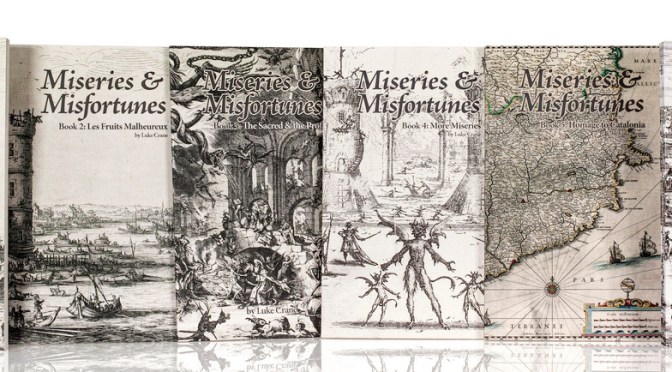
Miseries and Misfortunes: When D&D stands for Dauphins and Defamation
Luke Crane is best known as the designer of The Burning Wheel, an intensely detailed medieval fantasy/Tolkien RPG which aims for a very different fantasy experience than what you find in Dungeons and Dragons and its contemporaries. The Burning Wheel has more and more complex rules than D&D, but it’s also a game with a strong sense of time and place; Crane’s inspiration for the fantasy side of the game was Tolkien outright (which is not the case with D&D), and the rest of the setting was inspired by history nonfiction by the likes of Barbara Tuchman, Desmond Seward, and others. The result is a game heavily steeped in 12th-13th century medievalism, but with the historicity sanded off with some genericization and, oh right, wizards and elves and giant talking rats.
The next biggest non-licensed game from BWHQ (both Mouse Guard and Burning Empires are licensed) is Torchbearer, which is more than anything a direct shot at D&D. While it uses somewhat similar mechanics to Burning Wheel, it is much more focused on dungeon crawling, taking some of the more structured procedures of 0e and Basic D&D and extending them to everything, including not only the dungeons and wilderness exploration but also town visits and social interactions. Torchbearer is a distinct game from Burning Wheel, and while Burning Wheel is known for its complexity Torchbearer is known for being fiendishly difficult due to its constant Grind and aggressive resource management.
Luke Crane designed another game, more similar to Burning Wheel than the others in BWHQ’s portfolio. What’s truly strange about this game, though, is that it is a hack of Basic D&D. That in itself isn’t that weird, plenty of designers hack D&D for many purposes good and ill. What is weird, though, is that this hack of Basic D&D looks at the trajectory that Torchbearer plots from Burning Wheel and runs straight and fast in the opposite direction, aiming for more intrigue, more historical accuracy, and not a single dungeon to bother with. This game is called Miseries and Misfortunes.
Continue reading Miseries and Misfortunes: When D&D stands for Dauphins and DefamationWeekend Update: 6/21/2025
Welcome to the Cannibal Halfling Weekend Update! Start your weekend with a chunk of RPG news from the past week. We have the week’s top sellers, industry news stories, something from the archives, and discussions from elsewhere online.
Continue reading Weekend Update: 6/21/2025
Are fewer rules actually less complicated?
The debate about rules density in roleplaying games is a bit of a mess, frankly. What should be a relatively simple continuum (more, more detailed mechanics to fewer, higher-level mechanics) is conflated with story-first versus gameplay-first, indie versus traditional, and even in some cases old versus new. Actually pulling together a comparison where you’re actually looking at rules density and nothing else is difficult; controlling for these factors is hard because while they aren’t causal, they are correlated.
When it comes to actually running games, though, I’m going to make full use of Betteridge’s Law of Headlines here. Running light games can be very complicated indeed, for the simple reason that anything the rules aren’t laying out for you, you have to do yourself. Now…is that a simple reason? One of the reasons we have seen rulesets trend lighter over time is that the number of ‘things’ that players consider necessary to track or perform in a game session has gone down as games have become more specific. Furthermore, one of the reasons that more narrative driven games often have lighter rulesets is that the number of elements that a ruleset needs to codify in order to maintain fairness and consistency can often be much lower. But, if we’re looking across games of roughly similar style and intent, then we often see that more rules-dense, ‘crunchy’ games can be more approachable. That is for one broad reason.
Continue reading Are fewer rules actually less complicated?Weekend Update: 6/14/2025
Welcome to the Cannibal Halfling Weekend Update! Start your weekend with a chunk of RPG news from the past week. We have the week’s top sellers, industry news stories, something from the archives, and discussions from elsewhere online.
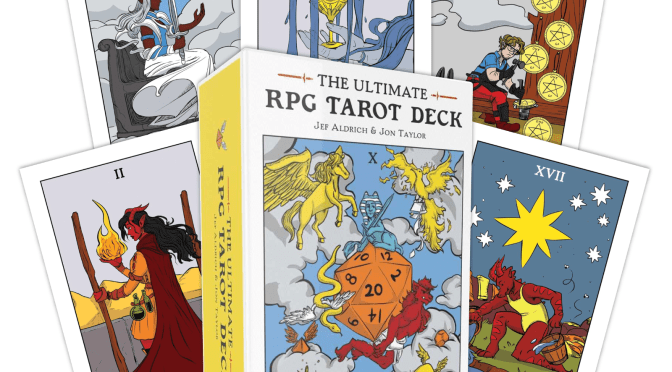
The Ultimate RPG Tarot Deck Review
The cards, the cards, the cards can tell, the past, the present, and the future as well… provided you can actually read them. Tarot decks are seeing increasing use in tabletop roleplaying game design, from pure oracles like in Tangled Blessings to full-on challenge resolution like in To Change. In many cases the games provide pretty good prompts and details for what a given card means, but I’ve often seen them limited to just the major arcana, or suggest the players can be inspired by the card’s art to help interpret things. For those unfamiliar with tarot (it’s me, I’m talking about myself), that can be a bit of a challenge. Enter the Ultimate RPG Tarot Deck from Jon Taylor and Jef Aldrich!

System Hack: Colony Sim Cortex Design Goals
It’s been a while since we’ve seen an extended System Hack at Cannibal Halfling Gaming. Genesys Mecha concluded in September of 2019 and Cyberpunk Chimera concluded in May of 2020. And yes, neither of them were ever expanded into standalone products; while writing did continue behind the scene the scope of the ambition of both of the projects was simply too high to be completed in the spare time of one or even two nerds who also had jobs (and in one case, kids).
With all those caveats out of the way, I’m trying it again anyway. Both Genesys Mecha and Cyberpunk Chimera provided great deep dives and game design ideas, and with that in mind I wanted to set my sights on something that’s both been a personal quest of mine for a little while as well as something that will add to the game design conversation in a positive way (whether or not the article series leads to anything more). Cortex Prime is, in my opinion, one of the most flexible and powerful rules toolkits on the market. It’s also a toolkit that takes some effort and consideration to set up, which has prevented it from taking off in the same way as the similar but much simpler Fate. Cortex Prime also has many fewer worked examples than Fate, which has the exemplary Fate Worlds series as well as a number of Fate System Toolkits; instead, Cortex only has Tales of Xadia as a fully implemented Cortex game outside of its three in-book examples which are too short and a bit too unconventional to be accessible demos (their genres are police procedural, rescue team, and neo-classical fantasy). A good system hack will walk through the various mechanics, mods, and character options and discuss why each choice is made and how they’re going to work in the final product.
Continue reading System Hack: Colony Sim Cortex Design Goals
Ringmaster Review: A Circus Troupe Descended from the Queen
Royal clowns? Well, not quite. For The Queen has taken quite the journey since Jason first looked at it. It got itself a second edition, and moved from Evil Hat Productions to Darrington Press, true. From near the start, though, it offered an SRD and the Descended from the Queen moniker to allow others to use the mechanical framework, and as it turns out there a lot of games under that tent now. This time we’re dealing with a dark and supernatural version of the greatest show on earth, with Ringmaster from Pascal Godbout/Spotless Dice Games!
Continue reading Ringmaster Review: A Circus Troupe Descended from the Queen
Weekend Update: 6/7/2025
Welcome to the Cannibal Halfling Weekend Update! Start your weekend with a chunk of RPG news from the past week. We have the week’s top sellers, industry news stories, something from the archives, and discussions from elsewhere online.
Continue reading Weekend Update: 6/7/2025 Cannibal Halfling Gaming