
It’s a Tuesday night. The Steve Jackson Games forums have over 220 active users right now, and Mongoose Publishing’s forums have nearly 600. While sandwiched between a few anime-styled games, DriveThruRPG’s top sellers are heavily represented by vintage properties. Their top 10 is split between four anime games (Fabula Ultima, two Twilight Sword books, and ‘The Legend of Heroes’) and six systems with original publication dates between 1977 and 1987 (Pendragon, Call of Cthulhu, Cyberpunk, Traveller, and Warhammer Fantasy Roleplay). While the anime part may be a bit new, the overall trend is not: Legacy properties being shepherded by Mongoose, Cubicle 7, and Arc Dream consistently jump to the top of sales charts, essentially every time a new supplement is released. Even if these companies aren’t doing WotC numbers, they’re consistently Tier 3 or maybe even better in the RPG world, on the success of old games. Calling these nostalgia plays may be technically true, but it misses the point; we’re in a world where fandom-creating Mothership is able to generate a little less than $1.5 million once in a Kickstarter, but Mongoose Publishing, mostly on the weight of a space game ten years older than I am, generates enough revenue year after year to securely buy the building their office is located in. Old games are built differently, and it begs the question: Is there something older games are actually doing better for their audiences, or are newer games simply being starved of new blood?
Continue reading It’s still all old gamesAll posts by Aaron Marks

Twilight Sword: Filtering reactions to D&D through video games
Most fantasy RPGs are a reaction to D&D in one way or another. This has likely been true for some time; while games like RuneQuest have had time to evolve and develop their own base principles, many of them, especially ones as old as RuneQuest, were very much about being either in alignment with or in opposition to what D&D did when they were first released. Given D&D’s current market share, this has become more nakedly true in the bestselling entries in the fantasy genre; Tales of the Valiant, Draw Steel, and Daggerheart are all essentially versions of the D&D formula and none of them purport to offer a different sort of game than D&D beyond differing priority rankings for things like narrative development, tactical combat, or power level.
A new trend I’ve observed is typified by game designers taking a different tack to how they ‘react’ to D&D, and this is generally one filtered through other media. Break, Fabula Ultima, and Twilight Sword are all versions of this to one extent or another. While these games all differ from each other, hidden in each is a similar underlying thesis: In order to make tabletop roleplaying more accessible, this game is derived from the most accessible D&D derivative, the fantasy RPG video game. The fact that these are all more from a JRPG lens likely has to do with legacy as well as differentiation; the first Final Fantasy outsold its licensed D&D contemporary Pool of Radiance by about 50%, and the gap only got wider. Final Fantasy VII outsold Baldur’s Gate, its licensed D&D contemporary, by about fivefold (and that’s only to 2005, not including any of the remakes or re-releases of either). Even if Baldur’s Gate III and the recent explosion in popularity for D&D have shifted this narrative, there’s no question that through the 90s, the JRPG reigned supreme when it came to sales volume and cultural impact.
Continue reading Twilight Sword: Filtering reactions to D&D through video games
Reflections on domains, factions, and “high-level play”
As is becoming perhaps more common, I feel compelled to react to an interesting piece from elsewhere in the RPG blogosphere. High Level Play and Scaffolding takes a Bluesky thread from Sam Sorensen and uses it as a jumping off point to discuss why there are noted trends of hesitancy among players to move into “high-level play” in an OSR sense, that is to say gameplay which shifts from focusing on dungeon crawling and party-level combat and treasure hunting to play where the characters become leaders of mercenary companies, warbands, or even nations. Post author Zak H. frames this as a scaffolding problem, essentially stating that the mode of play that “high-level play” requires isn’t set up or framed by any of the levels or modes of play that come before it. I find that perfectly reasonable; it makes sense that dungeon crawling doesn’t prepare you for factional intrigue or morale management. What I’m more interested in is where this all fits into the broader hobby here in 2026.
Continue reading Reflections on domains, factions, and “high-level play”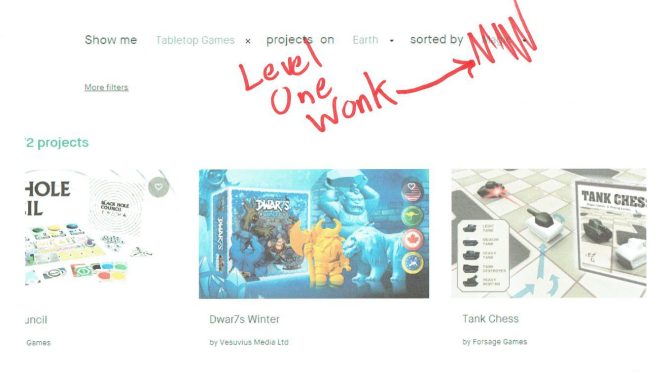
Crowdfunding Carnival: July, 2026
Come one, come all, to the Crowdfunding Carnival! It might be summertime sadness, but things are a bit quiet here at the carnival. That said, at least one barker has taken the opportunity to put a fresh coat of paint on the old tent. Kickstarter has rolled out a new search page, including significantly more filtering options. Also of note is the new ‘TTRPG’ category. While this first appeared last month, the line between it and the old Tabletop Games category was still blurry, so I opted not to bring attention to it. There’s still crossover between the two, but it looks like the more specific categories should help with searching. In addition to TTRPG there’s also STL being added as a category, which should help filter minis and other accessory-specific campaigns away from your search page if that’s not what you’re looking for.
While I don’t have proof I’d anticipate that Kickstarter is responding to the ever-increasing competitive pressure from other providers like Backerkit. While Kickstarter is still dominant in the broader crowdfunding space, Backerkit has brought the heat in TTRPGs as well as other toys and games categories. This month’s campaigns come from both services, and as is often true in the doldrums of July, it’s the indies that have come to play.
Continue reading Crowdfunding Carnival: July, 2026
From ashcans to zeroth editions: The new face of TTRPG revision
Players from every generation have taken it as a given that RPGs get updated. There are always new ideas to be implemented and tweaks to make, and basically every high profile attempt to make a ‘final’ edition of a popular game ended in failure (or, at least, another edition). Even if you can’t change a manual’s text, there are errata. Even if the base game stays largely the same, new supplements mix up how everything works and plays together. This is, at least in terms of how we engage with games, inevitable.
What’s not inevitable is how games will change, what that actually looks like. I had an opportunity to play in a short Fabula Ultima game a ways back, and while I liked the game (quite a bit, actually!), one thing was seared in my mind from the experience. After almost every session, one of the players would trawl through the game designer’s Discord and bring us rules updates. These weren’t errata, they were notably redesigned spells and class abilities which the designer was rebalancing in response to feedback on the game. Even though the published version of the game hadn’t changed, we had rules modifications delivered fresh…so long as someone in the group was on the Discord and at least nominally engaging with the fannish side of the game’s community. It is a very different way of adjusting rules, and it is but one aspect of a sea change in how designers approach adjusting, fixing, and yes, finalizing their games.
Continue reading From ashcans to zeroth editions: The new face of TTRPG revision
Umdaar: Fate’s Best, Maybe Last, Worked Example
For over twenty years, Fate has been a pillar in indie gaming. From its newsgroup origins in 2003 through its Kickstarter breakout in 2013 and on to today, Fate’s clever design and extensive modularity have kept it relevant to mechanics nerds and rules hackers and inspired designers and players alike. That said, Fate is a design for hackers above all others, and the popularity of systems as granular and mechanical as Fate has waned in favor of frameworks with fewer moving parts. Even Evil Hat Productions, publisher of Fate, is spending more development resources on publishing games like Apocalypse Keys and Blades in the Dark than it is on the Fate ecosystem. And it’s this context into which Umdaar bursts onto the scene.
Masters of Umdaar was originally published back in 2015 as one of the settings in Fate Worlds: Worlds Rise Up. In that original format, the setting was intended to use Fate Accelerated rules and allow for semi-random generation of character species and monsters to fit into its ‘planetary romance’ setting which read like a beautiful car crash of Star Wars and He-Man. The new Umdaar is much, much more than that original entry. Clocking in at over 450 pages and now using the more traditional skills-based Fate Core framework, Umdaar has evolved from a small setting guide to a full-fledged game, complete with its own set of completely new frameworks employing Fate’s usual building blocks of Aspects, Stunts, and Extras. Both the volume of content and number of new structures not seen (or only vaguely alluded to) in Fate Condensed or Fate Core is what solidifies Umdaar’s role in the Fate line-up: Fate’s current and primary worked example.
Continue reading Umdaar: Fate’s Best, Maybe Last, Worked Example
System Hack: Making a Useful Character Questionnaire
Character questionnaires aren’t new tech by any means; even before they started to be ingrained into character creation and session zero procedures, lists of key questions have been used extensively in TTRPGs to give players a starting point from where they could figure out who they wanted their character to be outside of mechanical determinants. In recent years, though, the character questionnaire has developed into a procedure all its own, with some interesting tech for making the process more specific to both TTRPGs in general and the given TTRPG a questionnaire was packaged with. One character questionnaire I’ve used recently, the persona generation questionnaire from the DIE RPG, is both powerful enough and generalizable enough that I want to break down what it does in an attempt to make writing a character questionnaire for your own session zero easier.
Continue reading System Hack: Making a Useful Character QuestionnaireCrowdfunding Carnival: June, 2026
Welcome to the Crowdfunding Carnival for June! June is a great time for all the small, weird games in the world: It’s several months after Zine Quest and Zinetopia, so the attention and designer attention isn’t focused there. At the same time, while it’s not close enough to GenCon to suck the air out of the room, it is close enough that most of the major publishers will wait a couple months before any big announcements, giving the little guys a chance for some more spotlight. We’re seeing it now and, as you’ll see later in the article, we saw it five years ago as well. With that said, let’s get into it. No major publishers this month, but we do have the newest campaign from one of the most successful singular designers going.
Continue reading Crowdfunding Carnival: June, 2026
Shifting Matters: More TTRPG/Bicycle Comparisons
As readers of the site know, I’m a cyclist in addition to a gamer. I spend at least as much if not more time riding and working on my bikes as I do playing, reading, and writing about RPGs, and riding my bike is an integral part of how I get around and interact with my community. I’ve even written about RPGs and bicycles before, though in that article I was speaking more to how the economics and business models of the hobbies compare. There are also comparisons to be made about how one actually rides a bike compared to how they play a game, and while this analogy is imperfect it can provide some insight to how we both play games and engage in games discourse.
Continue reading Shifting Matters: More TTRPG/Bicycle Comparisons
System Hack: Colony Sim Cortex Tech Tree
In RimWorld, the tech tree is the conceit which allows the game to work with its ‘societal drift’ conceit. Tribes of nearly cavemen, “modern” colonies, and ultra-tech feudal lords all coexist thanks to a set of technological ‘research projects’ which separate each colony by level of development. In our System Hack, we’re going to need the same tech tree conceit, but the underlying mechanics are going to be quite a bit different.
Before we go any further, I want to make sure you know that Cortex Prime is now available on DriveThruRPG. While digital versions of the game have been available before, you can now finally own a PDF version unfettered by a walled garden app which made the game significantly less accessible. With Cortex Prime finally available in the broader ecosystem, my hope is that there’s much more interest in this and a whole host of other projects using the system.
Continue reading System Hack: Colony Sim Cortex Tech Tree
