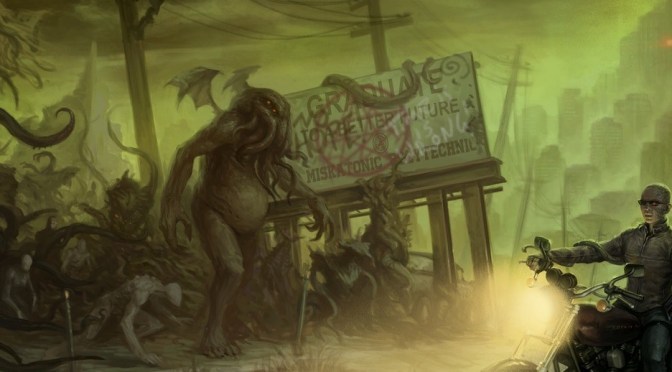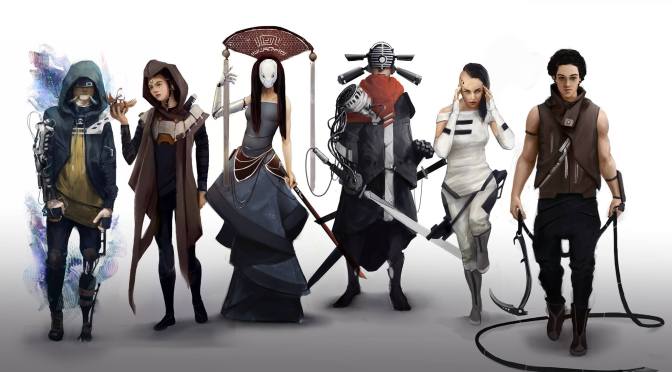
Tabletop RPGs evolved from wargames, which has somewhat stunted their growth with regards to most conflicts which don’t involve killing things. As board games show us, though, we can easily develop satisfying mechanics for a whole range of things other than combat. For the Cyberpunk Chimera, we’re envisioning a world that, while potentially violent and dystopic, doesn’t center around monsters or a national enemy or anything else that assumes that the majority of problems can be solved by killing.
All posts by Aaron Marks
Why Tabletop RPG Kickstarters Fail
Kickstarter Wonk is an opportunity for me to, every month, show off some neat Kickstarter campaigns that deserve to get a little extra attention. To write these articles, I read pretty much every Kickstarter campaign that could be termed as an original RPG, and then pull from there to make my list. Some months, getting to ten is difficult because there are twenty or more games, sixteen or more that are worth covering, and narrowing down the list gets really hard. That’s when I apply some really arbitrary metrics like “the campaign ends less than two days before the article will be published” and “I will weigh my choice towards the game with original mechanics as opposed to the one which is using Fate”. On the other hand, sometimes there’s fewer than ten games I want to cover, and the last one or two which are all right will have a bit of sarcasm in the descriptions. What has not happened until now was a month where I couldn’t even muster up half a dozen games I was excited about.
Fate Accessibility Toolkit Review
It’s time again to look at one of Evil Hat’s purple books for Fate. The Fate Toolkits, or the purple books, are the cornerstone of Fate rules hacking and, in my humble opinion, some of the best resources for a Fate GM out there. Today’s purple book takes a very different approach than the others, but still provides a comprehensive resource. The Fate Accessibility Toolkit is the book in Evil Hat’s lineup which deals bluntly with how to approach disability in your games, both in terms of characters and players.
Eclipse Phase Second Edition Review
Eclipse Phase has been in my gaming shelf ever since it first came out. The transhuman horror game has one of the best original settings available in the sci-fi RPG world, but its take on d100 mechanics were dense and difficult to work with, especially when it came to figuring out character creation. Now, Posthuman Studios has finished their work on the second edition of Eclipse Phase, taking notes from the community on the first edition and the reception of their Fate version, Transhumanity’s Fate. Eclipse Phase Second Edition (2e) is not intended to be a simpler or less complicated game than First Edition (1e) was, but what it does do is take the crunch and streamline it, including a significantly easier character creation system, revised faction rules, and a combat chapter which is an easier read while still doling out some ludicrous weapons and cybernetic enhancements. For me though, the discussion of Eclipse Phase begins with the core of what makes the game pop, the setting.
Cyberpunk Red Jumpstart Kit Gameplay Review
The Cyberpunk Red Jumpstart Kit made a splash at GenCon, selling out huge stacks of the black and red box set in what seemed like no time at all. Given the hype of Cyberpunk 2077, it’s important to step back and look at both what this means for Cyberpunk fans as well as what we can honestly expect out of a product which is still just a Beginner Box.
Personally, I’ve been waiting for this moment in one way or another since 2005. 2005 was, for those of us who remember, the release of Cyberpunk v3. Without casting (too many) aspersions at that product, I can say that it was not what Cyberpunk fans expected or wanted, and was disappointing to many, including myself. After making my peace with the fact that Cyberpunk 2020 was the last edition of the line that I’d play, the announcement of Cyberpunk Red split me between side-eyed skepticism and bouncing off my chair like, well, a nerdy teenager.
Continue reading Cyberpunk Red Jumpstart Kit Gameplay Review
Kickstarter Wonk: August, 2019
August is GenCon season, but it’s still bumping on Kickstarter! This month we’ve also seen the tagline “Break Kickstarter” pop up, which has produced some intriguing campaigns. Needless to say, there’s plenty to sift through. Don’t worry though, because sift I did, and I’ve come up with my top nine for the month! Check out some hacks, some new games, and some truly odd design projects.
Traditional Games and Why We Love Them
I’ve made plenty of hay over my opinions about D&D. D&D is not a bad game, but it’s such a limited expression of what a role-playing game can look like. The most common counter-argument I get to saying that a gamer should play games other than D&D is somewhere along the lines of “if that’s what they like, that’s what they should play”. This is usually followed by pointing out several more obscure games, which usually look absolutely nothing like D&D, and harping on about how that’s not the play experience they want. And this straw man argument is one of many reasons I’ve decided to sing the praises of the giant middle ground of the hobby, the traditional RPGs.
System Hack: Cyberpunk Chimera Combat
The one subsystem that all traditional RPGs bolt onto their core resolution mechanics is a conflict system and, like it or not, the most popular iteration of a conflict system is one for physical combat. Cyberpunk 2020 had a combat system designed with realism in mind, and, thanks to a statistical basis in actual criminal activity using guns, did very well in terms of combat verisimilitude. This did mean that some of the “imbalance” in the system, namely the overwhelming power of a high initiative roll and the destabilizing impact of armor, were based on reality. Quirks aside, what made ‘realistic’ fun was that the system played quickly and had enough detail to mean that player choices in terms of tactics and weapons mattered. The issue with Cyberpunk’s conflict systems, really, is that combat is much more ‘baked’ than the other conflict system, netrunning, and the only semblance of a social conflict system is the ‘facedown’ mechanic, which is one die roll for one specific situation.
Fate Space Toolkit Review
I’m a fan of Fate Core, and my favorite additions to the Fate Core family have been the purple books, the System Toolkits. What makes Fate so interesting to me is the level of modularity and genericization available in the rules, which both let players run pretty much anything they can imagine in Fate. With all that flexibility, though, comes the simple fact that there are a hundred ways to do anything, including some really inventive ones that any single player probably didn’t think of.
Torchbearer In-Depth
In RPG discussion circles in places like Reddit and Twitter, there has been a fair amount of hay made over the relative absence of ‘critique’ in the RPG realm. As someone who reviews RPGs fairly regularly, this is something which is difficult to parse but ultimately fair. A review aims to go over the traits and writing quality of a game in order to answer whether it is worth buying and worth trying to play. In RPGs (though honestly in all media) reviews skew positive because negative reviews get more negative attention, and because honestly writing 1500 words about something you don’t like simply isn’t fun.