Welcome to the Crowdfunding Carnival for September! We’re seeing the post-GenCon movement begin, and several of the big publishers are starting their engines up again with new campaigns. At the same time, there are a number of good indies out there which are worthy of your attention. Let’s get to it.
Continue reading Crowdfunding Carnival: September, 2025All posts by Aaron Marks

TTRPGs and fandom
The genesis of fandom as we know it starts and ends with communication. Sports fandom began evolving from the 19th century to today as radio, TV, and then the internet all brought access to more and more people. Literary fandom wasn’t too far behind: Jane Austen and Sir Arthur Conan Doyle both inspired fan movements with intensity rivaling the most fervent fandoms of today, famously doing things like publicly mourning the death of Sherlock Holmes.
There’s always a spectre behind fandom, though. Sports has seen a sea change from live attendance to broadcast as team owners can charge more and more for tickets and extract more and more money out of their audience. A massive subsection of the fandom factions collectively referred to as ‘nerd culture’ are owned by Disney, engineered to extract money from the existing audiences of Star Wars and Marvel. The strong feelings of identity and association associated with fandom can easily be weaponized, and the history of nerd culture brings along with it a whole other level of making spending choices feel very personal.
So what of role-playing games? The RPG hobby and RPG fandom are often seen as one and the same; traditional RPGs are high-commitment and there isn’t much of a casual following. Beyond that, RPGs, specifically licensed RPGs, are vehicles for other fandoms, taking advantage of the fandom overlaps implied by that phrase ‘nerd culture’. When we look at RPG fandom, though, we do see things falling out in a few different ways: Those who focus on the act of playing RPGs as a whole, those who are fans of their one chosen game, and those who are fans of the chosen game, Dungeons and Dragons. Just like fandoms of all sorts of other hobbies and media, the RPG fandom is driven not only from the enthusiasm and engagement of its members, but also by the companies who capitalize on those feelings of association and belonging in order to make money.
Continue reading TTRPGs and fandom
Coriolis: The Great Dark Review
One small step for the Year Zero Engine, one giant leap for Coriolis…
Free League has been shepherding the Coriolis series for nearly a decade now. Originally published by Jarnringen, the original designers of Symbaroum, Coriolis was released in 2008 to much acclaim in Sweden. Free League first got on board creating additional material for the game, but ended up the stewards of the series, releasing their first version in 2016. Now, we get the newest edition, a ‘standalone sequel’ set 200 years after the events of Coriolis: The Third Horizon.
Coriolis won accolades for being a solidly original sci-fi setting, and The Great Dark carries on that legacy by managing to be different even from the version of the game that came before it. At the same time, Free League didn’t mess with the formula of the YZE mechanics too much; we’re staying closer to home with the version of the mechanics established in Mutant: Year Zero and Forbidden Lands than many other recent YZE games have. While I don’t think that The Great Dark is going to win over all existing Coriolis fans, I do think that its combination of strong premise and continued originality is going to help it make a case for itself, either on its own or sitting on the shelf next to all of your Third Horizon books.
Continue reading Coriolis: The Great Dark Review
System Hack: Colony Sim Cortex Foundation
Let me tell you, I’ve been playing a lot of RimWorld over the last month. The new Odyssey DLC adds a whole dimension to the game that was previously fairly difficult to access: Exploration. With a gravship, it’s possible to go to so many more places on the map, and thankfully they added more things to see on that map as well. Odyssey adds to and enhances the gameplay loop of RimWorld, but thanks to the gravship’s function as a mobile base, that gameplay loop is largely maintained even with the changes.
Thinking about how the gameplay changes and doesn’t change with the addition of the gravship proved to be a good way to start thinking about the gameplay loop of this System Hack. When I’m playing RimWorld, what are elements I want more of that the game isn’t really going to provide? What pieces of the game, on the other hand, are best left to a computer? The trouble with developing an approach to a colony sim RPG is that the genre and its best examples are fairly broad, and you need to make some narrowing decisions very early on.
As I said earlier when discussing my design goals, I’m not trying to emulate RimWorld. Rather, the goal of the game is to provide a similar conceit that leads to storytelling. We are going to be using a few setting concepts from RimWorld to ground the setting of the game, and we are going to be focusing at least notionally on the idea of a colony, a homestead of a handful of people who are trying to make their way on a new world. There are going to be things we want to lean into, like relationships, that can be given significantly more depth at a game table than on a computer. There will be others, like tile-by-tile building layout, that are probably best left on the PC. Ultimately the three elements we want to build from are going to be creating characters, building the settlement, and exploring the world.
Continue reading System Hack: Colony Sim Cortex FoundationCrowdfunding Carnival: August, 2025
Welcome to the Crowdfunding Carnival for August! We’re still a little bit in the post-GenCon hangover, but there are definitely a lot of things to talk about and games to look into.
Before getting into the games, this seemed like the right place to reiterate the news that Gamefound has acquired Indiegogo, mixing Gamefound’s newer tech stack with Indiegogo’s massive subscriber base. Gamefound has been very successful in board games, though they haven’t broken into RPGs to the same degree. Still, these two companies joining forces means we will likely have a third viable crowdfunding platform after Kickstarter and Backerkit in terms of network effects and value for project developers. Will we see more RPG projects from Gamefound in this list? Possibly. The site still trails in terms of reach and backer-facing quality of life features, like requiring disclosures for projects that use AI art. Still, more competition is generally better in the space, and I look forward to seeing the newest iteration of Gamefound roll out.
And with that, on to the games! We’ve got horror, we’ve got dragons, and yes, we’ve got another attempt at writing a tabletop roguelike. Onward!
Continue reading Crowdfunding Carnival: August, 2025
Hit points: A cyberpunk case study
Are hit points meat? Does the answer to that question even matter? Hit points are an old mechanic, ported into RPGs at the beginning from wargames, where they made the assessment of unit health more granular than ‘alive’ or ‘dead’. D&D took the concept and applied it to player-characters and monsters alike, and from there it became profoundly common. Measuring damage taken and time until expiration is one of those things where the simplest approach is often the most fun, even if it’s hardly the most realistic.
Hit points as a mechanic are not a monolith. Not even D&D still uses the original mechanic where you have a number and when it’s reduced to zero, you’re dead. Death saves, critical wounds, damage thresholds and any other number of modifiers to the hit point schema make the act of bleeding out after being stabbed a lot more complex than it necessarily has to be, but sometimes more fun, too. Of course, a lot of the relationship that a game has to how its characters get shot and die has to do with genre.
Continue reading Hit points: A cyberpunk case study
On Specificity
Why is Mothership, well, Mothership? Put another way, why isn’t it Basic Roleplaying, or Call of Cthulhu? The core mechanics are all very similar; basically everything in Mothership that isn’t specifically about starships is adapted from Call of Cthulhu in one way or another. And that little starship aside does point to the answer: The reason Mothership is Mothership, Call of Cthulhu is Call of Cthulhu, and neither of them are BRP has to do with the specificity of their missions. Both Call of Cthulhu and Mothership frame their ideal game experience as horror, which lends itself to specific mechanics in the designers’ eyes. Mothership more specifically is science fiction horror, so the designer adds rules about spaceships and space travel. Specificity isn’t limited to genre, though. Mothership is also intended to be light on mechanics; famously the game has no mechanics for things like stealth which means that the adjudication of things like hiding and following are circumstantial and entirely in the lap of the GM. Whether you agree with this mechanical decision or not, it is deliberate and it is specific.
While specificity of game outcomes is produced by having more and more concrete rules (Mothership’s take on stealth is completely non-specific, while a game with one or more stealth skills and a laundry list of modifiers would be much more specific), specificity of game design is much more interesting, especially as there’s an entire class of games that deliberately avoids it. When I looked at QuestWorlds, I saw a game designed to try and do everything, at the expense of doing anything in a particularly interesting or engaging way. It’s hardly the only generic game, and one could make the same complaint and direct it at Fate, or GURPS, or Savage Worlds.
But hold on. If we go back and look at Mothership again we have, broadly, a fairly non-specific game. Yes, it’s about space horror, and the character options are tuned to space horror. The GMing advice is very good. The layout is very good. The game, though? It’s, outside of the space horror part, stripped down Call of Cthulhu. So where does that Mothership ‘vibe’ come through besides the design ethos? A good part of it is the modules (hardly a controversial opinion), but I think a specific and interesting point is that the modules bring with them hyper-specific mechanics. While GURPS has mechanics meant to be at the level of physics and D&D has mechanics which reinforce genre, Mothership has a good chunk of its mechanics corpus supporting specific stories, designed for and included in the pages of modules like Gradient Descent and Another Bug Hunt. And this is kind of important: While Mothership clearly takes inspiration from the DIY and hack-and-borrow ethos of the OSR, it’s presented a bit differently. The modules, in addition to providing the setting and conflict and everything else for a solid few sessions of adventure, also provide the hacked/modified rules to make that adventure feel different or play different than the base game. It does make me think, though: If you’re hacking the rules (or using the designer’s hacks) for every module, how truly different is that from using a generic game? Put another way, what really makes Mothership different from BRP, really? It’s not rules, after all.
Continue reading On SpecificitySystem Hack: Colony Sim Cortex Inspiration
Video games don’t make for easy translations to RPGs, especially if the video game isn’t really an RPG itself. For this continuing System Hack I’m aiming to put together a tabletop RPG that plays like a Colony Sim, and hopefully using Cortex Prime to do it. Before we get into any rules design, though, it’s time to look at my core inspiration for taking this project on in the first place.
RimWorld is a colony sim video game designed by Tynan Sylvester, and now supported and expanded through an entire team at Sylvester’s studio Ludeon Studios. The game was released in 2018 but had been in Early Access for five years at that point, and it continues to see frequent updates and support, including several large DLCs.
So how do we take that concept and translate it into a TTRPG? It’s not about the exact setting of RimWorld, though certain hard sci-fi conceits are going to port over. It’s more about understanding what experience the game produces, and then figuring out which elements of that experience could be employed to good effect in a tabletop game. With that in mind, let’s take a look at RimWorld’s premise and its mechanics, and get in the mood for some reverse engineering.
Continue reading System Hack: Colony Sim Cortex InspirationCrowdfunding Carnival: July, 2025
Welcome to the Crowdfunding Carnival for July! Just like every year, July is a lull prior to GenCon really revving everything up. Most larger publishers will hold announcements until the con, making July a little bit sparse in comparison. That said, this month may not have any major publisher campaigns but it does have a number of interesting entries. Interested in archaeology, cosmic horror, or making deals with the devil? Come right this way, we may have something for you.
Continue reading Crowdfunding Carnival: July, 2025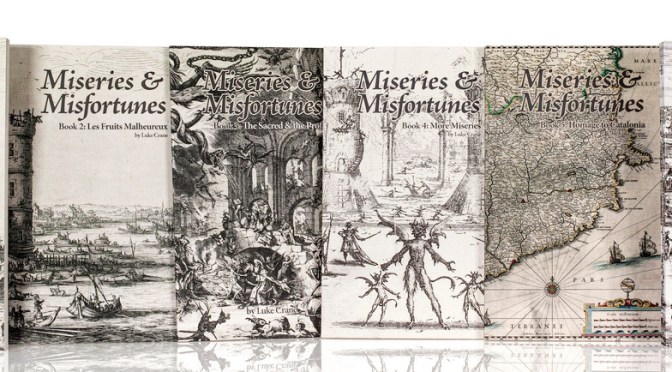
Miseries and Misfortunes: When D&D stands for Dauphins and Defamation
Luke Crane is best known as the designer of The Burning Wheel, an intensely detailed medieval fantasy/Tolkien RPG which aims for a very different fantasy experience than what you find in Dungeons and Dragons and its contemporaries. The Burning Wheel has more and more complex rules than D&D, but it’s also a game with a strong sense of time and place; Crane’s inspiration for the fantasy side of the game was Tolkien outright (which is not the case with D&D), and the rest of the setting was inspired by history nonfiction by the likes of Barbara Tuchman, Desmond Seward, and others. The result is a game heavily steeped in 12th-13th century medievalism, but with the historicity sanded off with some genericization and, oh right, wizards and elves and giant talking rats.
The next biggest non-licensed game from BWHQ (both Mouse Guard and Burning Empires are licensed) is Torchbearer, which is more than anything a direct shot at D&D. While it uses somewhat similar mechanics to Burning Wheel, it is much more focused on dungeon crawling, taking some of the more structured procedures of 0e and Basic D&D and extending them to everything, including not only the dungeons and wilderness exploration but also town visits and social interactions. Torchbearer is a distinct game from Burning Wheel, and while Burning Wheel is known for its complexity Torchbearer is known for being fiendishly difficult due to its constant Grind and aggressive resource management.
Luke Crane designed another game, more similar to Burning Wheel than the others in BWHQ’s portfolio. What’s truly strange about this game, though, is that it is a hack of Basic D&D. That in itself isn’t that weird, plenty of designers hack D&D for many purposes good and ill. What is weird, though, is that this hack of Basic D&D looks at the trajectory that Torchbearer plots from Burning Wheel and runs straight and fast in the opposite direction, aiming for more intrigue, more historical accuracy, and not a single dungeon to bother with. This game is called Miseries and Misfortunes.
Continue reading Miseries and Misfortunes: When D&D stands for Dauphins and Defamation Cannibal Halfling Gaming