Tag Archives: Advice

The Push and Pull of Backstories

Character histories have been part and parcel of role-playing games ever since Dave Arneson’s players had to figure out why their characters were crawling the dungeons under Castle Blackmoor. Between now and then there have been some games which took character origins and centered them; Traveller famously integrated a detailed character history into its character generation rules and many games emulated Traveller in one form or another. While many games offer a range of mechanical backstory generation, though, the most popular role-playing game and therefore the majority of players are given very little. While the Fifth Edition of Dungeons and Dragons has added a little above its predecessors (in the form of Backgrounds), first level D&D characters are largely a blank slate, leaving their history and origin up to the player.

When backstories are left up to the player, they become a battleground of narrative control. Some game masters, hungry for player input, get frustrated when a player expects race, class, and background to be enough and writes nothing. On the other hand, game masters much more concerned with their world (and perhaps not wanting to give players an opportunity to modify it) may resent even having to read the backstory a player writes; if they’re particularly vindictive or conceited they may even punish a player (we all saw the Tweet where a noxious GM joked that the character with the longest backstory would be the first to die). With such a range, it’s not hard to see that a mismatch of expectations is much more likely to cause trouble than what those expectations are.

Continue reading The Push and Pull of Backstories


The Trouble With Marketing

Game design doesn’t sell games. Sorry. No, what sells games is the promise that that game offers, articulated by its designer. If the promise is good, it doesn’t matter that the game is bad; that’s what got the Fallout RPG into the ICv2 top 5. But whether the game you designed is a work of art or a slapdash ashcan, sorry, you’re still going to need to market it.

The Trouble with Marketing is either that no one knows how or no one wants to. I tend to believe the second of those two items; plenty of game designers don’t really know how to write but they manage to hire someone for that in most cases. No, marketing, in addition to being its own skill which is challenging to learn, really turns people off. It reminds you you’re selling something, it makes the whole process feel less like art.

Continue reading The Trouble With Marketing

Adventure Log: Cyberpunk Red: CabbageCorp Part 10

An apocalyptic threat to Kansas? I’m sure someone in the local office can check it out. It’s affecting our share prices? That’s different, the CEO wants to meet with you! After delivering a cryptic speech at the Future of the Midwest conference, Dr. William Squires has disappeared. His former head of security, Simon France, thinks he’s going to destroy the world, but only the CabbageCorp team is really listening to him. However, when it’s clear Squires’ behavior is spooking investors and threatening Biotechnica’s bottom line, suddenly the company cares a lot. Mason’s still on thin ice with his boss after the whole ‘insider trading’ thing, but when he points out that his team also has inside information about Squires, suddenly the whole team is being flown first class to Spokane, Washington.

Continue reading Adventure Log: Cyberpunk Red: CabbageCorp Part 10

Adventure Log: Cyberpunk Red Interlude: The CabbageCorp Warehouse

The CabbageCorp crew has gotten themselves into some trouble in 2045. But they’ve also gotten some nice payoffs. After William Squires made a troubling, cryptic speech at the Future of the Midwest conference in Hydropolis, the team knew they needed to get in gear and figure out what was going on. They also had some real estate transactions to resolve. So when Mason, Philly, Relay, Jacob, TK, Doctor Kong, and Bubbles had to renovate a warehouse, what were they going to do?

More importantly, what was I, their GM, going to do? While Cyberpunk Red has a few options for stationary equipment, the Night City lifestyle isn’t really about property ownership. Giving the party options for their newly acquired warehouse that they actually cared about would require a combination of creativity, player input, and yes, a bit of a System Hack.

Continue reading Adventure Log: Cyberpunk Red Interlude: The CabbageCorp Warehouse

The Five Mechanic Game

There’s a wide world of games out there, but the ones that get played and talked about the most are more similar than you may think. In the realm of traditional games, most games have their rules structured the same way, at the same level of detail, to accomplish roughly the same goal. It means many of us that grew up among the bursting libraries of games in the 80s and 90s thought we were well-read, only to be waylaid by some markedly different ideas when the games of the Forge era like Burning Wheel and Apocalypse World started becoming popular.

Last week, I talked a bit about the idea of complexity, and grounded it to the idea of how many mechanics a game has interacting at once. This makes a game like Blades in the Dark, with many overlapping systems, more complex, while a game like Dread, where there is only one mechanic and it’s essentially ‘Jenga Or Die’, is less complex. What’s more interesting, though, is what it says about the middle. Basically every traditional game, from the real bloats like Exalted all the way down to little digest editions like Savage Worlds, have roughly the same type and number of mechanics. That number is five: character creation, task resolution, combat, game mastering, and at least one subsystem of note.

Continue reading The Five Mechanic Game

When The Game Blows Up

You have a great idea for a new campaign. You explain it to your group, and everyone’s on board. Session Zero goes great, it seems like everyone has made interesting characters and is totally bought in to the premise. Then you start playing. For whatever reason, things just aren’t hitting the same way that everyone thought. Then comes the big inciting action. This will drive everyone to really dive in, right? Maybe it doesn’t. Maybe everyone’s looking across the table awkwardly. Maybe someone gets upset, maybe not. Whatever happened, the game blew up, and now it’s time to pick up the pieces.

When most of the hobby assumes that you’ll pick one game and play it forever, there’s not a lot said about the risks of trying something new. Even among those inveterate RPG collectors with four dozen different systems in their bookshelf, there were never that many games that were really *out there* until recently…and even now, the vast majority of games sold hew to a common template. So, when the range of experiences and expectations is fairly narrow, you have to be prepared for what happens when you step outside of those experiences and expectations and something unpleasant happens.

Continue reading When The Game Blows Up

Pacing Problems

How fast do you burn through a storyline? If you’re like me, sometimes that core conflict is approaching a climax halfway through what you thought was your campaign. Or, if you’re like me at a different point in time, you find your players have cracked the advancement mechanics on the cool new system you wanted to try and now the power curve is shooting upwards, taking the storyline in places you weren’t ready for it to go. Whether it’s from game mechanics or your own writing, it’s easy for a GM to find themselves with a pacing problem.

There are a few issues with figuring out how to pace a role-playing campaign that don’t appear in other media. The first one is simply that other media have it way easier. It might be challenging to write a novel or direct a movie, but that author or director has complete control over how fast or slow events progress. When you’re GMing a game, with players staring back at you and wondering what’s going to happen next, that control is illusory. The second is that many of the tricks we’re taught in interactive media, like video games, either don’t translate or translate poorly back to the tabletop. Once again, a lot of that has to do with the fact that there’s more than one person playing and setting the clock.

Continue reading Pacing Problems

Cannibal Halfling Radio Episode 17: Looking For Players

Aaron, Geni, and Seamus take on the task of getting new players into the hobby – recruitment methods, mechanical choices, potential pitfalls, and what actually makes someone stick around in the first place.

Continue reading Cannibal Halfling Radio Episode 17: Looking For Players

Adventure Log: Cyberpunk Red: CabbageCorp Part 8

Nothing gets you in a productive mood like being in the crosshairs. Thanks in no small part to an insider trading scheme that was very ‘player character’ in its execution, Hydropolis is getting attention across the continent, attention that it may very well not want. For the employees of CabbageCorp, that means that it’s time to tie up loose ends…preferably before the tourists have bigger guns than they do.

When we last left our meddlesome mercs, they had placated Vlad’s boss with a promise of insider trading. The deal went wrong in the Russian Mob’s favor, and soon the whole world was wondering what was going on in this little corner of Kansas. The team also followed up on scientist/pervert Michael Forsythe, and in addition to helping ban him from the con scene they found themselves wondering what was going on in the upper floors of Jayhawk Agritech.

Continue reading Adventure Log: Cyberpunk Red: CabbageCorp Part 8

Adding Flavor To The Table

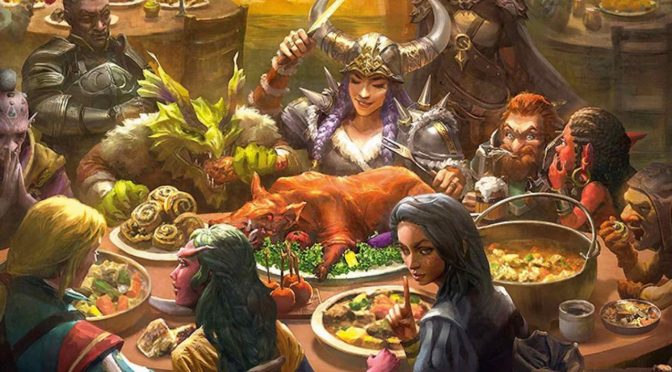
Between spending some time at the Flying Stag earlier in the week and recovering from the trials and tribulations of Thanksgiving, I’ve got food and drink on the mind with a side of tabletop worldbuilding. So your party of characters wander into the tavern and order… what? An ale?  Your freighter crew has two weeks of… consumables? That’s it? We can do better than that; both people running games and playing them can get some extra detail out of their setting and characters by keeping one fact in mind: even most protagonists have to eat.

Continue reading Adding Flavor To The Table