
Welcome to another Solitaire Storytelling! Until now, Seamus has been the one leading the way on solo games coverage here, finding a lot of interesting gems among all of the recent releases. Now, though, I’m throwing my hat in the ring and seeing what solo gaming has to offer. My first game is not only a solo game, it supports between one and five players. It also comes from one of the best known names in the narrative and storytelling game world, Bully Pulpit Games. In addition to a few straight-up RPGs like Night Witches and publishing other designers’ games, like Star Crossed, Bully Pulpit Games and its lead designer Jason Morningstar are likely best known for Fiasco, a comic game of Coen Brothers-style antics and table improv. The game I played this week takes a card-based format like that of the newest Fiasco edition and uses it for a very different purpose; instead of comedy we’re leaning into horror.
Continue reading Solitaire Storytelling: DesperationTag Archives: Opinion
Crowdfunding Carnival: August, 2023
Welcome back to Crowdfunding Carnival! While I’m not in Indianapolis this month, I’m still working to sift through all the cash-in board games and sexy elf minis to bring you the best in RPG crowdfunding from Kickstarter, Crowdfundr, Backerkit, and Gamefound. It’s Kickstarter and Backerkit that are really carrying the month this month, and I have ten campaigns that I’m excited to talk about.
Continue reading Crowdfunding Carnival: August, 2023
The Game or the GM?
One of the most controversial questions in the tabletop RPG hobby is ‘What makes a good game’. Entire philosophies of play are built around the idea that you don’t need much in the way of mechanics, and entire other philosophies of play are built around the idea that those mechanics are essential to creating the desired experience in a session. The reality, of course, is messier than either of these. We’ve all heard that “Every game is good with a good GM”, but that doesn’t actually mean that every game system that makes its way to a group’s table is, well, good.
In order to fairly review a game you need to understand what the game brings to the table, yes, but you need to understand the same for your GM. Good GMs can run good games with bad systems by working around or even ignoring aspects of a game system, as well as supplementing the system with experience or house rules from other systems and campaigns. Similarly, bad GMs can create bad experiences with good games by interpreting rules too rigidly or loosely, failing to do the right amount of prep for the system, or using the mechanics for situations in which they weren’t intended to apply. While no game can fix a bad GM who is truly set in their ways, good games can, though good writing, help inexperienced GMs avoid the pitfalls I’ve mentioned.
Continue reading The Game or the GM?
Turning the Page on Digital Distribution
The last ten to fifteen years of the RPG hobby have played host to a veritable explosion of content, from highly original new games to revivals of decades-old games and everything in between. A significant building block of this renaissance was digital publication. Instead of shelling out thousands of dollars for a print run and then having to find a distributor, a designer could create their game in PDF form and put it up for sale on a marketplace like DriveThruRPG, all for no upfront cost beyond whatever time it took them to design the game in the first place. This has made roleplaying games cheaper, more diverse, and more accessible than ever before.
The trouble with digital versions of RPGs does not lie in their economics; the real issue is that RPG PDFs are treated as ‘digital versions’, as facsimiles of a game whose platonic ideal is a bound paper book. I won’t mince words: Selling identically laid out books and PDFs is and will always be a usability failure. The way we use books and the way we use our digital reading devices, be those laptops, tablets, or e-readers, are completely different, and trying to use the same document these two ways usually leads to a suboptimal experience in both.
Continue reading Turning the Page on Digital Distribution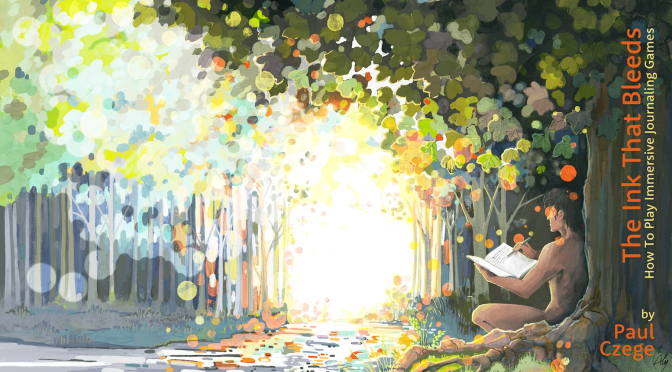
The Ink That Bleeds Review – An Immersive Dive Into Immersive Journaling
“My friend Adam feel that bleed, and games that aim for it, are ‘comparatively cheap, short-term pleasures… a bit like jump scares.’ My experience is so the opposite.
I think immersive, bleedy journaling games are act of purging ourselves of narratives that aren’t in our interests and enlivening ourselves for the temporal world.
I’m totally going to show you how.”
So writes Paul Czege in The Ink That Bleeds – How To Play Immersive Journaling Games, and I’m going to show you some of what’s inside and what it made me think.
Continue reading The Ink That Bleeds Review – An Immersive Dive Into Immersive Journaling
Cowboy Bebop RPG Review
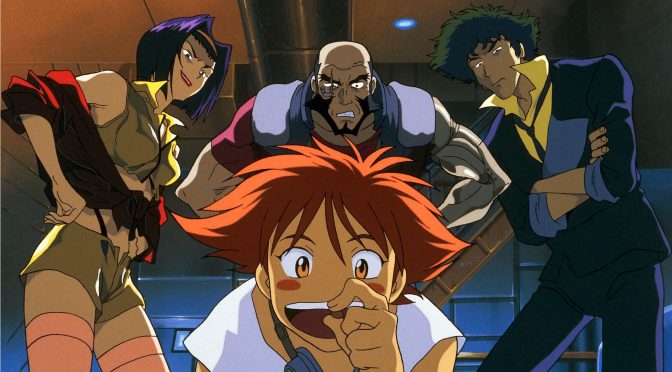
Adaptations are dangerous business, and that’s true no matter what medium you’re working in. Licensed RPG adaptations fall all over the map; for every The One Ring you get rules for Power Rangers contracting tetanus, and for every Star Wars there’s a Fallout. Reimagining old properties stays risky even if you’re staying in the same medium; the live-action reboot of Cowboy Bebop was a cautionary tale, albeit not quite as badly panned as live-action Death Note or live-action Ghost in the Shell. But what happens if you take Cowboy Bebop, the celebrated anime, and make it into an RPG? Well, in this case, something kind of magical.
The Cowboy Bebop Roleplaying Game was developed by designers from Italian company Fumble GDR and published by (also Italian) Mana Project Studio. While Mana Project is mostly known for publishing 5e settings, Fumble has a fairly impressive list of original games, including Not the End, a heroic game using an original ruleset called HexSys. A variant of HexSys powers Cowboy Bebop and, while it employs elements from games you likely know, it is completely original. The result is a game that feels like jazz; there is structure, rules, and even system mastery, but the mechanics create a loose, free environment to tell stories. And, because this is Cowboy Bebop, the stories center around bounty hunters, the bounties they’re chasing, and the memories from their past that haunt them.
Continue reading Cowboy Bebop RPG ReviewCrowdfunding Carnival: July, 2023
Welcome to Crowdfunding Carnival for July! When the majors are away, the indies shall play, and that’s exactly what’s happening right now. The Free Leagues and Kobolds of the world are toiling over their GenCon booths, but we still have some fabulous campaigns going on just under the con circuit radar. For those collectors out there fear not, there’s one big league campaign going on and it includes five alternate covers for the main book. And if you want to take a look back, this month’s retrospective includes a great underdog story and a less-great story of a five year old campaign that was fulfilled only a couple of months ago. For all that and more, read on; your wallet will not thank you.
Continue reading Crowdfunding Carnival: July, 2023
The Trouble with Licensed RPGs
The RPG hobby is in the midst of a significant supply-demand mismatch. With high switching costs and higher still depth of play, most hobbyists stick with one or a couple games and tend to funnel their dollars towards known quantities with existing fanbases and deeper supplement libraries. Meanwhile, there is the appearance that designing a game takes only incrementally more effort than simply running an existing one, something reinforced by the over 130,000 products on DriveThruRPG (most of them selling fewer than 50 copies). Designers struggle to differentiate in this environment, which makes the strategy of hitching your proverbial wagon to an existing property as popular as it ever has been.
Continue reading The Trouble with Licensed RPGs
Adventures in Rokugan Review
This review is delayed, far from the “hot off the press” take that I had intended back some time ago. Instead this has been an article I have stewed on for some time. In 2020 there came an announcement that Edge Studios would be taking over RPG properties that had been held by Fantasy Flight, which includes two that I have written about extensively in the past: Star Wars and Legend of the Five Rings. Since the acquisition, the publishing has mainly been constrained to reprints of books in use and published already developed supplements that had been in the pipeline before the acquisition. It was a bit of a surprise to me that the first new material from this new studio was to take the setting of Rokugan and put it into the mechanics of 5th Edition Dungeons and Dragons.
My reaction to reading it at first was, to put it politely, visceral.
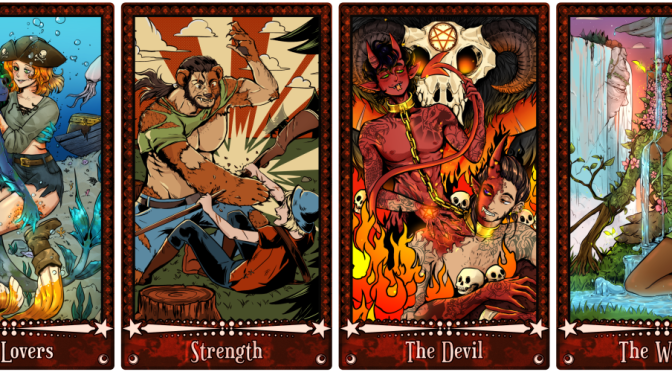
To Change Review – Transformative Tarot
Stories of transformation are both very old and very common. From Tiresias and Circe to The Emperor’s New Groove and Turning Red, people have been changing gender, species, state of matter, and all sorts of other things up and down the stories we tell through the ages. Heck, on a personal note one of the first stories I was ever told was about the Children of Lir. To Change seeks to put that kind of story in the spotlight through the medium of a roleplaying game, using short sessions and Tarot cards to explore dramatic transformations and the consequences of becoming something new.

