
September of 2025 marks the twentieth anniversary of my current gaming group. Yes, you read that correctly. While I’m not sure of the exact day, twenty years ago either this week or last week I met with five other nerds in the study room of Carnegie Mellon’s newest freshman dorm, New House (which has since been renamed). The organizer, my friend Dan, had swiped the mailing list from an event run by the university’s chapter of White Wolf’s Camarilla Society; he decided that while he wanted nothing to do with a Vampire LARP, he met some cool people at their D&D one-shot event and would want to play D&D with them. We all decided that yes, we’d like to play D&D, and from there we were off. Three more people joined over the next couple of semesters, a lot of games were played, and we were a close-knit group until graduation in May of 2009.
Continue reading My gaming group: A twentieth anniversary reviewCategory Archives: Editorial

Coriolis: The Great Dark Review
One small step for the Year Zero Engine, one giant leap for Coriolis…
Free League has been shepherding the Coriolis series for nearly a decade now. Originally published by Jarnringen, the original designers of Symbaroum, Coriolis was released in 2008 to much acclaim in Sweden. Free League first got on board creating additional material for the game, but ended up the stewards of the series, releasing their first version in 2016. Now, we get the newest edition, a ‘standalone sequel’ set 200 years after the events of Coriolis: The Third Horizon.
Coriolis won accolades for being a solidly original sci-fi setting, and The Great Dark carries on that legacy by managing to be different even from the version of the game that came before it. At the same time, Free League didn’t mess with the formula of the YZE mechanics too much; we’re staying closer to home with the version of the mechanics established in Mutant: Year Zero and Forbidden Lands than many other recent YZE games have. While I don’t think that The Great Dark is going to win over all existing Coriolis fans, I do think that its combination of strong premise and continued originality is going to help it make a case for itself, either on its own or sitting on the shelf next to all of your Third Horizon books.
Continue reading Coriolis: The Great Dark Review
itch.io Meddled by Payment Processors
Something terrible happened on the night of July 23rd; itch.io began clamping down on NSFW materials on their site. This is, unfortunately, something that was a long time coming.
Continue reading itch.io Meddled by Payment Processors
Cannibal Halfling’s Guide to PAX East 2025
It’s not quite as good for our purposes as PAX Unplugged or other tabletop-centric conventions, but PAX East in Boston still has plenty of things to check out for the roleplaying, card, and board gamers of the world. Running from today May 8th until this Sunday May 11th, PAX East 2025 has some familiar games, some new opportunities, and plenty of tables you might want to take a seat at.

Rules, retcons, and rightsholders: The tough road for superhero RPGs
Back in November of last year while talking about network effects and how they make you play D&D, I dropped a little bomb. I stated that there has never been a good mass market RPG in the superhero genre. At the time, no one took the bait, but I can imagine some easy dissent there. What about Champions? What about Marvel Super Heroes? How can you possibly hate FASERIP? But yet, I do maintain my position. While there have arguably been good superhero games, none of them have reached mass market popularity and, by the way things are going, none of them ever will. It’s not the fault of any particular game or its design, at least not directly. Instead, the instinctive way that a game designer wants to approach comic book superheroes is one that’s fundamentally at odds with ever seeing broader popularity.
Of course, as one would naturally surmise, that means there’s a different way to write a superhero game that could see broader appeal and generally be more easily used to tell superhero stories. We were even close to having a game that fit in this template actually see some measure of success; what killed it was of course nothing to do with the game but rather the other reason that superhero games can never really succeed, licensing. So let’s look at the flavors of superhero games we get, the flavor of superhero game we want, and why the two aren’t likely to match.
Continue reading Rules, retcons, and rightsholders: The tough road for superhero RPGs
Hero Forge Custom Dice Kickstarter Review
Hero Forge did its first Kickstarter more than ten years ago to launch a custom miniature printing business, and launched a second one to bring color to their minis. In between and after the fact the platform has continued to add more and more options to their catalog: new items, species, materials, and so on. Now Hero Forge has a third crowdfunding effort, and it’s focused on what you use to determine your miniature’s fate: the dice.
The three layers of Triangle Agency
Depending on how you look at it I either chose the best or the worst time to read Triangle Agency. Over winter break I finally beat Control, and found I absolutely loved its setting and vibe. The whole reason I picked it back up again (after getting stuck with it many months ago) was that I had also finished reading all four books in Jason Pargin’s John Dies At The End series, and in doing so discovered that I actually love cosmic horror so long as that schmuck named Lovecraft isn’t involved. When Triangle Agency, a game I thought looked kind of interesting when it was funding on Kickstarter, started picking up some end-of-year momentum, it seemed like a perfect complement to all the other horror/conspiracy media I had been consuming.
In fact, Triangle Agency followed so closely in the footsteps of Control that by the time I finished the player section, I was unclear on how it was going to differentiate itself. Cute-but-horrific is the artstyle of the book, and I wasn’t loving it compared to Control’s “dead serious but yet so absurd you’ll still laugh”. However, as I finished reading the GM’s section, my opinion of the book had picked up dramatically. This is, in part, because Triangle Agency is not Control, but in part because the most interesting ideas in the setting are back there in the GM’s section, telling you how to turn a light and kind of goofy monster-of-the-week game into the conspiracy horror game Triangle Agency actually wants to be.
Continue reading The three layers of Triangle Agency
Eight Years of Cannibal Halflings
80% of a decade down, and things are about to get decidedly enneadic around here! 2024 has certainly been one of the years of all time, but how did we do around here and what might the future hold?
Role-Playing Games in Psychotherapy: A Non-Therapist’s Review
While roleplaying games can certainly allow players to explore certain things and work through some stuff, an important axiom to remember is that your GM is not your therapist. Therapy is a serious business, and you shouldn’t be unloading your psychiatric needs on someone who is not trained to handle it (or try taking on those needs yourself, if you’re the GM), for their good and your own. Unless, one supposes, they were your therapist first, and are now running a game for you as part of your usual appointment. Such is the purpose behind Role-Playing Games in Psychotherapy: A Practitioner’s Guide by Daniel Hand.
Continue reading Role-Playing Games in Psychotherapy: A Non-Therapist’s Review
Tales of the RED: Hope Reborn – Cyberpunk RED Campaign Review
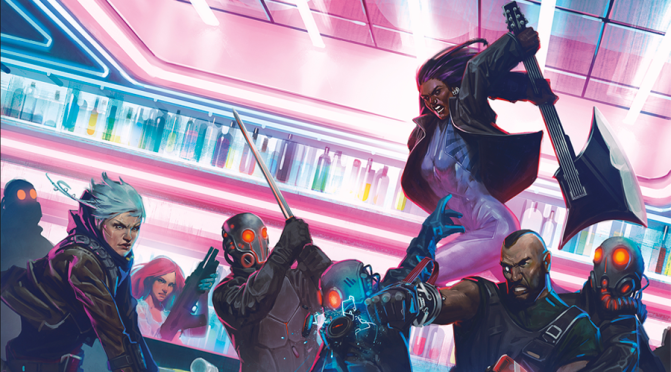
For decades of R. Talsorian Games’ Cyberpunk line (both in realspace since 1992 and in-universe since 2011), The Forlorn Hope’s been a bar where those Night City denizens who refuse to play by the Corporate rulebook go to unwind, connect, and reaffirm their humanity. But today (2024/2045), in the Time of the Red, The Forlorn Hope’s in trouble! Will this classic Night City institution die a whimpering death or survive and thrive, helping the next generation of cyberpunks navigate life on The Edge? Well in game that’s a question only you and your Crew can answer… but in the real, we’re going to be seeing how Tales from the RED: Hope Reborn can answer the same question!
Continue reading Tales of the RED: Hope Reborn – Cyberpunk RED Campaign Review
 Cannibal Halfling Gaming