
Welcome to the Cannibal Halfling Weekend Update! Start your weekend with a chunk of RPG news from the past week. We have the week’s top sellers, industry news stories, something from the archives, and discussions from elsewhere online.
Category Archives: Articles
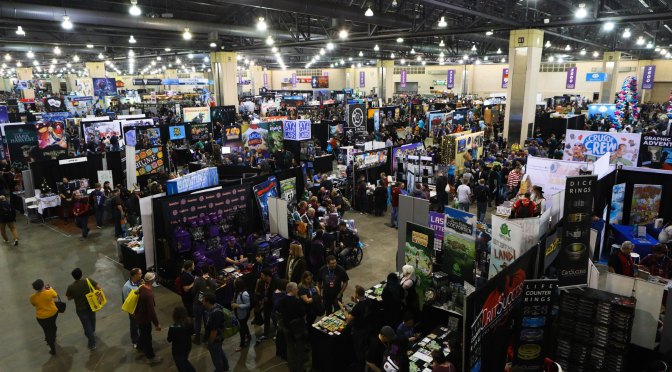
My first corporate convention
When it comes to nerd hobbies, the convention scene is bifurcated. There are local, volunteer-driven cons that put a lot of effort into building content from enthusiasts around the area. There are also the massive, national affairs that bring attention and revenue to their parents. Gaming cons moved quickly into the latter category, even if the initial efforts were modest; both GenCon and Origins came to prominence after their alignment with TSR and GAMA, respectively. And now there’s a massive leader in the corporate con sphere: Penny Arcade Expo, or PAX.
Continue reading My first corporate convention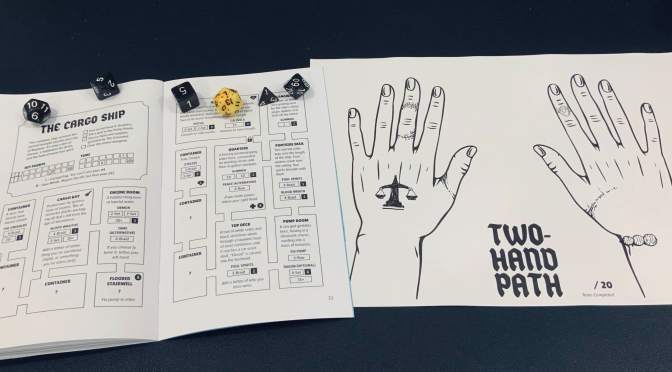
Two-Hand Path Review: Getting a Grip on Luck and Magic
“After the locusts and pits and boiling seas. After the war in heaven and feasting on earth. After the seven years of blood and forty years of night.
There is magic. Magic and bone.
Where streets grow weeds and skyscrapers stand hollow. Where old gods wake and new gods form in the hearts of the wayward. Where cult and banner flourish. Where the dead, they walk. Where the stars disregard their course and Jupiter’s children are born under powerful new signs.
Mages. Mages like you.”
With rings on your fingers, tattoos on your knuckles, and scars on the back of your hand, you’ll delve into the cursed ruins of a post-fall city and walk the Two-Hand Path.
Continue reading Two-Hand Path Review: Getting a Grip on Luck and Magic
Weekend Update: 11/22/2025
Welcome to the Cannibal Halfling Weekend Update! Start your weekend with a chunk of RPG news from the past week. We have the week’s top sellers, industry news stories, something from the archives, and discussions from elsewhere online.

System Hack: Colony Sim Cortex Base Building
If any one topic is ‘the core’ of this System Hack, this would be it. Base building is the underlying gameplay loop of RimWorld and it is also a topic du jour in RPG circles, with the (admittedly poorly detailed) stronghold building from the D&D days of yore coming back into focus as more gamers want broader storyline opportunities. For our purposes, of course, if we’re making a colony sim we need to make a colony. But what exactly is the best way to do that?
Base building from my perspective is sandwiched between two examples which effectively bracket the space we have to work in. On the heavy end is RimWorld itself, a computer-assisted colony manager where everything is measured out in five foot squares and the player has complete power to place elements as they want them, as long as everything fits. On the light end is the new generation of stronghold building rules, most effectively typified by Free League’s games, notably Forbidden Lands and Twilight:2000. These games add a strong layer atop their roleplay frameworks, but the actual mechanical existence of a Forbidden Lands stronghold is merely a list of buildings with requirements and effects. We know the first item is too much, but we know the second is not enough. So what will base building in our System Hack actually look like?
Continue reading System Hack: Colony Sim Cortex Base Building
Things to See at PAX Unplugged 2025
PAX Unplugged 2025 is this weekend! Which you probably already know, on account of clicking on this article while you’re on your way there or already in Philly. Alas, I won’t be there this time around. I hear tell some other Cannibal Halflings will be there, though, and I don’t have to be present to Know Things Worth Your Time. Let’s go over some games for you to buy, some games for you to play, and some interesting events to check out.
Weekend Update: 11/15/2025
Welcome to the Cannibal Halfling Weekend Update! Start your weekend with a chunk of RPG news from the past week. We have the week’s top sellers, industry news stories, something from the archives, and discussions from elsewhere online.

The design decision which won narrative gaming
Last week, Apocalypse World came back to crowdfunding, with the Bakers seeking funding for a Third Edition of the game. Apocalypse World was first released back in 2010 and it took the indie RPG world by storm; by the time Dungeon World was released in 2012 it was already all but certain that ‘Powered by the Apocalypse’ would be a phenomenon. It’s easy to forget that there was another indie darling riding high in the hobby in the early aughts. Fate was arguably the other big indie game, and it even made its way into the ICv2 bestseller list after the success of its 2013 Kickstarter, an honor typically reserved for D&D, Pathfinder, and a few other corporate games. The ICv2 data point is particularly interesting. Fate outsold Apocalypse World; not only did the game peek into commercial sales charts as late as 2020, Fate even holds the statistically dubious honor of being one of only three games to ever outsell D&D in the ICv2 rankings (the other two being Pathfinder and FFG Star Wars). Commercially, Fate was an indie juggernaut.
Fate has clearly not maintained the degree of impact and influence it once had. Hell, the last three Kickstarter campaigns run by Evil Hat Productions, publishers of Fate, were all Powered by the Apocalypse games. The literal keepers of Fate have, thanks in no small part to John Harper and Blades in the Dark, seemingly seen the writing on the wall in terms of salability and influence of PbtA over Fate. Why is that? To start, there’s an obvious disparity to the degree in which unaffiliated designers took the respective systems and ran with them. That said, it’s fairly clear to me that this is a symptom, not a cause. While it’s hard to beat the Bakers’ approach of ‘sure, just don’t literally plagiarize us’ for licensing, Fate was licensed under the OGL and later Creative Commons, which were both used by tons of creators in other contexts. No, the difference in third party support and expansion has to do with the design of the respective games, not their shepherding by their respective creators. And I think I know specifically which design elements made the difference.
Continue reading The design decision which won narrative gamingWeekend Update: 11/8/2025
Welcome to the Cannibal Halfling Weekend Update! Start your weekend with a chunk of RPG news from the past week. We have the week’s top sellers, industry news stories, something from the archives, and discussions from elsewhere online.
Continue reading Weekend Update: 11/8/2025
Crowdfunding Carnival: November, 2025
Welcome to Crowdfunding Carnival for November! There are a ton of campaigns out there this month; my initial pass easily got to 20 even after I realized that there were a lot and started filtering more aggressively. We’ve definitely got more designers putting in the juice, but there are some other interesting developments going on.
First, Gamefound has come roaring onto the scene again. While the provider got some recognition during the Kickstarter blockchain kerfluffle, their network was pretty weak until recently. First, over the summer Gamefound acquired Indiegogo (not the other way around). Second, Gamefound is currently in the midst of RPG Party, an event that started in mid-October to help promote and drive engagement with RPG campaigns specifically. Chaosium and Magpie got on board with RPG Party, so between their involvement and the recent access to the Indiegogo mailing list, Gamefound has jumped from also-ran to contender seemingly overnight.
But let’s move onto the games. This month features campaigns from all three major crowdfunding providers, meaning the space is starting to heat up a bit. Competition is a good thing, and supporting competitors to Kickstarter is a great idea when Kickstarter United is still on strike.
Continue reading Crowdfunding Carnival: November, 2025
