
Welcome to the Cannibal Halfling Weekend Update! Start your weekend with a chunk of RPG news from the past week. We have the week’s top sellers, industry news stories, something from the archives, and discussions from elsewhere online.
Continue reading Weekend Update: 2/7/2026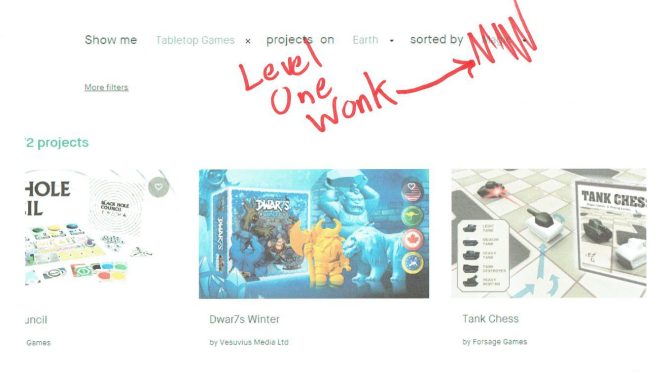
Crowdfunding Carnival: February, 2026
Welcome back to another Crowdfunding Carnival! It’s not just any Crowdfunding Carnival, though…it’s February. And that means it’s time for Zine Month! And this is a big deal, because for the first time since 2022, it’s actually time for Zine Month, not just Zine Quest. Backerkit has stepped into the ring and it looks like they’re going to stand toe to toe with…wait, I’ve just gotten word that Backerkit’s Zinetopia event is capped at 63 projects? Meaning that if we extrapolate from Kickstarter’s typical Zine Quest growth profile they’ll end up being around 30% of the size? Hm. Oh dear.
It’s not a bad showing, to be clear; 63 non-Kickstarter projects is more than we’ve ever seen from the alternate Zine Event folks since Kickstarter made the confusing decision to move Zine Quest to August. But ultimately there were more Zine Quest projects live even by February 2nd, and unlike Backerkit Kickstarter will let you tag any zine project started in February as Zine Quest, so we’re likely to have well over 200 projects by February’s end, if not even more. It is notable, though, that while the number of projects live in the first week of Zine Month is similar this year and last (around 150), the split is around 60/40 Kickstarter and BackerKit, meaning that a lot of people took Backerkit’s rival Zinetopia event seriously.
Continue reading Crowdfunding Carnival: February, 2026Weekend Update: 1/31/2026
Welcome to the Cannibal Halfling Weekend Update! Start your weekend with a chunk of RPG news from the past week. We have the week’s top sellers, industry news stories, something from the archives, and discussions from elsewhere online.

System Hack: Colony Sim Cortex Lists part 1
It’s time to move from theory to practice. As we move on to the next stage of this System Hack, I’m going to start taking the elements we discussed in the first set of articles and make them into actual game elements. For today, that means character creation. When we discussed characters for this System Hack, we landed on some pretty straightforward prime sets: Attributes, Skills, and Distinctions. As such, we’re going to lock in our Attributes and Skills. For Distinctions, the number I’d want to write is perhaps a bit high to cover comprehensively in one article, but I am going to lock in what the three Distinctions each character has are, what they do mechanically, and how they’ll be roughly categorized.
Continue reading System Hack: Colony Sim Cortex Lists part 1
Legend of the Five Rings: Imperials Histories Volume I & II
We tend to look at new things here at Cannibal Halfling Gaming. Our mission of putting games and gamers together often takes the form of introducing something that might be unknown in front of someone who may be interested. But what about sharing new things to love about something you already love, something that provides ideas for play that had not been considered before? I didn’t know it when I first encountered it but these two volumes, Imperial Histories I & II, had been powerful influences on games I played and still remember fondly.
Continue reading Legend of the Five Rings: Imperials Histories Volume I & IIWeekend Update: 1/24/2026
Welcome to the Cannibal Halfling Weekend Update! Start your weekend with a chunk of RPG news from the past week. We have the week’s top sellers, industry news stories, something from the archives, and discussions from elsewhere online.
Continue reading Weekend Update: 1/24/2026
Curseborne: Onyx Path’s next dark world
Instead of coming up with some TTRPG pablum for an introduction, I’m going to cut right to the chase: At first I thought it was really weird that Onyx Path Publishing released Curseborne. If you don’t look too closely, the game appears to ape World of Darkness, an entire fork of which Onyx Path is the licensee. The five lineages are clearly aligned to Vampire (Hungry), Werewolf (Primal), Mage (Sorcerer), Demon (Outcasts), and Wraith (Dead). And even if the game is in fact different, why did Onyx Path decide to make their own supernatural horror game now?
Continue reading Curseborne: Onyx Path’s next dark worldWeekend Update: 1/17/2026
Welcome to the Cannibal Halfling Weekend Update! Start your weekend with a chunk of RPG news from the past week. We have the week’s top sellers, industry news stories, something from the archives, and discussions from elsewhere online.

Around the OSR…Again
If you go by game release dates, 2026 is the year where Wizards of the Coast becomes the longest-running shepherd of Dungeons and Dragons. The release of 3e serves as an inflection point in how the game was designed, and as a historical note set the stage for the enormous surge in popularity enjoyed by both D&D and the TTRPG hobby as a whole in the following 26 years. This transition of power in the hobby also served as the impetus for the largest movement of D&D revanchism, the OSR. For better or worse, every edition of D&D Wizards put out eventually got its own revanchist movement: for 4e the backlash was harvested by Paizo and turned Pathfinder into the second-largest TTRPG. For 5e, the backlash was a slow burn, coming much later in the product lifecycle and mostly as a result of Wizards of the Coast’s attempt to rug-pull the OGL. It’s here now, though, and has brought us games like Draw Steel and Daggerheart.
The OSR, though, is special, because the grievances that started the movement are about playstyle more than one specific edition. D&D started as a wargame, and was molded over time (and editions) into the character-driven heroic fantasy game we know it as today. Somewhere in the ten year window between the release of original D&D and the release of the Dragonlance setting was something special, as the OSR tells it, a recipe for more grounded gaming. I think there is some merit to that idea; it’s one of the reasons I’ve written about the OSR before and also why I play games like Mothership and Mythic Bastionland. Even so. The era between OD&D and Dragonlance (the setting that “ruined everything” according to some) was ten years; the time that has passed between the release of OSRIC and now is about twenty. What does it mean to be part of a “revival” or “renaissance” that has been around for twice as much time as the thing that’s being revived or reborn?
Continue reading Around the OSR…AgainWeekend Update: 1/10/2026
Welcome to the Cannibal Halfling Weekend Update! Start your weekend with a chunk of RPG news from the past week. We have the week’s top sellers, industry news stories, something from the archives, and discussions from elsewhere online.
Continue reading Weekend Update: 1/10/2026 Cannibal Halfling Gaming