New Campaign day is a very exciting day. Your group is ready to try something new, and everyone’s agreed on what it should be. Now you may be getting ready to run a Session Zero with something like Apocalypse World, where the feeling and the aesthetic of the game’s implied setting is broadcast to you, loud and clear, from the first page of the book. You may be getting ready for character creation in D&D, where the implied setting is strong but allows for a lot of variation within its fantasy tropes. Or, you might be walking into a game where the world has sprung from the mind of the GM, and you don’t know what to expect beyond maybe a few sentences that have been shared. Regardless of what situation your campaign will start with, now is the time you’ll most benefit from some soft prep.
Continue reading Soft Prep for RPGSExploring Eberron Review
Raat shi anaa. The story begins. Rising from the Last War brought Keith Baker’s dungeon punk setting of Eberron back to 5th Edition in hardcover form, but it was the earlier Wayfinder’s Guide to Eberron that first brought a world of pulp, noir, and wide magic to the latest version of Dungeons and Dragons – and it also opened up the door for anyone to create Eberron content on the DM’s Guild. When I talked with Baker at PAX Unplugged 2019, the curious implications of that came up. Since it made it to the final three of the Setting Search in 2002 Wizards of the Coast has owned Eberron; while Baker was often brought back to work on supplements and novels, the final creative control didn’t belong to him. He could talk about ‘his’ Eberron, and thankfully did so quite often and at length, building a great rapport with the community, but plenty of material he came up with would never see the pages of a hardcover book. The Wayfinder’s Guide changed that, and now we have Exploring Eberron, Rising’s “perfect companion” straight from the man himself. So let’s go through chapter by chapter and section by section to see how an already big world had even more in its uncharted depths!
Genesys In-Depth
Back in November of 2017, Fantasy Flight Games released Genesys. Both Seamus and I wanted a fair shake at reviewing it, and in the process we learned why not to do two-part reviews. Still, a lot of people read it and we continued being excited for the generic version of the Star Wars RPG that many of us at Cannibal Halfing had spent a fair amount of time playing. Now, nearly three years later, it’s a perfect time to revisit the system. Asmodee, Fantasy Flight’s parent company, has reorganized their RPG development resources. In the near future new Asmodee-owned RPGs will be released from the new Edge Studio imprint, and based on a panel at GenCon 2020 this will include new Genesys material (the IP referenced there was Twilight Imperium). For now, though, the Asmodee RPG pipeline is on pause, at least until the last couple Legend of the Five Rings supplements enter distribution. On my personal end, I have finally both played and GMed games in Genesys, which means it’s a good time to give Genesys the In-Depth treatment.
How Exactly Do I Play This?
The world of role-playing games has been expanding outward ever since Dungeons and Dragons was first released. Within five years of the first published system, games which used different fundamental assumptions and mechanics not only existed but had started to find popularity. Within 15 years, games existed which used the medium in a completely different way than D&D ever intended or expected to. Now, over 45 years later, the RPG world is a vast plane of games with GMs, without GMs, games with dice, with cards, with block towers and with no randomizers at all. There are games which exist to simulate worlds, games which exist to be played optimally, and games which trace out the creation of a story scene by scene. It is, as they say, a glorious time to be alive.
Continue reading How Exactly Do I Play This?Eldritch Foundry – Custom Miniatures Review
The struggle of searching for that one perfect miniature for your tabletop roleplaying game character, or making do with the next best thing, is not nearly the problem it used to be. 3D printing means you can make your own if you have the right tech, and several options have popped up over the years for doing the design and printing work for you. Rising from the tentacled depths is Eldritch Foundry, a relative newcomer in the field, to share some of their arcane secrets with us – so let’s make some minis and see what prints out!
Continue reading Eldritch Foundry – Custom Miniatures Review
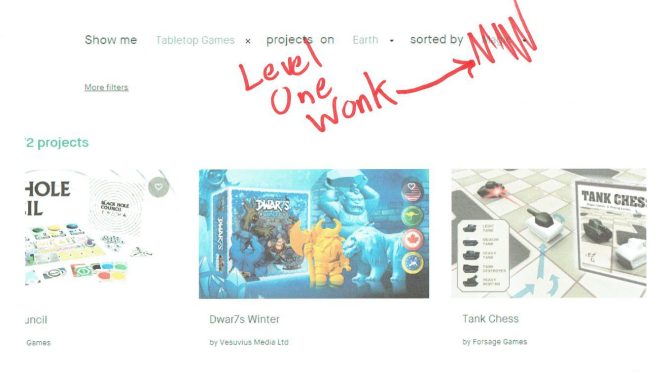
Kickstarter Wonk: September, 2020
Welcome to Kickstarter Wonk for September! Back to school, post-GenCon rush, none of these events make sense this year, at least not in the normal way we usually understand them. Some of the pent-up demand for Kickstarters is starting to appear in the marketplace again, but everything remains muted, and likely will for some time. The five project article is going to be the norm for the foreseeable future, though luckily we’ve gotten past the point where getting five projects together took effort. Nonetheless, it’ll be a few months before we get back up to the quantity (of quality) that I was used to back when this series started. Even so, fear not! These five projects are worth a look; I even backed a few myself.
Are RPGs Fun?
The English language would make a terrible role-playing game. There are a lot of rules, many of them contradict each other, and in certain places there still isn’t enough detail to make the mechanics do what you really want. Some words, therefore, words we use frequently in some cases, are surprisingly hard to define. Imagine, if you will, that someone asks you why you play role-playing games. Many of us will answer such a question with our favorite aspect of the hobby, saying something like “I enjoy playing interesting characters” or “I enjoy making a story with my friends” or even “I enjoy the thrill of combat”. These can all be chased down, toddler-like, with another question, “why do you enjoy that?” When you’ve been run down by questions, how many of you will end on (for either accuracy or to get the questions to stop) “because it’s fun”?
Battling Inner and Outer Demons: An Interview with Witch & Craft Games
The world can be a dark place, peopled with demons of all kinds. In XII: Inner Demons, Witch & Craft Games take the inner demons that haunt people and ask the question: but what if there were bigger demons that found that delicious? In their own words, “With the help of a ragtag band of lesser demons who certainly don’t have your best interests at heart, or perhaps another human with a kindred soul and no clue what they’re getting into, you have twelve days to confront the suffering that has been plaguing you… or face a very unfortunate end indeed.”
Combining urban horror and a punk ass-kicking aesthetic, XII: Inner Demons asks you to go on a journey to save yourself from a slavering Archdemon by traveling to personal anchors from your past. It’s also currently on Kickstarter! In the first of a series of interviews with diverse game designers, Cannibal Halfling Gaming talks to the founders of Witch & Craft Games about the past and future and some stuff in between.
Continue reading Battling Inner and Outer Demons: An Interview with Witch & Craft Games
A Glimpse into the Vault: Infomocracy
A Glimpse into the Vault is one of the oldest features on Cannibal Halfling, giving us opportunities to look into our respective “vaults” at other media we consume. These articles have covered a range of different items, but tended to stay in the gaming space…until now. You see, my personal vault doesn’t have many board games in it, but I do live surrounded by books. And recently, I finished a book that is not only a great read, but has some pointed lessons that gamers can learn about worldbuilding.
Infomocracy is written by Malka Older and was first published in 2016. It tells the story of a world in the near future where most of the world is ruled over by a unified micro-democratic government. The population that participates is divided into “cententals” of 100,000 people, who each vote on a government to represent them. Each government has power based on the centenals which elect them, but there is special influence (and statistical benefits) afforded to a government able to win a “Supermajority” of these centenals. The story, which I’ll summarize soon, focuses on the lead-up to an election where such a Supermajority is in play.
“I’m going to turn my campaign into a novel!”
When we play RPGs, we tell stories. For some it’s a fun consequence of the characters’ exploits, while for others it’s the whole point of the game. These stories can often have great power for the groups who create them, creating characters more personal and compelling than any novel ever could. It’s natural, then, to want to share these stories outside the group. The problem here, really, is that a tabletop campaign is a big, extended instance of “you had to be there”. As fun or dramatic or gutwrenching as it was at the time, you cannot recapture those feelings by turning your campaign into a novel.
Continue reading “I’m going to turn my campaign into a novel!”