Tag Archives: Opinion

Crowdfunding Carnival: May, 2024

Welcome to the Crowdfunding Carnival for May! The push in April means that the crowdfunding machine is quiet, at least in terms of big names pushing big games. For newcomers, though, there is some variety. We’ve got dystopias, we’ve got mecha, and we’ve got…maggots. Come with me, and see what games you want to throw some money to this spring.

Continue reading Crowdfunding Carnival: May, 2024

Stewpot: Tales from A Fantasy Tavern Backerkit Review

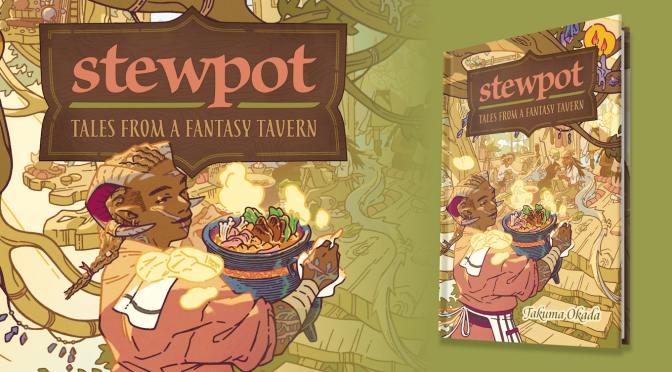
The tavern is the fulcrum point of the adventuring lifestyle. It’s where wandering heroes can find food and shelter after weeks out in the wilderness, it’s where quests can often begin… and it’s where quite a few stories find their happy ending. After all, being an adventurer is a tough life. Many adventurers, whether they retire after a successful career or call it quits early, get the idea to be the ones running the tavern, providing the same things they needed back when to a younger generation. It can take some doing, however, integrating back into settled society after a life living on the road and by sword and spell. How do you let go of who you were, and who will you become? Let’s have a taste of Stewpot: Tales from a Fantasy Tavern from Takuma Okada, now on Backerkit with Evil Hat Productions!

Continue reading Stewpot: Tales from A Fantasy Tavern Backerkit Review

Spooktacular Adventure Writing: Part 2

Adventure Design

Before we get started, here’s a link to Part 1 in case you missed it. There is an idea that rules-lite games don’t require adventures and scenarios the way crunchier games do. I think this is an idea shared mostly by younger gamers, because modern games that use Powered by the Apocalypse designs generally encourage the GM to build things improvisationally with players.

Continue reading Spooktacular Adventure Writing: Part 2

The Facility – A Breathless Choose Your Own Mad Science Adventure

You awaken, cold and in the dark. Fumbling around by low blue lights in a coffin shaped pod. You pull yourself out of the box, and in the dark see the faces of others. You are all wearing loose fitting white clothing and laceless shoes. Hospital patients? You peer into the dark, seeing little but hearing the sound of dripping, running water and distant machinery. You gather what you can, knowing that something is hunting you. It will be here soon.

Wait.

Can you remember who you are?

Welcome to The Facility by Galen Pejeau!

Continue reading The Facility – A Breathless Choose Your Own Mad Science Adventure

The Precarity of RPG Design

I’m not stating anything particularly controversial when I say it’s tough to be a game designer. The tabletop RPG market is an economics nightmare; demand is low and supply is incredibly high. Demand is low because this is a niche hobby whose marketing to the public at large is, essentially, Hasbro screaming so loud that nobody else is heard. Supply is driven by the fact that, at a functional level, thanks to crowdfunding Kickstarter, itch.io, and DriveThruRPG, basically anyone can make a TTRPG and get it on sale. TTRPGs and self-published fiction are very much the same, and everyone’s looking for the solution to the fact that 90% of everything in the market is utter crap.

Imagine, if you will, that you’re a good game designer. You’ve made something that’s captured the attention of part of the audience and, after you run some numbers, you realize that you could make a living on this. If you’ve done those numbers correctly, you’re still looking at a difficult life, one filled with a lot of hustle, a lot of compromises on your creative vision, and, most discouragingly, precarity. Precarity is, in essence, the amount of time you spend one decision away from ruin. It’s the constant enemy of anyone who doesn’t earn a constant and consistent income, and when your precarious income is game design instead of, say, insurance sales, there’s no relief from it, either. The only avenues to some meager financial security are to release a game that honestly gets famous, book dozens of hours of freelance work over and above your own design work, or simply have a day job.

Continue reading The Precarity of RPG Design

World Ending Game – Saying Goodbye With Style

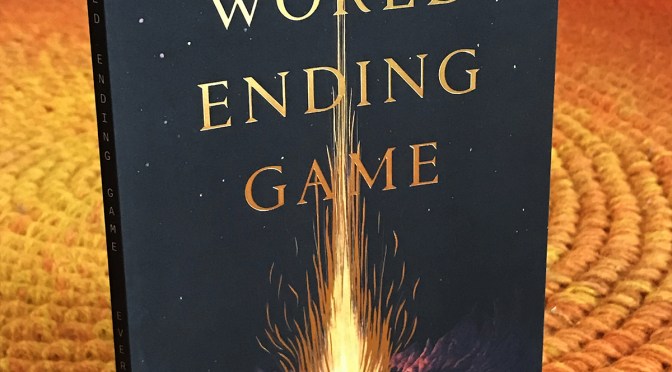
“Think about screenplays and films, or the final episode of a television show that you know will not be renewed. Think about saying goodbye to friends who are moving away. Think about the last day of summer vacation. Think about funerals. Think about the restaurant that closed all those years ago, and the noodles they used to serve. Think about the best birthday party you ever had. Think about putting off the last chapter of a book until tomorrow. Think about grief, and relief. Think about the end of a world. Think about the feeling of emerging from a movie theater into a dark parking lot, under the stars.” Longtime readers might recall I’ve written about saying goodbye to characters before, but that was largely in a ‘how to remember and treasure them’ way. The reasoning behind that article is, however, the same one that drew me to check out the subject of this one: the attachment to characters that we’ve created and a desire for closure as we leave them, and the snapshot of their lives that we played out, behind. This is a look at World Ending Game by Everest Pipkin.

Continue reading World Ending Game – Saying Goodbye With Style

Spooktacular Adventure Writing: Part 1

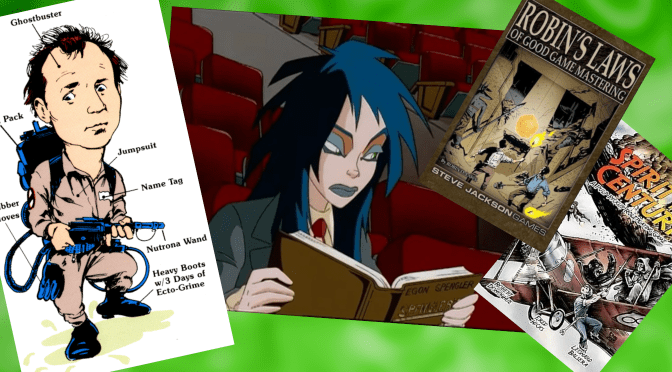
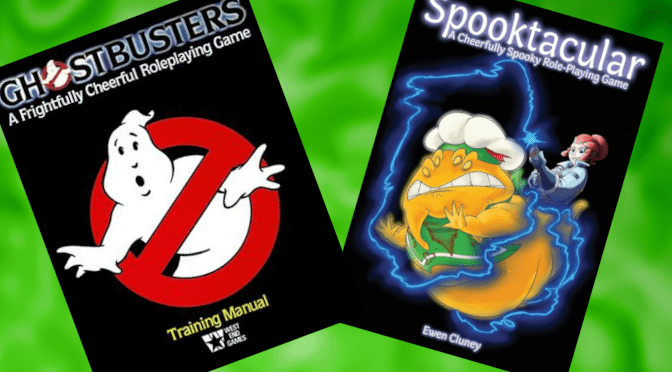
This is a vague sequel to the Maid RPG post published here recently. Spooktacular is a retroclone of the 80s Ghostbusters role-playing game written by Ewen Cluney, who not only translated Maid RPG but also wrote an original game, Kagegami High, that mixes Maid RPG‘s mechanics with the ones found in Ghostbusters.

I decided to write an original adventure for when I would eventually run Spooktacular for my players. This was a problem for me, because I live by the Mythbusters credo; if it’s worth doing, it’s worth overdoing.

Continue reading Spooktacular Adventure Writing: Part 1

Crowdfunding Carnival: April, 2024

Welcome to the Crowdfunding Carnival for April! As you business types know the first quarter is over, and it’s time to kick things up! More realistically, ZineQuest is over and PAX East is recently in the rearview, meaning that the first set of product announcements in the tabletop gaming world have kicked off in earnest. Commercial con season runs from roughly PAX East to GenCon in August, so we’re in the height of major announcements and the crowdfunding campaigns which accompany them. As such, we have four major glorified pre-orders campaigns that you can check out. Beyond that there’s still a lot of momentum in the indie space, at least somewhere down in there. Sifting through the weird porn minis and 5e “supplements”, I’ve picked out five indie campaigns that are worth checking out and, quite possibly, worth a pledge as well.

Continue reading Crowdfunding Carnival: April, 2024

Black Sword Hack and the evolving OSR

The Old School Renaissance is a microcosm within the RPG world. Although many (including myself) refer to the OSR as a whole, cohesive thing, the reality is that the movement is more the result of at least half a dozen origins that random-walked into game preferences which, to an outsider, look similar. The broad preference towards the genre establishment of Dungeons and Dragons (or at least Appendix N, if not the system itself) bounds the definitions we work with; other retroclones and revivals like Cepheus and RuneQuest aren’t included, even if they too are ‘old school’. No, the main thing that all vectors of the OSR have in common is that they are trying to recreate the time when the roleplaying game was new. And when RPGs were new, either literally or in the eyes of the designer, the new thing that they first touched was (almost always) D&D.

All OSR games are aiming for either D&D as it was, D&D as it could be, or D&D as it was supposed to be. D&D as it was is simple; Old School Essentials is a straight-up retroclone and proves that ‘Basic D&D without shitty layout and shitty editing’ is a winning recipe. It’s the best known and best selling retroclone, but the retroclone camp of the OSR is arguably the oldest (to the degree that OSR is a label we can trace it back to OSRIC). D&D as it could be is where we start getting a lot of the distillations; the rules in early editions were such a mess you barely used any of them, so clearly one could write a game only using those few rules we could actually make work. This is where Into the Odd comes in, this is arguably where The Black Hack comes in, and, if rules were in any way supposed to be primary in the game, this might be where Mork Borg would come in. This example shows setting and tone are a different topic here than ‘game’. D&D as it was supposed to be is a tough one, and there aren’t many games that really aim for this mark. Whitehack is the one that comes to mind for me, taking the length and complexity of the original booklets and turning that into something much more flexible and consistent.

Continue reading Black Sword Hack and the evolving OSR

Daggerheart Preview

Earlier this month, Darrington Press released the free playtest version of Daggerheart, their traditional fantasy RPG meant to go toe-to-toe with D&D. First with Pathfinder but now also with entries from MCDM and Kobold Press, we’re getting an awful lot of D&D-alikes, thanks to last year’s saga with the OGL. It’s now clear that a corporate game is a liability, so anyone making a livelihood in the gaming space is clearing out of the Halls of Hasbro. What makes Daggerheart, the entry from the Critical Role folks so special? I downloaded it for free, for one thing. In all seriousness Daggerheart is entering the public eye a little earlier than the MCDM RPG or Tales of the Valiant, both of which are currently fulfilling crowdfunding and doing any additional playtesting either contained to backers or within their own teams. The public playtest process is a great way to get a lot of feedback, and it’s worked well in the past; both 5e and the second edition of Pathfinder went through public playtesting.

It’s also caused some grief already. Darrington is somewhat in the crosshairs, between the moderate reception to their first game Candela Obscura and the relatively polarized fanbase that Critical Role has created by being the biggest voice in the room. Seems like a perfect time for someone like me to come in. I’m not the most impartial judge, given my growing disinterest in D&D or its cousins over the last five years, but I do understand what these games are trying to do. To that end, Daggerheart seems to have what it takes to grow a fanbase. It just needs to solve a few niggling issues with its own relationship to narrative mechanics first.

Continue reading Daggerheart Preview