Tag Archives: Opinion

How the Wonk GMs: Session Prep

Welcome back to How the Wonk GMs! Last time we had a bit of an introduction, framing the GMing experience by talking about campaigns and how one sets up for a campaign. Today, the discussion will be more specific, talking about how one gets ready to run a session. Later, I’m going to go into what I actually do in the GM’s chair, and what running a session looks like.

The one comment I got on the last post in this series was that it was vague, and I concede that. Here’s the thing, though: After you frame up what kind of campaign you want to run, what conceits and systems would be fun for you, you want to keep it vague. An RPG campaign is not a novel, and when you’re setting everything up prior to play you want to leave as many doors open as possible. It is now, when you’re looking to set up an actual session that your players are going to show up to, that you can start closing the doors and settling on what you actually want the game to look like.

I call this session prep, but in the real world with schedule breakdowns, cliffhangers, and everything taking just a bit longer than you’d expect, this might be more of an ‘adventure prep’ given that some of these ‘sessions’ will last two or three. For the most part, then, we’re going to be talking in units of plot rather than units of time. For each of these units of plot, you’re going to be figuring out a problem statement, a problem space, and then a problem resolution. When you’re prepping, though, you start with the problem resolution from last time, use that to write your new problem statement, and then use the new problem statement and your existing prep to define a problem space.

Continue reading How the Wonk GMs: Session Prep

Meet the Party: The Mecha Hack

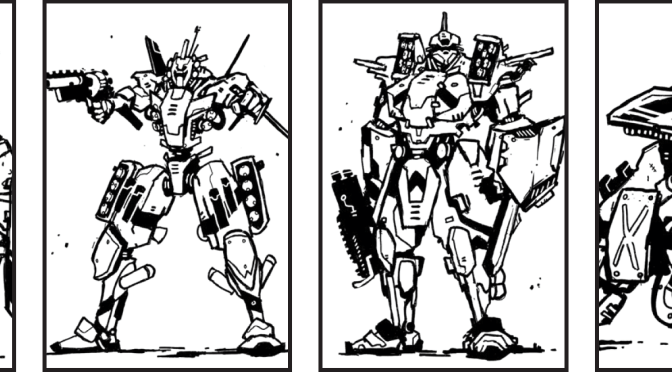
A mercenary band of mecha pilots stands prepared to fight another day in the Lodestar Alpha system, all for the credits its various factions are willing to provide for their services. Wing Crusader, Onyx Edge, Jester Epoch, Dagger Alpha, Iron Glory, and Chimera Sunset are the weapons of war that will see their pilots make their fortune and maybe decide the fate of the system altogether. All pilots, get in your giant robots and get ready to launch. Let’s do a quick little review of, and then Meet the Party for, The Mecha Hack from Absolute Tabletop!

Continue reading Meet the Party: The Mecha Hack

Cyberpunk RED: Black Chrome Review

We don’t review a lot of supplements here at Cannibal Halfling Gaming. From a pragmatic standpoint, there’s a lot less that a review can tell you about a supplement that will affect your purchasing decision than with a full game. For today’s subject, Black Chrome for Cyberpunk Red, that’s certainly true. We all knew Black Chrome would be the ‘stuff’ supplement, and even if there hadn’t been some grumbling about the ‘stuff’ or lack thereof in the core rules the ‘stuff’ supplement in a Cyberpunk game is almost always a must-buy, if only due to the association of the cyberpunk genre with gear porn. On the other hand, in some cases there’s a bit more to say about supplements. Cyberpunk Red is slowly working up to being a full-on RPG ecosystem just like Cyberpunk 2020 was; the earlier game had supplements from gear catalogs to corporate profiles to location gazetteers to big plot books like the Firestorm series. One consequence of this, perhaps an unintended one, is that Cyberpunk 2020 played quite differently when all the supplements were in play than when it was just the core book. While that’s neither unique to Cyberpunk nor particularly unexpected, it had a significant role in the reception of Cyberpunk Red, where the game in its early single book state was being judged against a Cyberpunk 2020 which already had literally dozens of supplements released. It stands to reason, then, that Black Chrome would be the first full-sized rules supplement for Cyberpunk Red. Black Chrome is an homage to the supplements which changed Cyberpunk 2020 the most and the fastest, the Chromebooks.

Continue reading Cyberpunk RED: Black Chrome Review

Zine Month 2023 Round Up #2

A ride or die Filipino adventure where the indigenous magic and monsters still dominate the archipelago. A seaside vacation meant to both help your health and help you find love, provided you can solve the murder. Living a version of your life affected by ADHD. It’s down to the wire, but there’s still time to check out another batch of Zine Month creations!

Continue reading Zine Month 2023 Round Up #2

Crowdfunding Carnival: March, 2023

Welcome to the Crowdfunding Carnival for March! It’s a bit of a weird time, early March. ZineQuest is ‘finished’, but with campaigns starting as late as yesterday there’s still a bit of backlog to dig through. Meanwhile, the bigger, more traditional campaigns are starting to spin up, but they’re often lost in the shuffle.

The campaigns we’re covering this month reflect that reality. There are 25 Zine campaigns here, which I will do my best to sell to you in a sentence or two. I didn’t have to have a hard cutoff like in the middle of the month, but most of the Zines that didn’t make the cutoff were just material for 5e that I don’t have the energy to care about. Such is life.

Here at the beginning of March it’s also worthwhile to reflect on ZineQuest as it is now, here in 2023. Based on numbers, there’s no doubt in my mind that this year was a return to form compared to the misstep of moving the event to August. That said, there’s an enthusiasm gap that seems to have formed between 2021 and now, and it’s in large part due to what happened in 2022. The number of people tracking and providing data on ZineQuest has withered significantly, meaning I don’t have a project count, funding level, or success rate easily at hand to compare to last year or the year before. Based on our August 2022 coverage, this year was significantly better than last year’s Kickstarter’s outing, but I don’t know how it compares to the combined total of the 2022 events, and that’s important because of what happened to Zine Month.

Continue reading Crowdfunding Carnival: March, 2023

Zine Month 2023 Round Up #1

A map for every adventure and an adventure for every map. The horror of magical academia. Making sacrifices to a river spirit. Last of Us a la Twin Peaks. Tracking down an entity that consumes time itself.  Another February, another month of roleplaying game zines, and I’m back for more Zine Month spotlights! 

Continue reading Zine Month 2023 Round Up #1

How the Wonk GMs: Intro and Campaign Prep

If there’s one thing I’ve been asked to write about over the years, it’s what my home games actually look like. Not an imagined campaign, not a system hack, just how I run when it’s my friends, my ideas, and my time. Needless to say that’s not something that can be condensed to 2000 words, so instead I’m welcoming you, albeit temporarily, to ‘How the Wonk GMs’.

I’ve recently come off of a literally five year stint of GMing for my primary gaming group, and I have run a lot of different games in that time. Spending all this time in the GM’s chair has reminded me that I’m extremely lucky to have as engaged and curious a gaming group as I do…as well as the fact that breaks are good. While taking this break, though, I’m going to be trying to distill down my methods and madness into something approximating fit for public consumption.

Continue reading How the Wonk GMs: Intro and Campaign Prep

Crowdfunding Carnival: February, 2023

Welcome back to the Crowdfunding Carnival! Now, it’s Thursday, which is a little unusual. I did this, though, for you, dear readers. You see, yesterday was the first day of ZineQuest, and a veritable torrent of zines hit my inbox around the time this article would have otherwise gone to post. That just won’t do, so I held off to pick through the wreckage for you. So now we have over 40 zines, and it’s been just one day! There are some other games too, and of course our second installment of the Crowdfunding Carnival/Kickstarter Wonk fifth anniversary retrospective. Onward!

Continue reading Crowdfunding Carnival: February, 2023

Rolemaster Unified Review

The OSR is a movement of nostalgia. Rather than seeking to actually emulate the way RPGs were played in the 1970s and 80s, the OSR is seeking to bottle the lightning of the first time you found a Player’s Handbook or Basic Set and just played, actual rules be damned. While the OSR as a movement is certainly informed by the cultural phenomenon of having the D&D red box show up in toy stores and in the hands of many kids and teens in the 1980s, the roleplaying hobby itself was already significantly more diverse than any one movement could capture. As an example, around the time that the OSR casts its rose-tinted glasses toward, there was a successful and long-lived game called Rolemaster.

Continue reading Rolemaster Unified Review

Most Games Don’t Matter

After graduating into one of the worst recessions the global economy had yet seen, I cut short a fruitless job search to go to grad school. I ended up with a Master’s Degree in Innovation Management, a field which sounds like it was made up by the Business School industry but yet taught me a lot. While invention is the act of creating something new, innovation is the act of deriving value from new things, from inventions. According to the World Economic Forum 1.7 million patents were granted in 2021, which is a huge number. But even setting aside things like filing the same patent in multiple countries, a small fraction of those patents represent anything like tangible value to society at large. While invention can happen with a bit of creativity and some work, innovation is significantly more dependent on exogenous factors, on what happens to the invention after it comes into being. RPG designers are like inventors in that way; many many people are designing, are inventing, but the vast majority of games will never make an impact on the market at large.

While there are certainly forces contributing to a greater stagnation of the RPG hobby (D&D comes to mind), the low ‘hit rate’ for new RPGs when it comes to moving the needle in the greater marketplace is largely structural, and unlikely to change in the long run. On the creator side, making an RPG is relatively easy, requiring significantly less money and specific skill than making video, digital games, or visual art, and often less time than writing long-form fiction. This means that the number of entrants into the market will be relatively high. On the consumer side, RPGs have higher switching costs than virtually any other form of media; a consumer needs to find a minimum of 2-4 friends to play with them, with a play time of two hours on the low side. Beyond that, when the presumed norm of the medium involves campaigns of literally dozens of four-plus hour sessions and understanding at least one densely-written rulebook, the perceived switching costs are significantly worse than the already high actual switching costs. These things combined to make the number of consumers in the market relatively low, and the number of games they will consume lower still.

Continue reading Most Games Don’t Matter