Tag Archives: Opinion

The Push and Pull of Backstories

Character histories have been part and parcel of role-playing games ever since Dave Arneson’s players had to figure out why their characters were crawling the dungeons under Castle Blackmoor. Between now and then there have been some games which took character origins and centered them; Traveller famously integrated a detailed character history into its character generation rules and many games emulated Traveller in one form or another. While many games offer a range of mechanical backstory generation, though, the most popular role-playing game and therefore the majority of players are given very little. While the Fifth Edition of Dungeons and Dragons has added a little above its predecessors (in the form of Backgrounds), first level D&D characters are largely a blank slate, leaving their history and origin up to the player.

When backstories are left up to the player, they become a battleground of narrative control. Some game masters, hungry for player input, get frustrated when a player expects race, class, and background to be enough and writes nothing. On the other hand, game masters much more concerned with their world (and perhaps not wanting to give players an opportunity to modify it) may resent even having to read the backstory a player writes; if they’re particularly vindictive or conceited they may even punish a player (we all saw the Tweet where a noxious GM joked that the character with the longest backstory would be the first to die). With such a range, it’s not hard to see that a mismatch of expectations is much more likely to cause trouble than what those expectations are.

Continue reading The Push and Pull of Backstories

Decisions and Endings in Video Games

When taken as a whole, it’s really only been in the most recent sliver of video game history that we’ve seen an explosion of robust narrative development. Sure, we must acknowledge the early pioneers, companies like Infocom and their titles like Zork. Still, modern video games, thanks to Bioware, Telltale, Quantic Dream, and others, have provided immense richness within the limitations of hardcoded storylines, settings, and decision points, richness that was not reachable earlier on.

Tabletop RPGs arguably got to this point earlier and have been there longer. It is simply more straightforward to write out several possible endings to a given module or adventure path than have to code them out and make more ingame content knowing that many players will never see it. In a weird way, though, that’s why I think looking at how narrative complexity presents itself in video games is so interesting and instructive. When video games fracture their storylines into multiple endings or complementary subplots (like, for example, character romance subplots), it has to be deliberate. Everything is designed intentionally, and for some players figuring out the combination of actions that leads to a given outcome is part of solving the puzzle of the game. 

Continue reading Decisions and Endings in Video Games

The Trouble With Marketing

Game design doesn’t sell games. Sorry. No, what sells games is the promise that that game offers, articulated by its designer. If the promise is good, it doesn’t matter that the game is bad; that’s what got the Fallout RPG into the ICv2 top 5. But whether the game you designed is a work of art or a slapdash ashcan, sorry, you’re still going to need to market it.

The Trouble with Marketing is either that no one knows how or no one wants to. I tend to believe the second of those two items; plenty of game designers don’t really know how to write but they manage to hire someone for that in most cases. No, marketing, in addition to being its own skill which is challenging to learn, really turns people off. It reminds you you’re selling something, it makes the whole process feel less like art.

Continue reading The Trouble With Marketing

Crowdfunding Carnival: June, 2022

Welcome to the Crowdfunding Carnival for the month of June in this two thousand and twenty secondth year! Not to worry, Aaron is fine – just lost on a bike somewhere in the continental US, definitely not my fault. While he’s away I’ve snuck in and nicked his top hat and baton and gone looking for some tabletop roleplaying game crowdfunding attractions that are worth your time and possibly your money. There are chaotic cafes, regency scandals, vibrant seas, divine tales, monster-collecting kids, meta games, and exigent exalts along with a few observations from my unusual perspective up on this stage. So, without further ado, on with the show!

Continue reading Crowdfunding Carnival: June, 2022

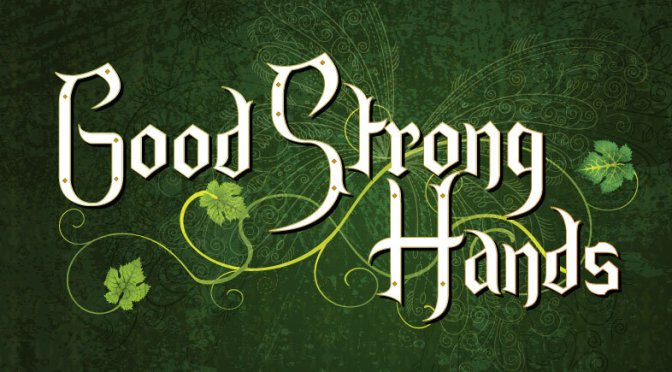
Good Strong Hands Review

I have to admit, fantasy games come to the plate with two strikes for me. The ubiquity of Dungeons and Dragons, coupled with the large number of single-game players, means that fantasy games generally need to work twice as hard to do something interesting within the existing constraints of the genre. When I first read Good Strong Hands, I saw a game that leaned hard into a very broad, often repeated conceit: A great evil is corrupting the land and you, the heroes, must stop it. Couple this with light, fairly basic mechanics, and I didn’t really know if I was going to find anything interesting in this game.

Luckily, I was wrong. While Good Strong Hands is a rules-light game, and while it absolutely leans on a simplified view of good and evil, it takes this basic struggle and makes it the centerpiece of the game. The mechanics of the Void, Shadow and Corruption, force players to make tough decisions and place the voice of evil with the GM to play with as they wish. The game does want to see its players triumph, but the risk of falling to the Void is very real and a party will likely see at least one character lost to evil in a campaign.

Continue reading Good Strong Hands Review

The Trouble With Drama Mechanics

Role-playing games are all about characters, otherwise they wouldn’t be role-playing games. And what really gets someone invested in a fictional character, whether they’re playing the character or watching or reading the character, is the character’s personal journey. We love to see it in books and movies and we love to see it in RPGs, but in RPGs we typically aren’t given additional rules to support these sorts of stories. This is in part because these stories haven’t been the focus of most RPGs, well, ever, but it’s also in part due to the belief of designers that characters’ inner lives should be governed by the people who play them, not by rules.

The issue with this is that mechanics are what provide richness for games. We want PbtA games to have a palette of different moves, and we want each playbook to feel different. We want a military simulation to differentiate between all its guns and vehicles. So why would we not want rules that help us look at and play out character drama? When I looked at Hillfolk a few weeks back, one thing I thought it did very well was stake out three necessary drivers of dramatic conflict: character desire, character internal conflict (the ‘dramatic poles’), and character external conflict (‘fraught relationships’). What was missing was the next step, which was to provide structure and guidance to build and play with those drivers.

Continue reading The Trouble With Drama Mechanics

Crowdfunding Carnival: May, 2022

Welcome back to the Carnival! Here at the beginning of May it’s a momentous time to be looking at crowdfunding. Well, that’s partially true. If you’re interested in the high profile campaigns earning hundreds of thousands or even millions of dollars, it’s a momentous time to be looking at crowdfunding. If you’re another indie fellow trying to get by, it’s another month. If you’re looking for those indies who have broken into the big leagues, though, there’s a great example of that going on right now. We’ve got co-marketing, we’ve got little old ladies solving murders, we’ve got Tarot cards, and, of course, we’ve got Free League. Let’s take a look.

Continue reading Crowdfunding Carnival: May, 2022

Cold Fires, Jedi Shadows, and Creativity: Why You Should Listen To Force Majeure

“Unforeseeable circumstances that prevent someone from fulfilling a contract.” That’s one of the legal definitions of force majeure, and I can think of a few examples. Getting discovered by a dark figure known as Tenth Brother might prevent you from fulfilling a work contract, or the ‘contract’ that is your prison sentence. An “irresistible compulsion or greater force” is another definition, and an offer you can’t refuse to retrieve an artifact from a strange wasteland certainly fits the bill. However, that second definition is also a pretty good description of the reasons Why You Should Listen to the podcast known as Force Majeure. You know how it goes: a long time ago, in a galaxy far, far away…

Continue reading Cold Fires, Jedi Shadows, and Creativity: Why You Should Listen To Force Majeure