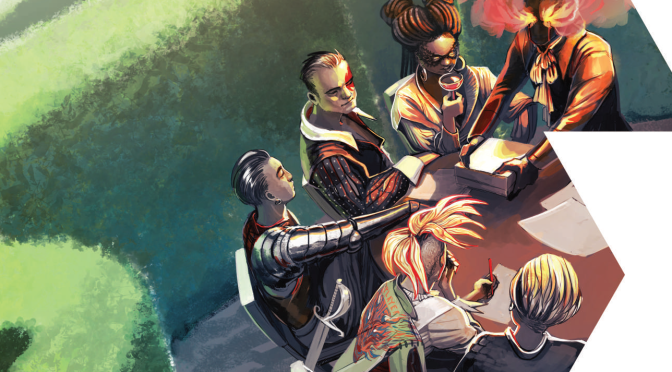
You’re dragged into a treacherous fantasy world made from your own fears, doubts and desires. There’s only one way to escape – but with limitless adventure within your grasp, would you even want to? You might very well have heard our first experience with DIE the RPG, based on the comic of the same name, when we featured it on Cannibal Halfling Radio: Now Playing! Jay, Evelyn, Fitz, and Max came back together to play one more roleplaying game and found themselves in the Fields of the Lost, facing down their own troubles. Well, last weekend I grabbed the d20 of the Master myself and ran a marathon session, ten hours long, and it was just as much of an emotional rollercoaster. With the book in hand and experience on both sides of the screen, let’s dive in for a proper review!
Tag Archives: Review

System Split: Death in Space and Mothership
Most big science fiction properties today err on the side of science fantasy. Star Wars is basically swords and sorcery in space, and Star Trek’s post-scarcity antimatter economy is built to support its storylines, not the laws of physics. In the tabletop RPG world, though, there are a few options for somewhat harder space sci-fi, especially if your definition of hard sci-fi includes horrors man wasn’t meant to know as well as the strong possibility of explosive decompression or straight up getting sucked out an airlock.
Today we’re going to look at two gritty space horror games which, through relatively light rules and strong emphasis on random outcomes, are easy for players but very tough on characters. Death in Space is created by Christian Plogfors and Carl Niblaeus, members of the Stockholm Kartell alongside the creators of Mork Borg and CY_Borg. Mothership is created by Sean McCoy and distributed and developed by Tuesday Knight Games, who are in the process of bringing the new Mothership box set into distribution as of this writing. Both games are about freelancers trying to survive deep in space, and quite often failing to survive deep in space. Despite similar rules and character survivability, each game has a degree of nuance with how it approaches the gameplay loop.
Continue reading System Split: Death in Space and Mothership
FIST: ULTRA EDITION Review – Paranormal Cold War Mercs
Now: the second half of the twentieth century. The powers that be are locked in a tense nuclear standoff, and the fate of the world hangs in the balance. Away from the watchful eye of national intelligence, a cadre of exceptional misfits is assembled. These soldiers of fortune are uniquely equipped for covert and unusual operations.
In these uncertain times, the line between science and superstition has been broken, and the new arms race is only beginning. You, or your associates, may be faced with weapons, tactics, and actors unlike any you have ever seen. For a price, those exceptional misfits can help.
When you’re all out of options, it’s time to call FIST. Continue reading FIST: ULTRA EDITION Review – Paranormal Cold War Mercs

Fantasy World Review
While Apocalypse World was the starting line for Powered by the Apocalypse, Dungeon World was what got the ruleset to really take off. By adapting the rules of the perennially popular Dungeons and Dragons as well as showing gamers what it looked like when Apocalypse World was hacked, Dungeon World not only moved significantly more copies than Apocalypse World but also kickstarted the popularity of PbtA in general. Now, years later, Dungeon World’s somewhat inartful mushing of Apocalypse World and D&D together is looked upon less fondly, given years of innovation and expansion of the PbtA ruleset. When you combine that with the checkered behavior of one of its authors, Dungeon World is a game that has sent many of its fans looking for a replacement.
Oddly, straight-up fantasy has not seen a lot of entrants into PbtA. There is Fellowship, but that is designed around a specific Tolkienesque sort of story. There is The Sword, The Crown, and the Unspeakable Power, but while that plays to Game of Thrones and popular dark fantasy themes, actually playing the game demands engaging in a unique and quite adversarial experience. No, the sort of fantasy romp typified by D&D but also offered in games like Forbidden Lands, RuneQuest, and even GURPS Dungeon Fantasy, is not really present to the same degree in PbtA as it is in other places. Maybe it’s the OSR attracting the sort of small press hackers and designers who want to write fantasy, or maybe Dungeon World’s shadow is too long. Either way, there’s a new fantasy PbtA game in town.
Continue reading Fantasy World Review
Fabula Ultima Review: A Golden Table Talk JRPG
Epic stories of larger-than-life heroes destined to accomplish great deeds fighting against fearsome villains and tragic antagonists! Fantasy worlds brimming with magic, wondrous locations, and uniquely bizarre monsters! Challenging battles that will call for clever tactics, cooperation with allies, and tricks up your sleeve to win! If you’ve played Japanese roleplaying games like Bravely Default, Chrono Trigger, Granblue Fantasy, Ocotopath Traveler, or (duh) Final Fantasy, the premise might be quite familiar indeed. This, however, is no video game. Neither will it take you through a predetermined story, however many branches it may have, thought up by writers and enabled by coders you’ll never meet. Instead, grab some dice and prepare to put your own tabletop twist on the genre you love, with a story and world of your own creation. Welcome to Fabula Ultima, created by Emanuele Galletto and published by Need Games!
Continue reading Fabula Ultima Review: A Golden Table Talk JRPG

System Split: Burning Wheel Hacks
Burning Wheel is past its twentieth birthday. The game, a famously complex child of the Forge, is one that everyone seems to either love or hate. I personally love it, but in this week’s System Split I’m extending a fig leaf to those on the other side (or at least those who tried to love it and bounced off).
Burning Wheel is a game predicated on its detail; thanks to its long lists of traits, skills, and lifepaths each one of its mechanics operates in a way that is predicated on its setting, itself a nerd-among-nerd’s joy of medieval history (via Desmond Seward and Barbara Tuchman) and Tolkien (via, well, Tolkien). You can’t really take much out of Burning Wheel and have it remain Burning Wheel…when the designers tried to take things out of Burning Wheel, they ended up with Torchbearer.
That all said, just because Burning Wheel is all layered into itself like an indie RPG biscuit doesn’t mean that there aren’t buttery nuggets we can take out. Those systems, like the mechanics around Beliefs, can certainly stand alone even if we usually see them in the context of something more. With that in mind, I turn to the subjects of today’s pondering. Hot Circle, a clear riff on Burning Wheel, is written by Casper Dudarec and aims to take the core mechanics of Burning Wheel down to a simple and portable core. But wait! The Gold Hack, more of a riff on the recent editions of Burning Wheel (i.e. Burning Wheel Gold), is written by Martin Van Houtte and…aims to take the core mechanics of Burning Wheel down to a simple and portable core. Huh.
Continue reading System Split: Burning Wheel Hacks
Solitaire Storytelling: Desperation
Welcome to another Solitaire Storytelling! Until now, Seamus has been the one leading the way on solo games coverage here, finding a lot of interesting gems among all of the recent releases. Now, though, I’m throwing my hat in the ring and seeing what solo gaming has to offer. My first game is not only a solo game, it supports between one and five players. It also comes from one of the best known names in the narrative and storytelling game world, Bully Pulpit Games. In addition to a few straight-up RPGs like Night Witches and publishing other designers’ games, like Star Crossed, Bully Pulpit Games and its lead designer Jason Morningstar are likely best known for Fiasco, a comic game of Coen Brothers-style antics and table improv. The game I played this week takes a card-based format like that of the newest Fiasco edition and uses it for a very different purpose; instead of comedy we’re leaning into horror.
Continue reading Solitaire Storytelling: Desperation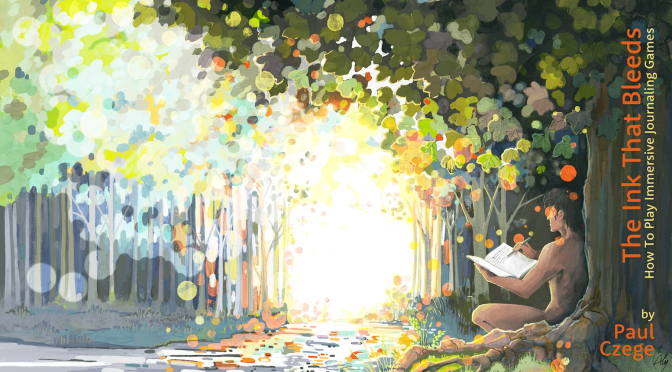
The Ink That Bleeds Review – An Immersive Dive Into Immersive Journaling
“My friend Adam feel that bleed, and games that aim for it, are ‘comparatively cheap, short-term pleasures… a bit like jump scares.’ My experience is so the opposite.
I think immersive, bleedy journaling games are act of purging ourselves of narratives that aren’t in our interests and enlivening ourselves for the temporal world.
I’m totally going to show you how.”
So writes Paul Czege in The Ink That Bleeds – How To Play Immersive Journaling Games, and I’m going to show you some of what’s inside and what it made me think.
Continue reading The Ink That Bleeds Review – An Immersive Dive Into Immersive Journaling
Cowboy Bebop RPG Review
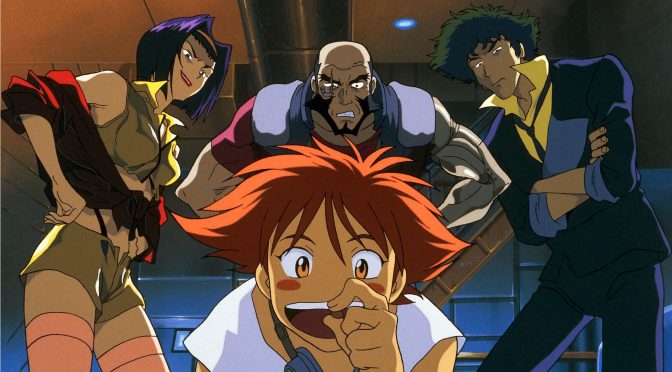
Adaptations are dangerous business, and that’s true no matter what medium you’re working in. Licensed RPG adaptations fall all over the map; for every The One Ring you get rules for Power Rangers contracting tetanus, and for every Star Wars there’s a Fallout. Reimagining old properties stays risky even if you’re staying in the same medium; the live-action reboot of Cowboy Bebop was a cautionary tale, albeit not quite as badly panned as live-action Death Note or live-action Ghost in the Shell. But what happens if you take Cowboy Bebop, the celebrated anime, and make it into an RPG? Well, in this case, something kind of magical.
The Cowboy Bebop Roleplaying Game was developed by designers from Italian company Fumble GDR and published by (also Italian) Mana Project Studio. While Mana Project is mostly known for publishing 5e settings, Fumble has a fairly impressive list of original games, including Not the End, a heroic game using an original ruleset called HexSys. A variant of HexSys powers Cowboy Bebop and, while it employs elements from games you likely know, it is completely original. The result is a game that feels like jazz; there is structure, rules, and even system mastery, but the mechanics create a loose, free environment to tell stories. And, because this is Cowboy Bebop, the stories center around bounty hunters, the bounties they’re chasing, and the memories from their past that haunt them.
Continue reading Cowboy Bebop RPG Review
Adventures in Rokugan Review
This review is delayed, far from the “hot off the press” take that I had intended back some time ago. Instead this has been an article I have stewed on for some time. In 2020 there came an announcement that Edge Studios would be taking over RPG properties that had been held by Fantasy Flight, which includes two that I have written about extensively in the past: Star Wars and Legend of the Five Rings. Since the acquisition, the publishing has mainly been constrained to reprints of books in use and published already developed supplements that had been in the pipeline before the acquisition. It was a bit of a surprise to me that the first new material from this new studio was to take the setting of Rokugan and put it into the mechanics of 5th Edition Dungeons and Dragons.
My reaction to reading it at first was, to put it politely, visceral.

