SPINE Review: Making A Game Of Getting Lost In A Book

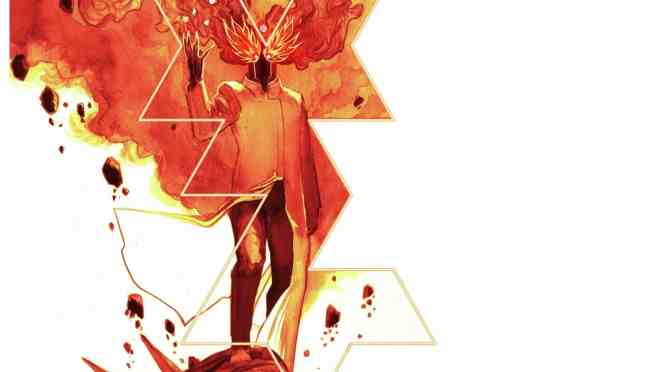
You and Granma were, frankly, on the worst terms. That’s what made it such a surprise when you got a package from your cousin, who had wound up being the executor of her estate. Maybe, your cousin writes, Granma was able to overlook your differences since you had become a fellow academic? Either way, the actual package is a copy from her rare books collection, willed to you. You can’t help yourself, so you start to read the book. It’s a weird one, an anthology of works all talking about books and stories and death and living forever and… rituals? Hold on. You really can’t help yourself. You consider just not turning the page, but you turn it all the same. The notes you’re writing in the margins stop being the words you intended to write. You can feel the book pulling you in…

The book is Siderius Plug’s SPINE – Immortality in Ninety-nine Endnotes.

Continue reading SPINE Review: Making A Game Of Getting Lost In A Book

Adventure Log: If you could DIE all over again

Playing the same scenario over again is a tough proposition. As good as the first time went, finding something else to discover, some other way to engage with the scenario, or simply just another perspective is not easy. Admittedly, the core scenario of DIE, Reunited, isn’t any old module. This past month my group played it again, and doing things over again was a core component of the twist I introduced.

You’re likely familiar with the first time my group played Reunited, it’s the basis for Seamus’s review of DIE, and it was an incredible experience sinking our teeth into the game over one long day. There was interest in revisiting DIE this year, and my thought was there was going to be one of the scenarios for the game; last year I ran Distant Fans from the core rulebook and it went well, though not quite with the same gutpunch as Reunited. When the stars aligned and our gaming weekend was going to step down to six people on its final day, I decided to lean in to returning to the gutpunch. Arguably, I leaned too far.

Continue reading Adventure Log: If you could DIE all over again

System Hack: Colony Sim Cortex Tasks and Work

When you boil it all the way down, RimWorld is a game where you assign tasks to your colonists and optimize how they get performed. Every time you place down blueprints, place a zone, or add a ‘bill’ to a production structure, you’re effectively communicating a specific task. When it comes to our tabletop colony sim, these sorts of tasks are going to be a cornerstone of the gameplay loop just like how they are in RimWorld. The actual implementation, though, is going to be quite different.

Structured time in RPGs is seen as something to be avoided, at least outside of combat. In most trad games, the passage of time is something either tracked closely in increments no more than a few seconds, or glossed over entirely. We have started to see games, especially games using Free League’s YZE system, paying more attention to the passage of time, while Edge’s new DPS mechanics used in Arkham Horror are assigning a mechanical bounding to the typically loose definition of a ‘scene’ by anchoring characters with a dice pool that exhausts over the span of one scene. It’s useful to consider rules like these for our game, but a Colony Sim is going to require something different. With productive tasks being primary, constant and consistent time tracking is going to be needed to fairly assess what’s going on in the colony.

Continue reading System Hack: Colony Sim Cortex Tasks and Work

It shouldn’t have been called Single Player Mode

Cyberpunk Red has been going strong for around five years now. The game came out around the same time as the tie-in video game Cyberpunk 2077, and represented a return to form after 2005’s Cyberpunk v3 (and 2020 being over 30 years old). Now, R. Talsorian Games has kept the party going with continual Cyberpunk support both free (in the form of Monthly DLC) and for pay (in the form of the Interface Red collections as well as standalone supplements like Black Chrome). Single-Player Mode is the most recent standalone supplement, and your take on it will depend entirely on what you think a solo RPG is (or should be).

If you’re older than a certain age, when you think solo RPG you think something like Mythic GM Emulator, a set of rules that can act as a GM and let you play through modules or combats on your own. If you’re younger than a certain age (let’s say younger than me at least), your first thought of a solo RPG is probably more like a journaling game, or a hybrid narrative game like The Wretched. It’s important to state this because despite its 2025 release date Cyberpunk Red Single Player Mode is firmly the first of those two. There are no campaign framing tools, no narrative generation, and no character supplements. Cyberpunk Red Single Player Mode is built firmly on using an ‘oracle’ to answer questions which allow you to progress forward through your imagined narrative, and also provides tools to let you play out investigations, social interactions, combats, and neutrons all on your lonesome. What it’s truly best at, though, is having a library of random tables which enable you to set up all sorts of premises, missions, and random encounters to make your Cyberpunk solo game more interesting. You may realize as I say this that random tables aren’t just for solo gaming. Not only is that true, it means that while I think Single Player Mode makes for an excellent GM aid and has some good rules additions…it just doesn’t work as an effective solo game.

Continue reading It shouldn’t have been called Single Player Mode

The Last Caravan – Con-Apocalyptic Road Trip

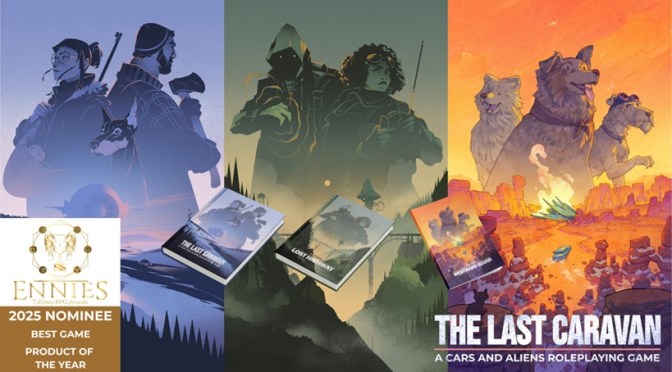
They came less than a year ago. The war was swift – and brutal.

Humans and aliens bombed each other to smithereens, and now both sides are licking their wounds. Mysterious new factions rise to join the struggle of the fallen titans. In this landscape of shifting allegiances, we may have to choose sides. Debris from the explosion of the aliens’ mothership has clouded the atmosphere, lowering the temperature and creating the coldest winter in a thousand years.
We find ourselves in a melancholy, wintry landscape — quiet, until it’s not. Egg-shaped alien structures thirty stories tall now squat, humming, over the cities they crushed. Xenofauna and lost invaders stalk the woods and highways. A war is brewing in the aching silence.

We are navigating the waking remnants of human and alien empires — and all we’ve got is a car, our fellow travelers, and the road.

It’s time to head west with The Last Caravan.

Continue reading The Last Caravan – Con-Apocalyptic Road Trip

Cultures of Play, Quanta of Play

The assumptions, intentions, and design of tabletop roleplaying games are infamously broad; seeing eye to eye on how to play is as primary a challenge as finding a time on the calendar for four to six people. Back in April of 2021, the blog The Retired Adventurer published a post called Six Cultures of Play which still sees reference as a succinct overview of distinct play traditions which have evolved over the last fifty-ish years of structured tabletop roleplaying. Between solid analysis and the author’s own admonitions not to see bright lines between the cultures where there aren’t any, I see the article as a useful model to start thinking about how people game and what they want.

Of course, the gaming world hasn’t stayed still, and from the publication of the original post to the renaming of Twitter to “X” in 2023, fragmentation was the word of the day. Since then, we’ve seen continuing fragmentation joined with an upswell in interest in fairly specific playstyle differentiation, driven by migration away from Wizards of the Coast products and strong take-up of “D&D alternative” products including not only Pathfinder but Daggerheart, Tales of the Valiant, and Draw Steel. The core ideas in the Cultures of Play post still hold true, but the consistent signpost in my mind is in the introduction, where the author describes a culture of play as equivalent to a ‘network of practice’. A community of practice is a group which forms around something they collectively do (or practice) which they have a passion for and want to do better; a network of practice is also that but doesn’t assume the same consistent strength of relationships, therefore being a more appropriate term for a larger, more nebulous group. As broad as a network of practice can be, I don’t really think it aligns with a ‘culture of play’ anymore.

Continue reading Cultures of Play, Quanta of Play