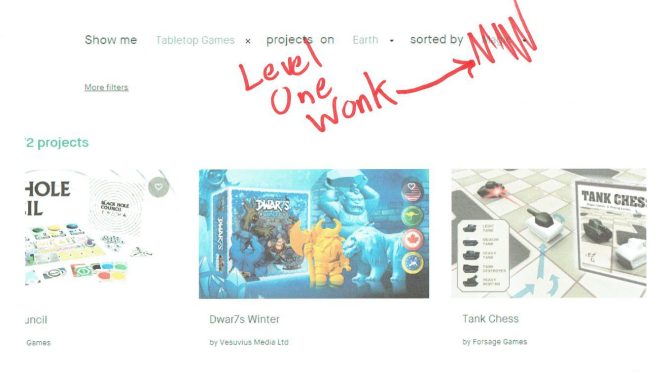
Welcome back to Kickstarter Wonk! February is the month of romance, and I think you’ll find plenty to love with a deeper field of new RPGs than we had in January. In addition to nine completely new games people are trying to bring to life, we have two honorable mentions: First, a new edition of an old game that deserves some recognition, and second, a board game which is trying to make RPG elements a primary part of its design.
All posts by Aaron Marks

Stars Without Number
Are you an old-school gamer, or a new-school gamer? I’m the Level One Wonk, and I consider myself both, which may be why I enjoy this week’s game so much. Today we’re going to talk about Stars Without Number, a game designed by Kevin Crawford. Crawford has released many games through his Sine Nomine Publishing imprint, which are all built around similar design principles: hackable sandbox experiences with an old-school heart. Games like Godbound, Scarlet Heroes and Stars Without Number are all designed to bolt right in to both old-school D&D and its retroclones, but these games are no mere clones. While Stars Without Number has characters with six familiar stats, saving throws, classes, and levels, it stretches the D&D framework quite far. As you may be able to guess from the name, Stars Without Number is a science fiction game.

Level One Wonk: Gaming on Earth
Welcome back! I’m the Level One Wonk, and this week I’m being totally down to Earth. Fact is, we live on a pretty interesting planet, and if you’re running a game that concerns itself with the past, present, or future of humans as we know them, you may be running a game using actual places. Depending on your disposition, using the real world as a basis for your games can either be way easier than worldbuilding, or way more difficult. Everything in the real world is “written” for you, which can be a boon to those of us not predisposed to improv…but on the other hand, the idea of doing research to run a game rubs a lot of people the wrong way. However, no matter the preference, anyone can run a fun game in the real world, or something like it.

Adventure Log: Dungeons and Dragons Prologue
Welcome to Adventure Log! While the Borrowed Time may have finally run out, there are still new adventures to be had around every corner. Today, we move from a long time ago in a galaxy far, far away to a distant world, where empires have crumbled and the planes themselves are opening passages between dimensions. There may be dungeons, and there may be dragons, but not everything is as it seems.
Continue reading Adventure Log: Dungeons and Dragons Prologue
Level One Wonk Reviews: The Veil: Cascade
Welcome back to Level One Wonk, where it’s time to go back to the Dark Future! We’re substituting the interface plugs and cyberarms for a whole new Slack as we check out The Veil: Cascade. This supplement not only advances the timeline on PbtA Cyberpunk game The Veil, but also adds a whole slew of new settings, playbooks, and rules tweaks for upload. After reading, it appears that Fraser Simons and his contributing authors were not only thinking outside the box, but have gone so far as to delete the box with no chance of data recovery.
Kickstarter Wonk: January, 2018
Greetings all, and Happy New Year! The Level One Wonk has returned, emerging wide-eyed and determined to face 2018 down! Of course, New Year often means new games. Like I mentioned in the Holiday Special, I’ve wanted to find good write-ups of new RPGs available on Kickstarter ever since Kickstarter began absorbing strangely large quantities of my money back in 2014. While some of these sorts of articles do exist, they are either irregular (covering only Kickstarters relevant to the topic of a given blog as an example) or short-form (there are good Kickstarter threads on RPGnet, but with a max post count north of 1000 these can be quite tough to track with). So I’ve taken it upon myself to plumb the depths of Kickstarter looking for new games.

The Level One Wonk Holiday Special: 2017
‘Tis the season, nerds and geeks, fellow wonks and gamers of all ages. The season when we gather with family and friends, reflect on the year that is ending, and look forward to the new one. And, of course, ’tis the season when your very own Level One Wonk sneaks away from his family, but only has time to hastily bang out a year-in-review article rather than bring you any new content. It has been a good year, though. We started the year with a good foundation and finished strong, bringing in tons of eyeballs with a review that was very nearly a scoop, and of a game people actually cared about to boot. Let me tell you what I’ve seen, and what I think 2018 is going to look like.

Level One Wonk: The Kitchen Sink
Welcome back! I’m the Level One Wonk, and today we’re throwing things at a wall to see what sticks! Most popular games out there exist within the framework of a genre or existing setting, and use those constraints to create interesting stories. In Dungeons and Dragons you have magic, monsters, and an underlying battle between good and evil. In Star Wars you have the Force, liberties taken with the laws of physics, and…an underlying battle between good and evil. At the end of the day, though, sometimes you want to mix chocolate and peanut butter and get something else. What if your D&D setting was invaded by aliens? Who were actually Force Ghosts…who actually came from the world of Exalted? What if they were all psychic? Why stop there? Sometimes you want everything and the kitchen sink.

Level One Wonk: Session Zero
Welcome back to Level One Wonk, where new campaign day is every day! Starting scenarios run a huge gamut in role-playing games, but it’s the tropey tired ones that continue to haunt the institutional memory of this hobby. “You all meet in a tavern” has steadily been replaced by “you all wake up in prison”, but the fact remains that establishing a campaign introduction without player input makes you vulnerable to these and other contrivances. There is of course a time and a place for every kind of campaign introduction, but sometimes you want to both get into the stuff your players care about as well as make them care quickly. This is when you want to run a Session Zero.
Genesys Review: Part Two
Last week, Seamus gave a comprehensive overview of the first part of Fantasy Flight Games’ new toolkit system Genesys. The first section presented a new angle on the Narrative Dice system which lived up to the promises of a genericized Star Wars game, while the second section on settings left a lot on the table and a bit to be desired. But there’s a lot more book here! Even if Seamus got more page count, this last section is the one that’s really full of the stuff you’re going to want. Now, if you need to get the lowdown on the basics of the mechanics and how this book differs from the Star Wars games, you should go ahead and check out Seamus’ first review. If you’re ready to talk toolkit, though, read on. All four of these chapters are from Part 3, the Game Master’s Toolkit. Overall, the toolkit is very well done, though there are several missed opportunities to have taken an addition that was merely good and make it great.
 Cannibal Halfling Gaming