
Welcome to the Cannibal Halfling Weekend Update! Start your weekend with a chunk of RPG news from the past week. We have the week’s top sellers, industry news stories, and discussions from elsewhere online.
Tag Archives: Opinion
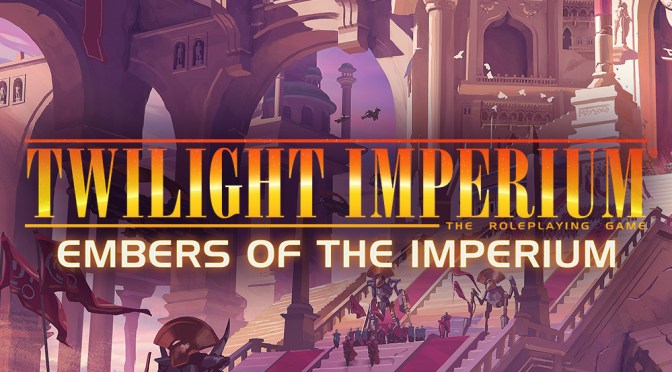
Embers of the Imperium Review
Genesys was released in late 2017, and supported with four major supplements from 2018 through 2020. At that point, the generic RPG went dark. The Covid pandemic was certainly part of this, but it was first a symptom of the broader issues for the RPG business at Fantasy Flight Games (FFG). In the mid 2010s, Fantasy Flight was (excuse me) flying high; as both the licensor of Star Wars and several enormously popular RPGs based on Games Workshop properties, Fantasy Flight was one of the biggest players in the RPG space, but that turned around quickly and badly. When FFG lost the Games Workshop license in 2017 they had nothing left in the portfolio outside of Star Wars; their biggest other game, Anima: Beyond Fantasy had been discontinued the year before. The company wasn’t ready to give up on RPGs, though. They had bought the rights to Legend of the Five Rings two years before, and whether in an effort to maximize their investment or simply because of the sunk cost fallacy, they also invested in a new game based on the ruleset they used for Star Wars. Genesys came out first, while Legend of the Five Rings was ultimately released over three years after FFG bought the property.
Embers of the Imperium comes into the picture after several upheavals, only one of which was a pandemic. In late 2019 FFG divested themselves of their RPG business, shuttling it over to another division of their parent company, Asmodee. Edge Studios, a Spanish company which originally published The End of the World, was the new brand for Asmodee’s RPG line. How did it work? Hard to say. The company does have two 5e-based games now (Midnight: Legacy of Darkness and Adventures in Rokugan), so they might be making money. That said, they did not give up on Genesys. After being announced in April of 2021, Embers of the Imperium has finally been released.
Continue reading Embers of the Imperium Review
Solitaire Storytelling: I Have No Railgun And I Must Scream
Hey, so, if you’re reading this, first of all I’d like to know how you got your hands on my diary. Second of all, if it’s because I’m, you know, dead, then thanks for taking the time to read what I’ve written. It’s kind of a comforting thought. Anyway, my name is Hope! I’m seventeen years old, they/them. I like farming sims and books. And I’m writing this because magical extraplanar alien mecha have invaded, and I need some way to vent!
See, it’s not enough that giant bird robots are stomping around trying to kill all of us. My older sister Hazel happens to be one of the Pilots fighting them, using mecha of our own. She gets a railgun. I have to make do with a diary, I guess.
I miss her a lot.
So yeah, I’m going to be scrapbooking headlines right out of the news and recording my own experiences as the world tries to get itself ended by the Nondwellers – that’s what we call the alien mecha. Oh, and hey, if I am dead and you’re going to post or publish this yourself for a quick buck or something, could you at least title it the way I would? I already have it picked out.
“I Have No Railgun And I Must Scream.”
Continue reading Solitaire Storytelling: I Have No Railgun And I Must Scream
Candela Obscura Quickstart Review
This review doesn’t really matter.
This review doesn’t matter because there are four types of people who will click on this review when they see it, and none of them are looking for more information in order to form an opinion. You will have critters who’ve already decided they love Candela Obscura and want to see if I do too, and then critters who’ve already decided they hate Candela Obscura, think switching rulesets was pointless…and want to see if I do too. On the indie/OSR side, you have those who can’t stand Critical Role, and want to see if I’m going to bag on it, ranting as long as I did when I reviewed Root. You also have those who are just thankful that the largest Actual Play in the game is using something other than D&D, and have already decided it’s better. Ultimately, I don’t think my conclusion is going to satisfy any of these camps.
It’s fine.
Now, given my own biases from both years of experience in RPGs as well as other media (not to mention writing to a specific audience for a living), I find it hard to believe that anyone was expecting a conclusion other than ‘it’s fine’ for the first ground-up new game from Darrington Press. Just like nobody should have expected Tal’Dorei to be a Planescape or Spelljammer or other setting that really pushes on the conventions of the D&D genre, nobody should really have expected that a new game from Critical Role Productions would do anything other than nestle neatly into the range of genres already popularized in roleplaying, specifically nestling in next to another bestseller, Call of Cthulhu.
I’m starting the review in this way because, ultimately, the specifics of Candela Obscura aren’t nearly as interesting as the reactions they’ve elicited. On Twitter, the first reactions I saw were mostly from indie designers who seemed primed to hate it. Apparently everyone became an IP lawyer since the OGL kerfluffle, because there were people outright claiming that the game had plagiarized Blades in the Dark and was violating the terms of the Creative Commons license (in case it isn’t clear, this is untrue). On Reddit, I read a lot of confusion about the system, though it’s hard to tell from comments if this is just from newness and lack of context, or if it is actually confusing in play. And, of course, the first big review expressed disappointment at how much of a retread the whole thing is.
Continue reading Candela Obscura Quickstart Review
What are RPGs made of?
The roleplaying experience cannot be solely defined by which books you pick up at your hobby shop. More than essentially any other medium, RPGs are changed by the people who play them and what they attempt to do with the game when they play. It is both the medium’s greatest strength and its greatest source of annoyance when trying to both critique published RPGs and set standards of good play.
If there’s one thing the RPG community is better at than anything else it’s talking past each other, and in a way this is inevitable. Every game and everything about each of those games which makes them good, bad, memorable, or forgettable is dependent on the people sitting around the table (on the discord, in the LARP space) actually playing. Now, this human element doesn’t discount what the rules bring to the game, and the ability to enjoy yourself in spite of a game doesn’t make it good (likewise, having a game bounce off your group because of your particular preferences and predilections doesn’t make it bad). This does mean, though, that we need to know what we’re talking about.
RPGs are more complicated than other games because they present three separate surfaces of writing which, in other media, either aren’t separated or don’t exist at all. The RPG system is the scaffold, the underlying mechanics, rules, and math which define how games work. The game is the group of elements built around that scaffold, the setting, procedures, and options which tell the players what the game is actually about. Finally, the campaign is the game itself, either from the players’ heads or from a pre-written adventure or two (or three). These elements in total build up to the game a group will actually play, and all of them bring something different and important to the final product.
Continue reading What are RPGs made of?
Postmodernism and RPGs
If you’re a millennial and deigned to even dip your toe into art or literary criticism, you ended up in a discussion about postmodernism at some point if only because of the time you grew up in. Modernism was a dominant bloc of philosophical and artistic thought in the western world from the 19th through the twentieth century, heavily informed by how society was changing at the time. While I’m not an especially well-read critic (I had the good fortune to study engineering in school, which is why I can blog for free), I do understand the broad tenets of modernism, which are rooted in scientific inquiry and the ability to discover truth, human capacity to create order, and an implied mission to improve all aspects of life and society through creation of something new. Modernism rejected earlier principles of realism, allowing for more innovations of form in visual art, music, and literature. And if you think I’m not about to tie this back to RPG theory communities and extensions of form like journaling and lyric games…well, you’re wrong.
Continue reading Postmodernism and RPGs
The Trouble With Combat
Role-playing games have their origins from wargames. The through-line from Chainmail to Dungeons and Dragons is an undisputed point of historical record, and the through-line from Dragon Pass to RuneQuest pretty much the same. And as the eponym of wargame is war, it’s pretty clear that all wargames have concerned themselves with killing and dying all the way back to the invention of chess. The problem is that, derivative as they are, role-playing games are not wargames. Role-playing games need not merely concern themselves with killing and dying. After nearly fifty years of evolution, I’d argue that role-playing games shouldn’t only concern themselves with killing and dying.
To be fair, even back to the earliest editions of D&D there were more interesting things going on than just monsters to slay. By 1983 we had Call of Cthulhu, where few or none of the foes within the game were intended to be ‘taken on’ in a violent manner. White Wolf games prized intrigue and social dynamics over outright violence, though both clearly had a place. White Wolf games, though, especially Vampire:the Masquerade, revealed the distinct liability of designing a game, regardless of genre or intended primary activity, with a wargame-like combat system at its center.
Continue reading The Trouble With Combat
The Unpublished Network at PAX East 2023
If you want to catch a tabletop game in one of its more interesting stages, it’s always a good idea to swing by the Unpublished Game Network. The ‘Unpub’ Network provides, well, networking for unpublished games that are still in development and at a convention gives them a place to put their game through its paces. It’s notable that the signage says ‘looking for playtesters’ instead of just ‘looking for players.’ While not quite as rich in traditional CHG content as its Unplugged sibling PAX East offers the advantage of being right in my own stomping grounds, and getting to attend its ’23 iteration for all four days meant I was able to swing by the Unpub tables multiple times.

The Maximalist Fallacy
I enjoy a whole lot of different role-playing games. Indie games, trad games, OSR games, solo games, you name it. As I’ve said before, there’s a wide world of games out there. Despite that, there is one design method for RPGs that profoundly irritates me. And, as luck would have it, it is incredibly common.
The basis of pretty much any RPG is that you, the player, have a character, and you guide that character through the setting, using the rules to determine what happens. The ways that RPGs can structure those rules are basically endless; you can have the entire game determined by a single die, or you can map out six phases of play in as much detail as any strategic board game. Where many games seem to fall, though, is that characters and all they can do are defined by long lists of incremental abilities, all assigned or selected one by one. This is a form of maximalist game design, where the quality and capability of a game is defined by the number of incremental elements you can cram in there. And yeah, it kind of cheeses me off.
Continue reading The Maximalist Fallacy
How the Wonk GMs: Running a Session
You’ve prepped, plotted, and planned. You have character sheets from the players, printouts from the rulebook, and everyone found a spot on the calendar that works. Now, your players are sitting around the table, dice in hand, and are looking expectantly towards your end of the table. What do you do?
I wouldn’t go so far to say that running your game is easier than prepping for it, but it is a completely different set of skills. Many of those skills, like using the game’s rules and putting yourself in the headspace of a character, apply equally to all players, whether they’re the GM or not. Others, like taking notes and tracking what’s going on in the setting, look the same whether they’re happening during the session or in prep time before. There is one skill, though, that is both admired and dreaded in equal measure: improv.
Continue reading How the Wonk GMs: Running a Session Cannibal Halfling Gaming