Tag Archives: Game Design

How do you become an RPG publisher?

The RPG hobby is nearly 100% self-published. This makes sense on itch.io and when talking about the many solo designers with DBAs like ‘Sine Nomine Publishing’ or ‘Bastionland Press’, but it extends across the whole hobby. At no point did Mike Pondsmith submit Mekton to a publisher; he formed his own company, R. Talsorian Games (and had investors in his company, somewhat unusual then and much rarer now). Steve Jackson Games was formed, unsurprisingly, by Steve Jackson. Even TSR was just designers trying to get their games out into the world.

This dearth of publishers creates a problem for aspiring RPG designers: A complete lack of support services. You can hire an editor, artists, even a marketing consultant, but that’s money out of your pocket and a severe constraint for most designers who haven’t yet sold a game. That’s the reason the publisher model is so appealing: For a promise of future revenue, a publisher will provide a designer with all the resources they need to succeed. All the designer needs to do is bring them a game that all parties agree is good.

It works great for fiction, it’s been used much less often in the RPG world. Some designers who extend into publishing, companies like Evil Hat Productions, typically represent games by designers they’re already familiar with as a way to reduce downside risk. It’s a reasonable business strategy but it greatly diminishes the number of new games that can be elevated if fewer risks are taken to discover them. Others, like Indie Press Revolution, do a great service getting games into print and distributed but, once again, they’re curating existing games and designers more than discovering new ones. It all begs one question: Is there an effective business model to discover promising game designers and give them the resources they need to stand toe to toe with the big guys?

Continue reading How do you become an RPG publisher?

Spooktacular Adventure Writing: Part 2

Adventure Design

Before we get started, here’s a link to Part 1 in case you missed it. There is an idea that rules-lite games don’t require adventures and scenarios the way crunchier games do. I think this is an idea shared mostly by younger gamers, because modern games that use Powered by the Apocalypse designs generally encourage the GM to build things improvisationally with players.

Continue reading Spooktacular Adventure Writing: Part 2

The Precarity of RPG Design

I’m not stating anything particularly controversial when I say it’s tough to be a game designer. The tabletop RPG market is an economics nightmare; demand is low and supply is incredibly high. Demand is low because this is a niche hobby whose marketing to the public at large is, essentially, Hasbro screaming so loud that nobody else is heard. Supply is driven by the fact that, at a functional level, thanks to crowdfunding Kickstarter, itch.io, and DriveThruRPG, basically anyone can make a TTRPG and get it on sale. TTRPGs and self-published fiction are very much the same, and everyone’s looking for the solution to the fact that 90% of everything in the market is utter crap.

Imagine, if you will, that you’re a good game designer. You’ve made something that’s captured the attention of part of the audience and, after you run some numbers, you realize that you could make a living on this. If you’ve done those numbers correctly, you’re still looking at a difficult life, one filled with a lot of hustle, a lot of compromises on your creative vision, and, most discouragingly, precarity. Precarity is, in essence, the amount of time you spend one decision away from ruin. It’s the constant enemy of anyone who doesn’t earn a constant and consistent income, and when your precarious income is game design instead of, say, insurance sales, there’s no relief from it, either. The only avenues to some meager financial security are to release a game that honestly gets famous, book dozens of hours of freelance work over and above your own design work, or simply have a day job.

Continue reading The Precarity of RPG Design

Stardew Valley’s Closed World

Stardew Valley returned to the video game consciousness in a big way recently with the release of its 1.6 update. This update includes new content, rebalancing, and generally significant improvements and changes to the game that most thought unlikely after the 1.5 update due to designer Eric ‘ConcernedApe’ Barone shifting his focus to his next game, Haunted Chocolatier. Needless to say the scope of the update was a very pleasant surprise, and many players, myself included, dove back in.

I’ve put a number of hours into a new playthrough of Stardew Valley, having previously put the game down after the 1.5 update. Compared to my last two playthroughs I’ve taken more time to consider the design of the game and what it can teach us about tabletop games. Much like the last time I analyzed a video game like this, No Man’s Sky, the intent is not to imply that the gameplay loops would make much sense at the tabletop; Stardew Valley’s most tactile elements, like its combat and fishing, belong firmly in the digital realm. Instead I’d say there’s a lot to learn about how Stardew Valley presents a world and the avenues by which a player can interact with that world. This world design is, in some ways at least, the opposite of No Man’s Sky. Stardew Valley presents a ‘closed world’ where the avenues of interaction are finite and presented from the beginning, and that mode of world design can teach some lessons to tabletop RPGs, either to designers or GMs.

Continue reading Stardew Valley’s Closed World

World Ending Game – Saying Goodbye With Style

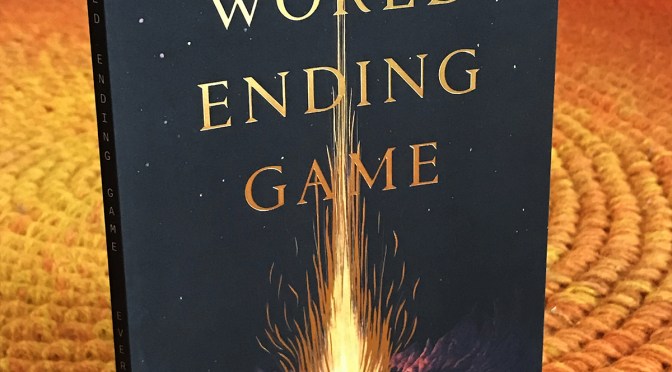
“Think about screenplays and films, or the final episode of a television show that you know will not be renewed. Think about saying goodbye to friends who are moving away. Think about the last day of summer vacation. Think about funerals. Think about the restaurant that closed all those years ago, and the noodles they used to serve. Think about the best birthday party you ever had. Think about putting off the last chapter of a book until tomorrow. Think about grief, and relief. Think about the end of a world. Think about the feeling of emerging from a movie theater into a dark parking lot, under the stars.” Longtime readers might recall I’ve written about saying goodbye to characters before, but that was largely in a ‘how to remember and treasure them’ way. The reasoning behind that article is, however, the same one that drew me to check out the subject of this one: the attachment to characters that we’ve created and a desire for closure as we leave them, and the snapshot of their lives that we played out, behind. This is a look at World Ending Game by Everest Pipkin.

Continue reading World Ending Game – Saying Goodbye With Style

System Hack: Using Playing Cards

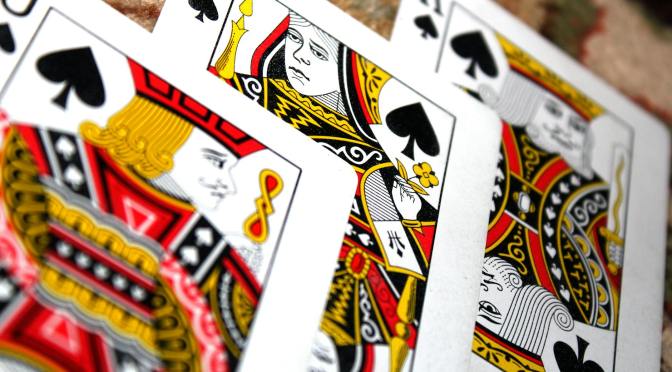
Welcome to another System Hack! Way back when I gave an intro to how to use dice and dice statistics in your game designs. This is in some ways a sequel to that article, but given the design assumptions of RPGs it also plays a very different tune. We use dice in RPGs because large swathes of our game mechanics are predicated on the probability of something happening. Success, failure, or something in between is determined by odds that reflect the internal consistency of the setting. This, like so many norms in gaming, comes from wargames and isn’t particularly necessary in many game designs. We have gotten through the checkpoint of ‘you don’t have to use dice’ but the result has been, merely, diceless games. What if we play differently, and steal a deck of cards from the poker set instead of stealing dice from Monopoly?

Continue reading System Hack: Using Playing Cards

System Hack: Cyberpunk RED Minions

Two of the roads with the most traffic to Cyberpunk RED are, naturally, players of Cyberpunk 2077 and players of older tabletop editions like Cyberpunk 2020. However, once arriving at their new carmine destination there are naturally going to be a few disconnects, and one of the biggest is in the nature of combat. The smart Cyberpunk 2020 party wanted to blast their opponents to chunky salsa as fast as possible and often could, and V eventually becomes a cybergod capable of mowing through entire gangs on their own. Cyberpunk RED characters are themselves tougher in turn than their 2020 counterparts, but they simply can’t go through their enemies that fast. Aaron pondered changes to the combat rules but found that, as with anything else, fiddling with the wiring that already exists can pose a lot of challenges. I’m not fiddling with the wires, so much as I’m adding an attachment (much like the Cyberpunk RED Luck Deck from that same article) – and I’m stealing from a galaxy far, far away to do it. 

Continue reading System Hack: Cyberpunk RED Minions

System Hack: Advancement for GURPS

As longtime readers of this site may be aware, I have a long history with GURPS. GURPS was the first game I GMed for what is still my primary gaming group, and I GMed GURPS for the majority of all games that I ran from 2006 until 2014. In the intervening decade I moved away from the system because my own interests changed; I began seeking out specific experiences and different approaches to game design. Some of my favorite games and game systems from the last decade, systems as diverse as Twilight:2000, Electric Bastionland, and Apocalypse World, all share the common property of being designed for a specific circumstance. In other words, all of these games could be considered the antithesis of GURPS at least as far as design goals are concerned.

That said, my affection for GURPS and generic game systems in general has never completely waned. Beyond that, when it comes to a more simulative approach to gaming, to times when you want to know how to make a very wide range of situations relevant, GURPS is still king. I cannot think of a better game for bringing verisimilitude and consistency to a very wide set of characters and circumstances. However, as much as I hold a lot of affection for GURPS, there are still some things I’d want to change if I were to return to the system. For this System Hack or two (or three?) I’m going to look at GURPS and look at things which haven’t gotten as much revision and research as the tech level system, or the frightening number of weapons, or the comprehensive and extremely math-heavy solar creation templates of GURPS Space. No, I’m going to be talking about things that have received a lot of attention since GURPS Fourth Edition was released in 2005. Spotlight management. Player-driven goals. And today, advancement.

Continue reading System Hack: Advancement for GURPS