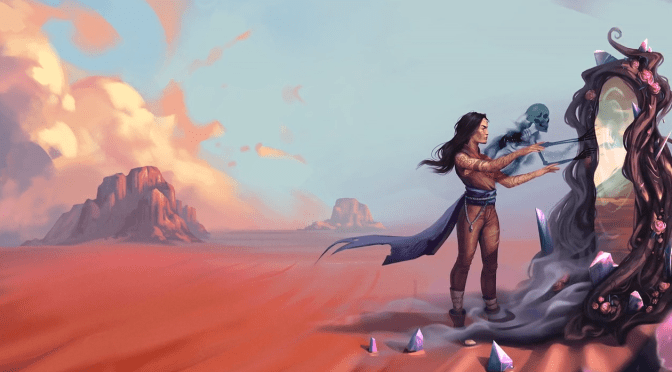
“Welcome to the Tenebris. You died and something went wrong. You were meant to ascend to heaven, walk the path of reincarnation, be food for worms—that did not happen. Instead, you took a solemn boat ride across darkened water with other lost souls. Desperately trying to retain memories from your former life, you realised you died and cannot go back. The light at the end of the watery tunnel revealed an endless desert, known by its inhabitants as the Tenebris—the dark.” You’ll have to fight against the death of hope, find your own memories and learn about your own past, and find your way to the true Beyond in Afterlife: Wandering Souls from Angry Hamster Publishing!
There’s a wide world of RPGs out there. In that world, Dungeons and Dragons represents a small sliver of the gameplay experiences and stories that are possible, but a disproportionately large slice of the games that are actually played. It’s from this juxtaposition that comes the frequent and often irksome question “how do I hack D&D to play [insert genre]?” However, when you mix D&D mechanics with a designer who has actually played other games and given thought to how the mechanics must change, you can get something rather good. Carbon 2185 has taken 5th Edition D&D mechanics, given them a solid restoration to work better in the Cyberpunk genre, and then added some bolt-on systems which take inspiration from the best of sci-fi roleplaying.
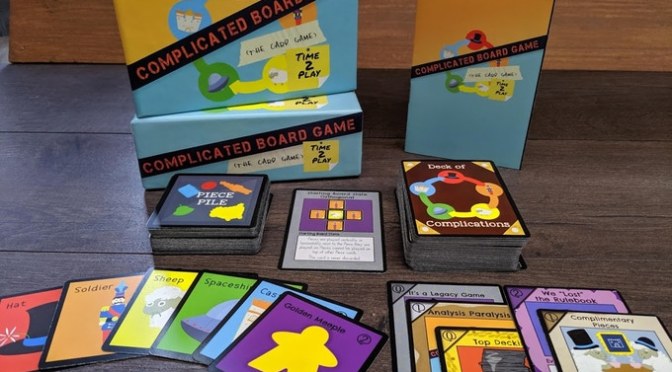
Let’s be honest, there are a lot of board games out there that might as well double their ‘estimated time of play’ because of how long they take to actually start playing. The rules are byzantine, the pieces are better counted by the score than by the dozen, arranging everything on the table is akin to cartography, and shuffling the cards can count as a cardio workout. It’s almost as if the set up portion is its own game . . . hey, wait a minute, there’s an idea. And what if it was actually a really simple card game that’s easy to learn and full of tongue-in-cheek humor about all the board games we love to play and hate to set up? That’s how we wind up with Complicated Board Game the Card Game: Time 2 Play!
Welcome to Kickstarter Wonk for November! What am I thankful for? Well, I’m thankful that not only was November a bumper crop of games on Kickstarter, but it was also one where there were a large number of really solid offerings. Whether you try and take over the moon or try and explore your Jewish identity, this month’s Kickstarters were for a huge number of really diverse games. Check out the descriptions below, and consider what sort of game either tickles your fancy or stretches your mind.
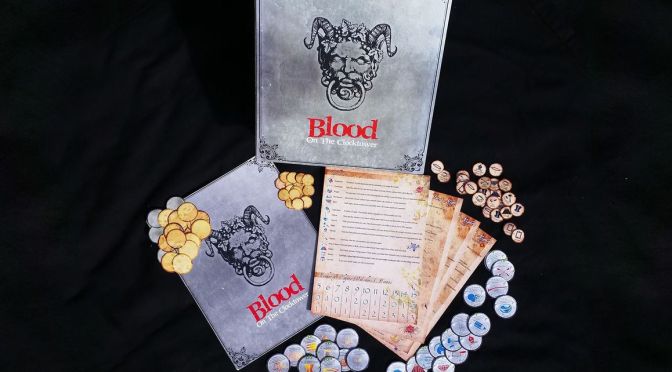
“In the quiet village of Ravenswood Bluff, a demon walks amongst you… During a hellish thunderstorm, on the stroke of midnight, there echoes a bone-chilling scream. The townsfolk rush to investigate and find the town storyteller murdered, their body impaled on the hands of the clocktower, blood dripping onto the cobblestones below. A Demon is on the loose, murdering by night and disguised in human form by day. Some have scraps of information. Others have abilities that fight the evil or protect the innocent. But the Demon and its evil minions are spreading lies to confuse and breed suspicion. Will the good townsfolk put the puzzle together in time to execute the true demon and save themselves? Or will evil overrun this once peaceful village?” In order to answer those questions, you’ll have to give the bluffing and deduction game known as Blood on the Clocktower a try!
As I’ve wandered into the Indie Frontiers this past year, I’ve heard tales of a fabled place where indie RPG designers gather from across the land: Big Bad Con. This yearly tabletop and LARP convention is hosted in Walnut Creek, CA, a short seven hour drive from my home in Los Angeles. I had never been to an RPG convention before, but this was too good an opportunity to miss. I left LA with a backpack full of dice and a mission—a mission to interview as many up-and-coming indie RPG designers as I could find.
Today’s interviewees: JR Goldberg, Viditya Voleti, Riley Rethal, Dee Pennyway, and Kurt Potts.
The RPG space is filled with unchecked assumptions regarding what gaming groups actually do. We already know that market information is hard to find, but it’s even harder to find information on how people consume whichever RPGs they choose to consume. Are they playing mostly in organized games hosted at game stores? With a group of friends at someone’s home? At cons? How often do they play? How many different systems do they try? We have, as one of my players once said, no hard data but a lot of assumptions and circumstantial evidence. The one element which is most significantly reflected in how games are actually designed is how long a discrete ‘game’ or ‘campaign’ is intended to be played.
“Your world will fall unless you risk it all. Are you ready to collaboratively design a world you must defend? Create powerful characters destined to fight the ever-present Darkness? Solve challenges, fight battles, and risk death and injury to save the realm? Heroic Dark is a build-your-own setting game about heroes defying the forces of darkness that threaten their world. The GM and players work together to tell a one-of-a-kind story about danger, sacrifice, and hopefully victory.” The odds are against you. The ending is uncertain. But if this opening pitch catches your eye, then you might find yourself one of those brave enough to fight the good fight in a setting of your own making with Heroic Dark!
Role-playing games are a delightfully analog hobby; the best parts of coming together with your friends to roll dice and tell stories cannot be duplicated by digital media. The way we play, though, has changed, with forums and voice chat programs and online dice rollers all giving us ways to use technology to enhance the RPG experience. When it comes to the actual reference materials, progress has been uneven. Online SRDs and paywalled content providers like D&D Beyond show we at least acknowledge that digital reference materials can look different, but the majority of game PDFs out there are just books, barely improved from the days when RPG PDFs were made with a scanner.
Æon. Poor, sweet Æon. Or is it Trinity? Depends on who you’re asking and if Viacom is listening. This RPG was meant to be White Wolf’s epic space opera, but fell short financially and was cancelled much to the dismay of it’s small, but loyal fanbase. However, the death of Æon had larger reprocussions. As the first chapter in what became a planned trilogy, its inability to generate sales spelled doom for the other two games in the Æon Continuum. I had written a piece awhile back about Aberrant, the second game in the series, which was White Wolf’s swing at the superhero genre. They introduced us to an engrossing, but nihilistic story of superhumans doomed to be their own destroyers. In the time since writing that article, Amazon released The Boys, which is basically Aberrant the TV show. I had a friend text me, quite serious, asking if White Wolf was planning to go to court over it. They didn’t. He didn’t know it was a comic and White Wolf didn’t invent the grim superhero shtick. They didn’t invent the epic space opera either, but with Æon they gave it an earnest shot.



 Cannibal Halfling Gaming