
Welcome to the Cannibal Halfling Weekend Update! Start your weekend with a chunk of RPG news from the past week. We have the week’s top sellers, industry news stories, and discussions from elsewhere online.
Continue reading Weekend Update: 5/27/2023Tag Archives: RPG

What are RPGs made of?
The roleplaying experience cannot be solely defined by which books you pick up at your hobby shop. More than essentially any other medium, RPGs are changed by the people who play them and what they attempt to do with the game when they play. It is both the medium’s greatest strength and its greatest source of annoyance when trying to both critique published RPGs and set standards of good play.
If there’s one thing the RPG community is better at than anything else it’s talking past each other, and in a way this is inevitable. Every game and everything about each of those games which makes them good, bad, memorable, or forgettable is dependent on the people sitting around the table (on the discord, in the LARP space) actually playing. Now, this human element doesn’t discount what the rules bring to the game, and the ability to enjoy yourself in spite of a game doesn’t make it good (likewise, having a game bounce off your group because of your particular preferences and predilections doesn’t make it bad). This does mean, though, that we need to know what we’re talking about.
RPGs are more complicated than other games because they present three separate surfaces of writing which, in other media, either aren’t separated or don’t exist at all. The RPG system is the scaffold, the underlying mechanics, rules, and math which define how games work. The game is the group of elements built around that scaffold, the setting, procedures, and options which tell the players what the game is actually about. Finally, the campaign is the game itself, either from the players’ heads or from a pre-written adventure or two (or three). These elements in total build up to the game a group will actually play, and all of them bring something different and important to the final product.
Continue reading What are RPGs made of?Weekend Update: 5/20/2023
Welcome to the Cannibal Halfling Weekend Update! Start your weekend with a chunk of RPG news from the past week. We have the week’s top sellers, industry news stories, and discussions from elsewhere online.
Continue reading Weekend Update: 5/20/2023
Postmodernism and RPGs
If you’re a millennial and deigned to even dip your toe into art or literary criticism, you ended up in a discussion about postmodernism at some point if only because of the time you grew up in. Modernism was a dominant bloc of philosophical and artistic thought in the western world from the 19th through the twentieth century, heavily informed by how society was changing at the time. While I’m not an especially well-read critic (I had the good fortune to study engineering in school, which is why I can blog for free), I do understand the broad tenets of modernism, which are rooted in scientific inquiry and the ability to discover truth, human capacity to create order, and an implied mission to improve all aspects of life and society through creation of something new. Modernism rejected earlier principles of realism, allowing for more innovations of form in visual art, music, and literature. And if you think I’m not about to tie this back to RPG theory communities and extensions of form like journaling and lyric games…well, you’re wrong.
Continue reading Postmodernism and RPGsWeekend Update: 5/13/2023
Welcome to the Cannibal Halfling Weekend Update! Start your weekend with a chunk of RPG news from the past week. We have the week’s top sellers, industry news stories, and discussions from elsewhere online.
Continue reading Weekend Update: 5/13/2023
The Trouble With Combat
Role-playing games have their origins from wargames. The through-line from Chainmail to Dungeons and Dragons is an undisputed point of historical record, and the through-line from Dragon Pass to RuneQuest pretty much the same. And as the eponym of wargame is war, it’s pretty clear that all wargames have concerned themselves with killing and dying all the way back to the invention of chess. The problem is that, derivative as they are, role-playing games are not wargames. Role-playing games need not merely concern themselves with killing and dying. After nearly fifty years of evolution, I’d argue that role-playing games shouldn’t only concern themselves with killing and dying.
To be fair, even back to the earliest editions of D&D there were more interesting things going on than just monsters to slay. By 1983 we had Call of Cthulhu, where few or none of the foes within the game were intended to be ‘taken on’ in a violent manner. White Wolf games prized intrigue and social dynamics over outright violence, though both clearly had a place. White Wolf games, though, especially Vampire:the Masquerade, revealed the distinct liability of designing a game, regardless of genre or intended primary activity, with a wargame-like combat system at its center.
Continue reading The Trouble With CombatWeekend Update: 5/6/2023
Welcome to the Cannibal Halfling Weekend Update! Start your weekend with a chunk of RPG news from the past week. We have the week’s top sellers, industry news stories, and discussions from elsewhere online.
Continue reading Weekend Update: 5/6/2023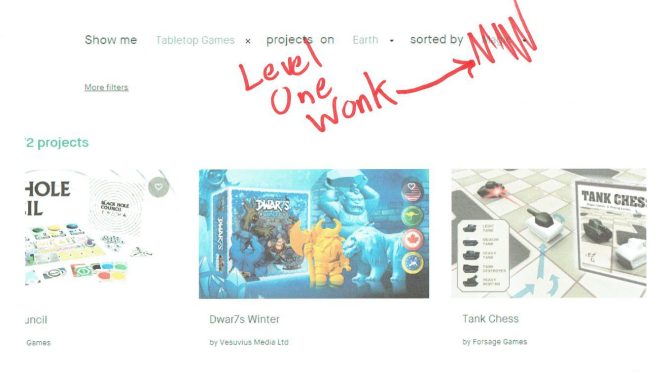
Crowdfunding Carnival: May, 2023
Welcome to Crowdfunding Carnival for May! Now, I admit, last month I was a bit low on energy, low on patience, and I forgot some things. For one, I forgot to write a five year retrospective for April. Now, there’s no use in crying over spilt free content, but I assure you that my energy is up and we’re back in the swing of things for May. In addition to this month’s five year retrospective, I have thirteen different games that I’ll run through in rapidfire fashion. We’re back to all Kickstarters for standalone games this month, but in between the copycat 5e pablum and a whole lot more NSFW miniatures (seriously, what is up with that), there were some diamonds in the rough.
Continue reading Crowdfunding Carnival: May, 2023Weekend Update: 4/29/2023
Welcome to the Cannibal Halfling Weekend Update! Start your weekend with a chunk of RPG news from the past week. We have the week’s top sellers, industry news stories, and discussions from elsewhere online.
Continue reading Weekend Update: 4/29/2023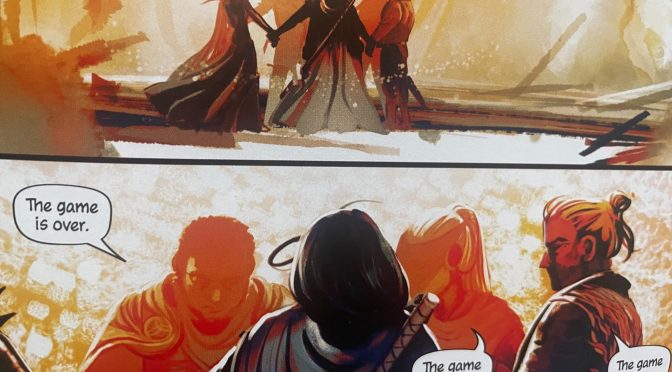
Cannibal Halfling Radio Episode 22 – Now Playing: DIE Pt 3
Four friends who drifted apart came back to play a game together for old times’ sake, only to find themselves becoming their characters. Jay the gamemaster has vanished, leaving Fitz, Evelyn, and Max wondering exactly what is going on. When they track Jay down will the game continue, or come to a final end? Find out as the Cannibal Halflings find one another in the Fields of the Lost in the conclusion to our actual play trilogy of Now Playing: DIE the RPG!
Continue reading Cannibal Halfling Radio Episode 22 – Now Playing: DIE Pt 3
 Cannibal Halfling Gaming