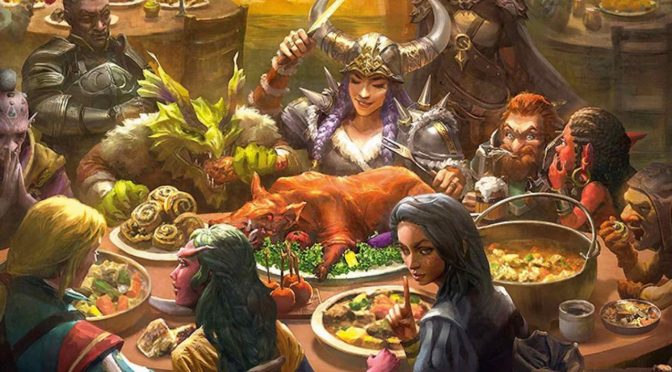
Between spending some time at the Flying Stag earlier in the week and recovering from the trials and tribulations of Thanksgiving, I’ve got food and drink on the mind with a side of tabletop worldbuilding. So your party of characters wander into the tavern and order… what? An ale? Your freighter crew has two weeks of… consumables? That’s it? We can do better than that; both people running games and playing them can get some extra detail out of their setting and characters by keeping one fact in mind: even most protagonists have to eat.
Category Archives: Editorial
Game Wizards Review
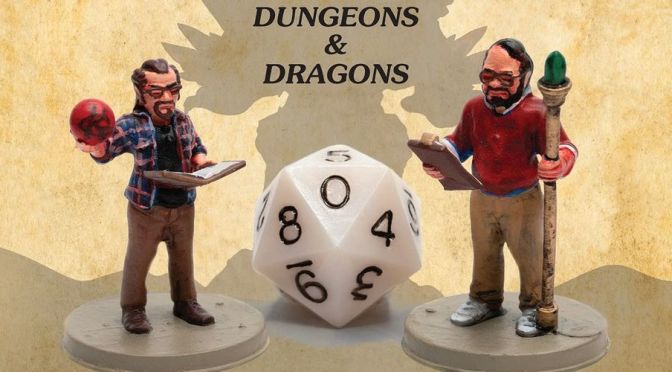
The story of role-playing games begins with the story of Dungeons and Dragons; the story of Dungeons and Dragons begins with Gary Gygax. And Dave Arneson. And, frankly, all of TSR. As our hobby evolves and our record keepers get older, we need to look back and make a good record of what got us to this point. With both Gary Gygax and Dave Arneson passed away, the invention of D&D is becoming just a story, in some people’s minds a footnote to Mentzer and Moldvay and Allston and Tweet and Mearls and Crawford that have come since. Well, Jon Peterson to the rescue.
Off the success of Playing at the World, a history of the role-playing game as a concept, and The Elusive Shift, an investigation of the role-playing game as its own standalone ‘thing’, we now have Game Wizards, arguably now the definitive text on the luminaries who invented D&D and how rabidly they fought over credit for that specific thing. Peterson is showing his breadth here, moving from broad-based historical synthesis (Playing at the World) to deep, particular investigation (The Elusive Shift) and now into that popular but difficult historical realm, disputed narrative. In some ways, this is a bit of a departure from Peterson’s earlier work, which was very much grounded in the how and why that made RPGs what they are. That said, Game Wizards as a book has convinced me that, as someone interested in RPG history, the story of Gygax and Arneson is one I need to know.
Continue reading Game Wizards Review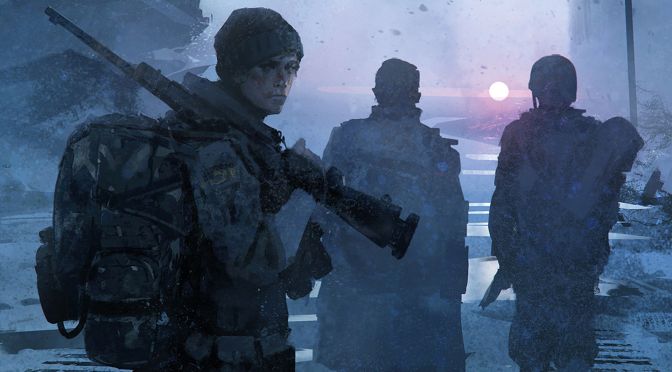
Twilight:2000 Review
The RPG hobby is driven by remakes and revisions. Fifth Edition this and Seventh Edition that, yes, but entire movements in the hobby are built around hacking and re-hacking D&D’s sub-sub-genre of play, fantasy dungeon crawling. With this perspective, RPGs fit in nicely alongside movie studios who remake Spiderman and Batman decadally, and media companies who continue to make live-action versions of critically acclaimed anime without asking how they’re actually improving things. In a young hobby like RPGs, though, there is still space for remakes to be good. So if you want to make a good remake, why not start with a game that practically screams ‘don’t update me’, the 1984 classic Twilight:2000?
Continue reading Twilight:2000 Review
The Game Master’s Book of Non-Player Characters Review
There are only so many ways you can spell – or pronounce – the name Bob before your players are going to realize that you’re just making up Dungeons and Dragons characters on the fly. There’s nothing wrong with making up NPCs as you go, of course, but it’s a lot of work! You have to name them, make them interesting, and then you actually have to remember to write down what you made up or next session you’ll have players asking why Ba’ab is named Dave now. Wouldn’t it be nice to have that work done for you, in such quantity that you don’t have to make anything from scratch for a good while? How about, say, 500 characters? Think that’ll be enough? That’s what you’ll find in the The Game Master’s Book of Non-Player Characters from Topix Media Lab!
Continue reading The Game Master’s Book of Non-Player Characters Review

Under Hollow Hills Review
How much changes in a decade? A couple years ago I went to my tenth college reunion. I was struck by how different things were; how my old fraternity was simply not familiar any more, and how my favorite late night food spots gave me significantly more indigestion. I couldn’t help but notice, also, how much was exactly the same. The city of Pittsburgh was still the same idiosyncratic mix of rust belt and academic, and the campus very much elicited all the memories I had from being in that place. Ten years seems like both enough time for something to change completely and yet not change at all. And so it is with Powered by the Apocalypse.
It hasn’t been exactly ten years since the start of Powered by the Apocalypse (PbtA), Apocalypse World was released in 2010. That said, as the game scooped up awards through 2010 and 2011, we could say that it’s roughly the 10th anniversary of PbtA as a phenomenon. By the end of the 2011 awards season the momentum had built, and Dungeon World, the game that arguably sent PbtA into the next tier of indie phenomena, came out in 2012. No matter your exact accounting, though, 2021 is the perfect time to reflect on a decade of PbtA because the Bakers have released a new PbtA game.
Continue reading Under Hollow Hills Review
Deviant: the Renegades Review
Role-playing games are like most media in that they tend to resonate with the largest audience when peddling a blend of novelty and comfort. That said, the hobby has a history of lashing out when too much novelty is introduced. Consider Fourth Edition D&D. Or Traveller:The New Era. Or Warhammer Fantasy Roleplay Third Edition. I could go on, but the point is fairly clear: Gamers like new things, as long as they aren’t actually that different from the old things they already have.
Say, what’s been going on in the World of Darkness recently?
Continue reading Deviant: the Renegades Review
Fallout: The Roleplaying Game Review
RPG licensing. RPG licensing never changes. In some ways it’s amazing that it took until 2021 to get an honest Fallout tabletop RPG, given the original game’s mechanical dalliance with GURPS and other design elements borrowed heavily from pen and paper games of the time. Nonetheless, it wasn’t until Fallout 4 that the series turned back to its roots and, with the help of Modiphius, got an official licensed port. Fallout the Role-Playing Game leans heavily on the most recent iteration of the video game series; both the mechanics and the setting borrow heavily and almost exclusively from Bethesda’s Fallout 4 for source material. Comparing this game to a Bethesda game ends up being quite apt, though; like most of the modern software titles released by this game’s licensor, Fallout the Role-Playing Game shows a lot of promise and appears at first glance to be ported well into its new mechanics…but in reality it’s hampered by a raft of grave unforced errors in editing and product management. So is it endearingly buggy, or is it hopeless? Let’s take a look.
Continue reading Fallout: The Roleplaying Game Review
Generic RPGs: What’s Out There
There’s a world of games out there, but they still just scratch the surface. Maybe your favorite book series or movie hasn’t caught the eye of anyone making RPG adaptations. Maybe you have your own spin on a popular genre that you just can’t pull off with an existing game. Or maybe you just want to run something wild and straight from your own head. No matter the reason, if a game off the shelf doesn’t quite do it for you, you’re looking for a generic RPG.
We’ve talked a bit about generic RPGs before, reviewing Cortex Prime and Everywhen, discussing Fate, and even using GURPS as an example text for looking at how to use generic games. This article is less about what to do with generic games, though, and more about how to find the right one for you. We’re going to discuss three broad types of generic games: Engines which are designed to model as many situations with as few rules as possible, Codexes which use a simple base ruleset and then expand it with a wide library of additional mechanics, and Chassis which take more traditional setting-driven RPGs, strip out the specific parts, and then (hopefully) build back up to something useful. The ‘Chassis’ generic RPG is the most common and popular, but the other two design modes may very well have more to offer the prospective game master.
Continue reading Generic RPGs: What’s Out There
Avatar Legends Quickstart Review
Water… Earth… Fire… Air. Long ago, Avatar: The Last Airbender told the story of a nascent master of all four elements and the group of young heroes that helped him save the world. Then everything changed when the Legend of Korra brought us the tale of his successor and her many trials and tribulations. But then, as these things go, that journey ended and that world vanished from the screen. Seven years passed, with the story continuing in novels and comics, but now we’ve discovered a new window into the Avatar world. Magpie Games is telling the story this time, and the prologue is the Quickstart for their newest roleplaying game: Avatar Legends!
Here’s A Health To The Company – Saying Goodbye To Campaigns And Characters
Peren walked off into the shadows, the Mark of Death on his back and Erandis d’Vol ahead of him. Alek Dacar d’Cannith walked into the Silver Flame and began to shape it into something that creates as often as it smites. Verdeloth took his place in what had once been Oalian’s grove, becoming the next Grand Druid of the Wardens of the Wood and literally putting down roots. Capax declined to return to Xen’drik and instead hit the open road, ready for whatever adventure was next . . . with his sweetheart at his side. It took eight years of real time, but the adventurers of the Stormhold Guild finally accomplished their goals, achieved their Prophecy-marked destinies, and went their separate ways.
Darn it all, I miss them.
Continue reading Here’s A Health To The Company – Saying Goodbye To Campaigns And Characters
 Cannibal Halfling Gaming