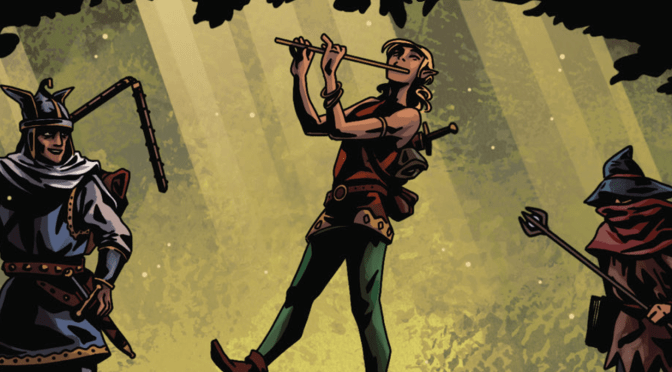
When Dungeon World was released in 2012, it slammed the door to Powered by the Apocalypse open so hard it broke the hinges. By taking the recipe crafted in the Baker House and mating it to the memetic power of Dungeons and Dragons, suddenly everyone could see what was so powerful about PbtA. Of course, Dungeon World was hardly a perfect recipe. Using the architecture of ‘moves’ established in PbtA but keeping both the stats and classes of D&D made for an incomplete match, and some of the mechanical choices made to get the two to pair up have received more significant criticism now that the design community has had a good decade and a half to really figure out what PbtA is. Still, the combination of a solid foundation and a lot of good ideas made Dungeon World into a rare specimen: The commercially successful fantasy heartbreaker.
Continue reading Is Grimwild the next Dungeon World?Category Archives: System Split
Same genre, same system, different games! How do they compare?

System Split: War Never Changes
The Fallout show on Amazon Prime is actually good, the latest video game property to successfully push back a decades-old curse that has sent similar adaptations plummeting to the bottom of box office rankings and critics’ opinions. And, like any good mass media property, the Fallout TV show has inspired interest in other formats. The contemporary video games were already big hits; with the newest one being six years old the tail effect has been relatively modest (both Fallout 4 and Fallout 76 did re-enter Steam’s top 10 most played games, but that impact has already abated). In the smaller TTRPG world the impact on the official licensed Fallout RPG has been a bit more pronounced, with both the game’s core rulebook and its most recent supplement staying in the DriveThruRPG top ten for weeks now. Much as happened for Cyberpunk Red in the wake of Cyberpunk 2077, Fallout is seeing a wave of renewed TTRPG interest.
Continue reading System Split: War Never Changes
System Split: Not Shadowrun
Shadowrun hit a home run back in 1989 with its fusion of cyberpunk and fantasy, adding classic D&D races and magic to a near future corporate dystopia. Since then it’s gathered a significant fan base and seen multiple video game adaptations dating all the way back to the Sega Genesis. One thing that was never a clean hit, though, was the rules. While the first two editions of Shadowrun had quirks that were on par with most 80s RPGs, the game got truly overwrought in its third edition and spent fourth and fifth trying to clean things up (without really succeeding). The sixth and current edition, Sixth World, attempted to peel back the rules bloat but did so while both alienating most existing Shadowrun fans and still failing to fix the editing.
Now, I like Shadowrun. I have a soft spot for cyberpunk as many readers already know, and have had some good fun in the campaigns I ran across its fourth and fifth editions. That said, from a mechanical perspective, Shadowrun isn’t a shining star. The attempts to layer multiple magic systems alongside perennial headaches like hacking and vehicle rules make the game tricky for the players and utter masochism for the GM, and as much as the sixth edition did introduce some needed streamlining it still ultimately suffers from the same problems.
Continue reading System Split: Not Shadowrun
System Split: Death in Space and Mothership
Most big science fiction properties today err on the side of science fantasy. Star Wars is basically swords and sorcery in space, and Star Trek’s post-scarcity antimatter economy is built to support its storylines, not the laws of physics. In the tabletop RPG world, though, there are a few options for somewhat harder space sci-fi, especially if your definition of hard sci-fi includes horrors man wasn’t meant to know as well as the strong possibility of explosive decompression or straight up getting sucked out an airlock.
Today we’re going to look at two gritty space horror games which, through relatively light rules and strong emphasis on random outcomes, are easy for players but very tough on characters. Death in Space is created by Christian Plogfors and Carl Niblaeus, members of the Stockholm Kartell alongside the creators of Mork Borg and CY_Borg. Mothership is created by Sean McCoy and distributed and developed by Tuesday Knight Games, who are in the process of bringing the new Mothership box set into distribution as of this writing. Both games are about freelancers trying to survive deep in space, and quite often failing to survive deep in space. Despite similar rules and character survivability, each game has a degree of nuance with how it approaches the gameplay loop.
Continue reading System Split: Death in Space and Mothership
System Split: Burning Wheel Hacks
Burning Wheel is past its twentieth birthday. The game, a famously complex child of the Forge, is one that everyone seems to either love or hate. I personally love it, but in this week’s System Split I’m extending a fig leaf to those on the other side (or at least those who tried to love it and bounced off).
Burning Wheel is a game predicated on its detail; thanks to its long lists of traits, skills, and lifepaths each one of its mechanics operates in a way that is predicated on its setting, itself a nerd-among-nerd’s joy of medieval history (via Desmond Seward and Barbara Tuchman) and Tolkien (via, well, Tolkien). You can’t really take much out of Burning Wheel and have it remain Burning Wheel…when the designers tried to take things out of Burning Wheel, they ended up with Torchbearer.
That all said, just because Burning Wheel is all layered into itself like an indie RPG biscuit doesn’t mean that there aren’t buttery nuggets we can take out. Those systems, like the mechanics around Beliefs, can certainly stand alone even if we usually see them in the context of something more. With that in mind, I turn to the subjects of today’s pondering. Hot Circle, a clear riff on Burning Wheel, is written by Casper Dudarec and aims to take the core mechanics of Burning Wheel down to a simple and portable core. But wait! The Gold Hack, more of a riff on the recent editions of Burning Wheel (i.e. Burning Wheel Gold), is written by Martin Van Houtte and…aims to take the core mechanics of Burning Wheel down to a simple and portable core. Huh.
Continue reading System Split: Burning Wheel Hacks
System Split: Campaign Managers
Roleplaying games are an information-heavy endeavor. Before the game, you need to sketch out your setting and initial conceit. During the game you need to track what your characters do and who they encounter. Between sessions you need to prep and see what’s changed. How do you keep all that straight? For years, the standard answer was a spiral-bound notebook, maybe a binder if your notes got particularly voluminous. And while that answer still works, it’s 2023. We can use a little technology.
Somewhere between a completely analog down-in-the-basement experience and a session run entirely on a virtual tabletop is the use case of the campaign manager. Campaign managers don’t aim to run your game or change your environment, but instead serve to provide structure for both your game notes and the setting material you present to your players. What makes campaign managers different from simple note-taking software is that ability to share and collaborate with your players, which helps extend your table into the setting as you’re envisioning and creating it. If it sounds good, it’s because I think it is good; I’ve used the campaign manager Obsidian Portal in the past and it’s very likely that I will start using one of the sites reviewed in this article in the near future. That said, a campaign manager is another tool in the GM’s already bursting toolbox, and reviewing the campaign managers out there fairly starts with a question of need.
Continue reading System Split: Campaign Managers
System Split: Apocalypse World and the Burned Over Hackbook
It’s tough being the first. Back in 2010, before Dungeons and Dragons Fifth Edition (and before Fourth Edition Essentials too), Vincent Baker released the first edition of Apocalypse World. While the praise was immediate, the snowball effect of the game had just started. By the time Baker released the second edition, now (and from this point forward) sharing the byline with his wife Meguey Baker, Powered by the Apocalypse had become a force in the indie game world. After another five years, the Baker family revisited Apocalypse World again, with Vincent and Meguey working with their children to produce Burned Over.
There are two things about Burned Over which caused me to overlook it initially. The first was a misunderstanding, though also a reflection of how many indie games are made these days. Burned Over is a hackbook, and having not heard this phrase before I confused it in intent with an ashcan. An ashcan is essentially the game equivalent of a minimum viable product or Early Access; it contains the rules to play and a first draft of the written game while being otherwise incomplete. Burned Over is not incomplete; though some of the initial rules were released on Vincent Baker’s Patreon (of which I am a subscriber, full disclosure) in ashcan form, the hackbook as it stands is complete, laid out, and 100% playable. What hackbook means is that Burned Over is a hack of Apocalypse World released as a book; Burned Over requires Apocalypse World to play though this belies the differences made somewhat.
The second element which caused me to overlook Burned Over at first came from the description of what it was. When the Baker family undertook Burned Over as a project, it was described as a version of Apocalypse World which toned down the sex and violence of the original. My initial reaction was that this would be a bowdlerized Apocalypse World, and I didn’t really like that. Needless to say I was wrong, but it meant that I didn’t actually read Burned Over until I had seen praise of it elsewhere. Burned Over strongly recenters many elements of Apocalypse World without changing the core mechanics of the game or its core gameplay loop; this recentering both revises and strengthens the rules as well as shifts the game’s relationship towards its own setting. While this is perhaps too informed by recent discourse, I think Burned Over shifts Apocalypse World from genre emulation of post-apocalyptic film and games to being a post-apocalyptic work in its own right with its own setting.
Continue reading System Split: Apocalypse World and the Burned Over Hackbook
System Split Redux: Legend of the Five Rings (AEG and FFG/EDGE)
A while ago I had a bit of a hot take off the press. At the time I had played the Beginners Box for Legend of the Five Rings 5th edition produced by Fantasy Flight Gaming and then, in purely coincidental timing, played in a campaign of 4th edition that had been written by AEG. Excited, and with childhood memories rekindled, I ran to write up the differences I have seen between the two. So, why do I mention it?
It’s been a few years since that article was written, and the world proceeded to break time with the years of 2020 and 2021. With a slew of personal life changes, and with a need for incredible caution for social gatherings, my choice in games became dictated by what I could find online. Over the last two years, I’ve had a healthy diet of games run in 4th edition and finally had the chance to build characters and play in a campaign using the full 5th edition rules. As I reflected, I began to wonder: had I done a disservice by rushing to put something out? Sometimes we become too excited at a new prospect, and become so eager to champion it that we don’t get the full picture. There is also another element in play now as well: time. Back when I did my first crack at a System Split, FFG were the new kids on the block, with their hands on a shiny new property and some interesting ideas on how to freshen things up. Now, not only have they released the full rules and published several expansion books for Legend of the Five Rings and reorganized. EDGE Studio has now taken over the IP, and while books continue to be published, and the system itself remains mostly intact, I feel like it’s worth circling back and taking a deeper, more nuanced dive into the differences between the two systems. Overall, with some time and space, I have come to believe that FFG created their version with a firm eye on past editions, but there are noticeable differences that might sway both gamerunners and players in one direction or the other.
Continue reading System Split Redux: Legend of the Five Rings (AEG and FFG/EDGE)
System Split: Worlds Without Number and D&D Fifth Edition
It’s never been a better time to be a dungeon crawler. Dungeons and Dragons Fifth Edition and Pathfinder, two versions of the same underlying D&D ruleset, are bestsellers 1 and 2 in the RPG world, and have been for some time. Pathfinder is built for detail and breadth of options, while D&D’s Fifth Edition is built for accessibility and continuity with earlier versions and settings. They offer two versions of a fairly modern D&D experience, where GMs run story arc-based campaigns built around fighting monsters and exploring dungeons. Characters are treated like protagonists, and death is relatively rare. At the same time, we’ve seen a resurgence in “old-school” playstyles, usually represented within the D&D ecosystem by the OSR. Old-school games tend to have fewer rules, presenting challenges and decisions to the players rather than the characters. They tend to have weaker characters who aren’t treated like protagonists, and they need not be organized around a story.
There is a middle ground, though, and a new entrant in the middle ground has stormed into the DriveThruRPG sales charts. Worlds Without Number presents a dangerous old-school world, but uses rules innovations from later versions of D&D (and other role-playing games) to make the game more accessible and make the characters feel a bit more heroic. On top of all that, it provides tons of tools to help GMs run interesting game worlds with or without a driving story. Although many people will simply call Worlds Without Number an OSR game (and there are fair reasons for that), I think that it deserves to be examined against the current state of the art. That’s why this System Split pits Worlds Without Number against Dungeons and Dragons Fifth Edition.
Continue reading System Split: Worlds Without Number and D&D Fifth EditionSystem Split: L5R AEG 4e and FFG
Memories are a powerful thing. They define much of who and what we are, and even when the edges become hazy some things, some impressions, remain crystal clear in our psyches. I can’t remember how long ago it was (though math tells me that we are pushing 20 years now), but I can remember who I was with and what we were doing (trying the dangerous addiction that is Magic: The Gathering) when I was first introduced to my Friendly Local Game Store. Looking back, it was dingy and in a sketchy part of the neighborhood, but I would wind up spending so much time there over the years that I can’t help but look back at it with fondness.
It was on one of those trips that I was saw something that caught my eye: a card game that I hadn’t seen before, but whose art reminded me of some of the new cartoons I was seeing at the time. I wound up buying a pack and trying out the game and, I had no idea what I had stumbled into. I played for a while, found some of the tie-in novels, and largely forgot about it as a part of my adolescence that I would likely never see again. Suddenly, in the last six months, Legend of the Five Rings (commonly referred to as L5R) came back into my life. I not only found that there a Tabletop RPG version of the franchise, I found myself playing in two different editions: the 4th edition, originally published by the original creators Alderac Entertainment Group, and the new version created by Fantasy Flight Gaming. I found myself marveling at how different they were, and yet, how strong of a fanbase I found for each. After having played a bit of both, it seemed worthwhile to look at some of the pivot points at which the game changes.
 Cannibal Halfling Gaming