Tag Archives: Review

Candela Obscura Quickstart Review

This review doesn’t really matter.

This review doesn’t matter because there are four types of people who will click on this review when they see it, and none of them are looking for more information in order to form an opinion. You will have critters who’ve already decided they love Candela Obscura and want to see if I do too, and then critters who’ve already decided they hate Candela Obscura, think switching rulesets was pointless…and want to see if I do too. On the indie/OSR side, you have those who can’t stand Critical Role, and want to see if I’m going to bag on it, ranting as long as I did when I reviewed Root. You also have those who are just thankful that the largest Actual Play in the game is using something other than D&D, and have already decided it’s better. Ultimately, I don’t think my conclusion is going to satisfy any of these camps.

It’s fine.

Now, given my own biases from both years of experience in RPGs as well as other media (not to mention writing to a specific audience for a living), I find it hard to believe that anyone was expecting a conclusion other than ‘it’s fine’ for the first ground-up new game from Darrington Press. Just like nobody should have expected Tal’Dorei to be a Planescape or Spelljammer or other setting that really pushes on the conventions of the D&D genre, nobody should really have expected that a new game from Critical Role Productions would do anything other than nestle neatly into the range of genres already popularized in roleplaying, specifically nestling in next to another bestseller, Call of Cthulhu.

I’m starting the review in this way because, ultimately, the specifics of Candela Obscura aren’t nearly as interesting as the reactions they’ve elicited. On Twitter, the first reactions I saw were mostly from indie designers who seemed primed to hate it. Apparently everyone became an IP lawyer since the OGL kerfluffle, because there were people outright claiming that the game had plagiarized Blades in the Dark and was violating the terms of the Creative Commons license (in case it isn’t clear, this is untrue). On Reddit, I read a lot of confusion about the system, though it’s hard to tell from comments if this is just from newness and lack of context, or if it is actually confusing in play. And, of course, the first big review expressed disappointment at how much of a retread the whole thing is.

Continue reading Candela Obscura Quickstart Review

Crowdfunding Carnival: May, 2023

Welcome to Crowdfunding Carnival for May! Now, I admit, last month I was a bit low on energy, low on patience, and I forgot some things. For one, I forgot to write a five year retrospective for April. Now, there’s no use in crying over spilt free content, but I assure you that my energy is up and we’re back in the swing of things for May. In addition to this month’s five year retrospective, I have thirteen different games that I’ll run through in rapidfire fashion. We’re back to all Kickstarters for standalone games this month, but in between the copycat 5e pablum and a whole lot more NSFW miniatures (seriously, what is up with that), there were some diamonds in the rough.

Continue reading Crowdfunding Carnival: May, 2023

The Unpublished Network at PAX East 2023

If you want to catch a tabletop game in one of its more interesting stages, it’s always a good idea to swing by the Unpublished Game Network.  The ‘Unpub’ Network  provides, well, networking for unpublished games that are still in development and at a convention gives them a place to put their game through its paces. It’s notable that the signage says ‘looking for playtesters’ instead of just ‘looking for players.’ While not quite as rich in traditional CHG content as its Unplugged sibling PAX East offers the advantage of being right in my own stomping grounds, and getting to attend its ’23 iteration for all four days meant I was able to swing by the Unpub tables multiple times.

Continue reading The Unpublished Network at PAX East 2023

Basic Roleplaying Review

Back in the 1970s, a new role-playing game built a foundation that would stand for years to come, a foundation of accessibility, hackability, and ease of use. Am I talking about D&D? Absolutely not! I’m talking about RuneQuest, a game which, in 1978, not only became a quick second place finisher to D&D in the fantasy genre but also established many RPG conventions we still see today. In 1980, the RuneQuest second edition box included a little 16-page booklet titled Basic Role-Playing, and from there it was off to the races. Basic Role-Playing (later Basic Roleplaying, also called BRP) would form the basis of every game released by RuneQuest’s publisher, Chaosium. As that esteemed publication history includes none other than Call of Cthulhu, BRP is likely the bestselling house system in the history of role-playing games.

Thanks to RuneQuest and Call of Cthulhu, BRP forms the cornerstone of how gamers expect d100 systems to work. In short, your attributes and skills give you percentile values which are equal to the probability of rolling under them on a d100 roll. Look at your sheet, you know how likely you are to succeed at a baseline roll. In addition to BRP itself, this mode of d100 mechanics saw widespread adoption in games as varied as Warhammer Fantasy Roleplay and Eclipse Phase. Now, Chaosium is staking the future of BRP on its utility as a platform. The new edition of Basic Roleplaying is here, and it’s being marketed to game designers as much if not more than game masters.

Continue reading Basic Roleplaying Review

System Split: Campaign Managers

Roleplaying games are an information-heavy endeavor. Before the game, you need to sketch out your setting and initial conceit. During the game you need to track what your characters do and who they encounter. Between sessions you need to prep and see what’s changed. How do you keep all that straight? For years, the standard answer was a spiral-bound notebook, maybe a binder if your notes got particularly voluminous. And while that answer still works, it’s 2023. We can use a little technology.

Somewhere between a completely analog down-in-the-basement experience and a session run entirely on a virtual tabletop is the use case of the campaign manager. Campaign managers don’t aim to run your game or change your environment, but instead serve to provide structure for both your game notes and the setting material you present to your players. What makes campaign managers different from simple note-taking software is that ability to share and collaborate with your players, which helps extend your table into the setting as you’re envisioning and creating it. If it sounds good, it’s because I think it is good; I’ve used the campaign manager Obsidian Portal in the past and it’s very likely that I will start using one of the sites reviewed in this article in the near future. That said, a campaign manager is another tool in the GM’s already bursting toolbox, and reviewing the campaign managers out there fairly starts with a question of need.

Continue reading System Split: Campaign Managers

Meet the Party: The Mecha Hack

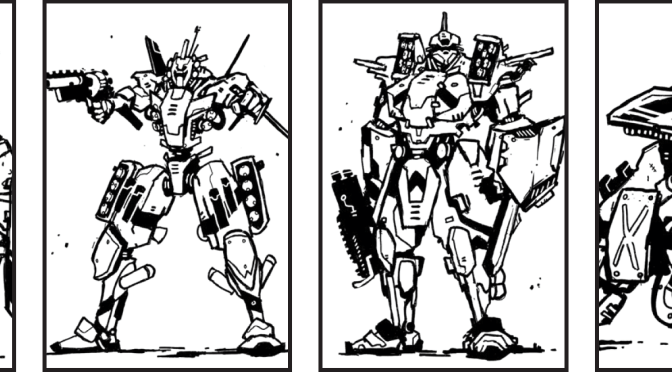
A mercenary band of mecha pilots stands prepared to fight another day in the Lodestar Alpha system, all for the credits its various factions are willing to provide for their services. Wing Crusader, Onyx Edge, Jester Epoch, Dagger Alpha, Iron Glory, and Chimera Sunset are the weapons of war that will see their pilots make their fortune and maybe decide the fate of the system altogether. All pilots, get in your giant robots and get ready to launch. Let’s do a quick little review of, and then Meet the Party for, The Mecha Hack from Absolute Tabletop!

Continue reading Meet the Party: The Mecha Hack

Cyberpunk RED: Black Chrome Review

We don’t review a lot of supplements here at Cannibal Halfling Gaming. From a pragmatic standpoint, there’s a lot less that a review can tell you about a supplement that will affect your purchasing decision than with a full game. For today’s subject, Black Chrome for Cyberpunk Red, that’s certainly true. We all knew Black Chrome would be the ‘stuff’ supplement, and even if there hadn’t been some grumbling about the ‘stuff’ or lack thereof in the core rules the ‘stuff’ supplement in a Cyberpunk game is almost always a must-buy, if only due to the association of the cyberpunk genre with gear porn. On the other hand, in some cases there’s a bit more to say about supplements. Cyberpunk Red is slowly working up to being a full-on RPG ecosystem just like Cyberpunk 2020 was; the earlier game had supplements from gear catalogs to corporate profiles to location gazetteers to big plot books like the Firestorm series. One consequence of this, perhaps an unintended one, is that Cyberpunk 2020 played quite differently when all the supplements were in play than when it was just the core book. While that’s neither unique to Cyberpunk nor particularly unexpected, it had a significant role in the reception of Cyberpunk Red, where the game in its early single book state was being judged against a Cyberpunk 2020 which already had literally dozens of supplements released. It stands to reason, then, that Black Chrome would be the first full-sized rules supplement for Cyberpunk Red. Black Chrome is an homage to the supplements which changed Cyberpunk 2020 the most and the fastest, the Chromebooks.

Continue reading Cyberpunk RED: Black Chrome Review

Zine Month 2023 Round Up #2

A ride or die Filipino adventure where the indigenous magic and monsters still dominate the archipelago. A seaside vacation meant to both help your health and help you find love, provided you can solve the murder. Living a version of your life affected by ADHD. It’s down to the wire, but there’s still time to check out another batch of Zine Month creations!

Continue reading Zine Month 2023 Round Up #2

Zine Month 2023 Round Up #1

A map for every adventure and an adventure for every map. The horror of magical academia. Making sacrifices to a river spirit. Last of Us a la Twin Peaks. Tracking down an entity that consumes time itself.  Another February, another month of roleplaying game zines, and I’m back for more Zine Month spotlights! 

Continue reading Zine Month 2023 Round Up #1

Rolemaster Unified Review

The OSR is a movement of nostalgia. Rather than seeking to actually emulate the way RPGs were played in the 1970s and 80s, the OSR is seeking to bottle the lightning of the first time you found a Player’s Handbook or Basic Set and just played, actual rules be damned. While the OSR as a movement is certainly informed by the cultural phenomenon of having the D&D red box show up in toy stores and in the hands of many kids and teens in the 1980s, the roleplaying hobby itself was already significantly more diverse than any one movement could capture. As an example, around the time that the OSR casts its rose-tinted glasses toward, there was a successful and long-lived game called Rolemaster.

Continue reading Rolemaster Unified Review