Tag Archives: Review

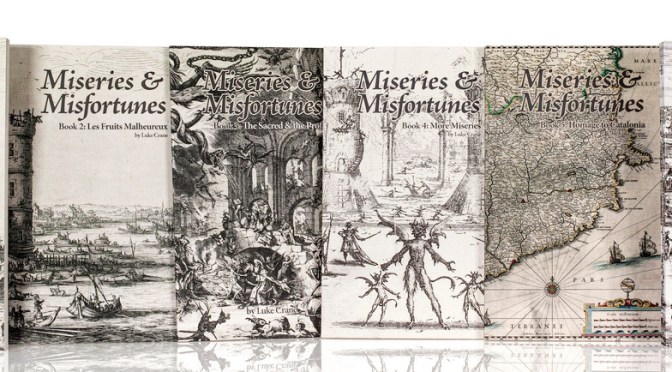
Miseries and Misfortunes: When D&D stands for Dauphins and Defamation

Luke Crane is best known as the designer of The Burning Wheel, an intensely detailed medieval fantasy/Tolkien RPG which aims for a very different fantasy experience than what you find in Dungeons and Dragons and its contemporaries. The Burning Wheel has more and more complex rules than D&D, but it’s also a game with a strong sense of time and place; Crane’s inspiration for the fantasy side of the game was Tolkien outright (which is not the case with D&D), and the rest of the setting was inspired by history nonfiction by the likes of Barbara Tuchman, Desmond Seward, and others. The result is a game heavily steeped in 12th-13th century medievalism, but with the historicity sanded off with some genericization and, oh right, wizards and elves and giant talking rats.

The next biggest non-licensed game from BWHQ (both Mouse Guard and Burning Empires are licensed) is Torchbearer, which is more than anything a direct shot at D&D. While it uses somewhat similar mechanics to Burning Wheel, it is much more focused on dungeon crawling, taking some of the more structured procedures of 0e and Basic D&D and extending them to everything, including not only the dungeons and wilderness exploration but also town visits and social interactions. Torchbearer is a distinct game from Burning Wheel, and while Burning Wheel is known for its complexity Torchbearer is known for being fiendishly difficult due to its constant Grind and aggressive resource management.

Luke Crane designed another game, more similar to Burning Wheel than the others in BWHQ’s portfolio. What’s truly strange about this game, though, is that it is a hack of Basic D&D. That in itself isn’t that weird, plenty of designers hack D&D for many purposes good and ill. What is weird, though, is that this hack of Basic D&D looks at the trajectory that Torchbearer plots from Burning Wheel and runs straight and fast in the opposite direction, aiming for more intrigue, more historical accuracy, and not a single dungeon to bother with. This game is called Miseries and Misfortunes.

Continue reading Miseries and Misfortunes: When D&D stands for Dauphins and Defamation

The Ultimate RPG Tarot Deck Review

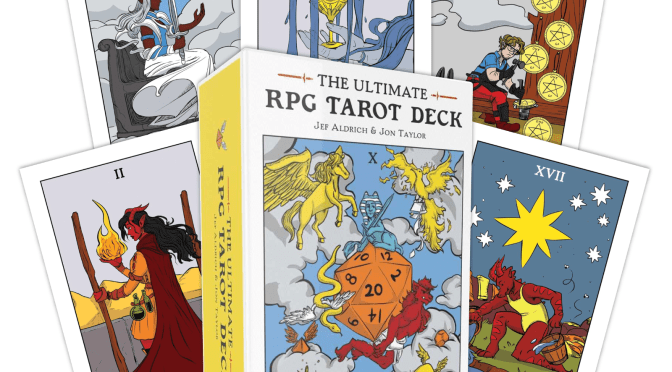
The cards, the cards, the cards can tell, the past, the present, and the future as well… provided you can actually read them. Tarot decks are seeing increasing use in tabletop roleplaying game design, from pure oracles like in Tangled Blessings to full-on challenge resolution like in To Change. In many cases the games provide pretty good prompts and details for what a given card means, but I’ve often seen them limited to just the major arcana, or suggest the players can be inspired by the card’s art to help interpret things. For those unfamiliar with tarot (it’s me, I’m talking about myself), that can be a bit of a challenge. Enter the Ultimate RPG Tarot Deck from Jon Taylor and Jef Aldrich!

Continue reading The Ultimate RPG Tarot Deck Review

Ringmaster Review: A Circus Troupe Descended from the Queen

Royal clowns? Well, not quite. For The Queen has taken quite the journey since Jason first looked at it. It got itself a second edition, and moved from Evil Hat Productions to Darrington Press, true. From near the start, though, it offered an SRD and the Descended from the Queen moniker to allow others to use the mechanical framework, and as it turns out there a lot of games under that tent now. This time we’re dealing with a dark and supernatural version of the greatest show on earth, with Ringmaster from Pascal Godbout/Spotless Dice Games!

Continue reading Ringmaster Review: A Circus Troupe Descended from the Queen

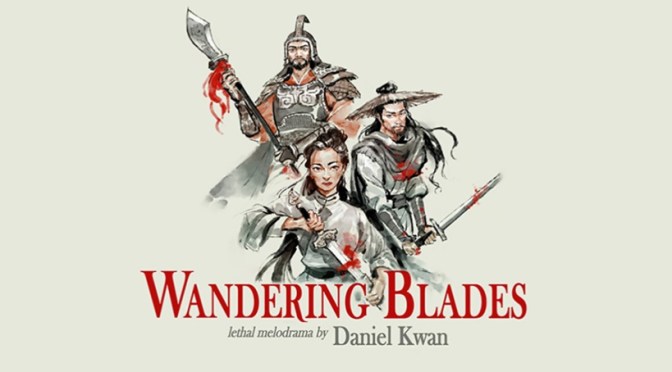
Wandering Blades Review: Old School Tech, Wuxia Style

Highly skilled martial artists roam the lands seeking to redress wrongs, help the downtrodden, and free the innocent from oppression. Heroism, action, melodrama! These are the hallmarks of the wuxia genre, and when they show up in the tabletop sphere they tend to come with a pretty big set of rules and no small amount of actual magic. In this case, though, we have a game trying to use old school renaissance-style mechanics to enable wuxia genre conventions:  Wandering Blades!

Continue reading Wandering Blades Review: Old School Tech, Wuxia Style

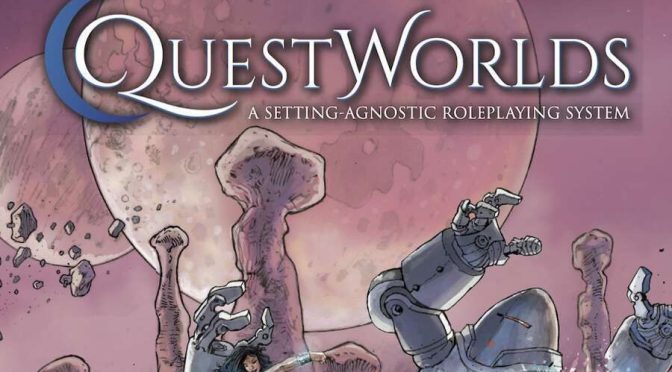
QuestWorlds: Who wants a generic game?

Generic RPGs are designed to accomplish a goal that many say they want. The ability to write anything, make any genre fit together, and theoretically never have to learn another system again all sound great. The reality usually ends up being something different, though. The entire reasoning behind generic RPGs even being possible has forever been couched in very narrow assumptions about what an RPG actually is. Once you expand those assumptions a little bit, a generic game starts to look impossible.

QuestWorlds, originally called Hero Wars (and HeroQuest in between those two), is a game that came out of a post-TSR, pre-Forge era of the early 2000s much like the first edition of Fate. Both of these games have the same essential objective: build out a set of mechanics that can take any character on one side, any challenge on the other, and adjudicate that character standing up to that challenge regardless of the specifics. Add in some balancing rules for character creation and advancement, and you’ve got a game that’s ready for anything. Kind of. Both QuestWorlds and Fate make very similar disclaimers about only working with genres with capable and proactive heroes prevailing over larger-than-life challenges. The disempowerment of horror doesn’t really work, nor do the continuous drags of hunger, thirst, or wound management found in survival games. These generic games, and many generic games, quickly reveal themselves to be “roughly the way we think people play RPGs” games.

Continue reading QuestWorlds: Who wants a generic game?

A PAX East 2025 Tabletop Round-Up

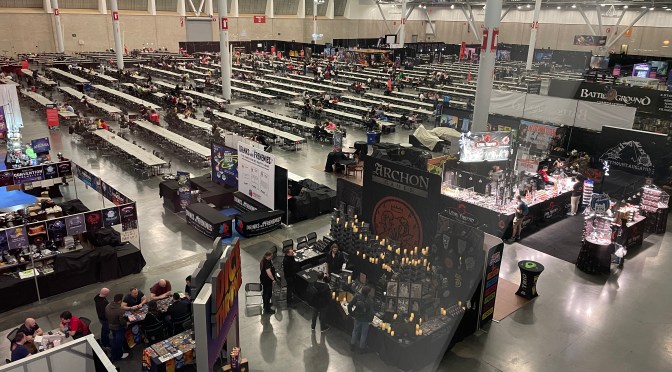
Just because PAX East isn’t a 100% tabletop-dedicated convention doesn’t mean I’m going to stop treating it like one. Well, mostly. I did check out some “video” games while at the con, but that will be more of a CHG aperitif. Let’s get to the main course first so that I can share the games that caught my eye this past weekend with you: dead gods, burning forests, nighttime escapes and knives in the back, things upon things, and glittering glass!

Continue reading A PAX East 2025 Tabletop Round-Up

A Glimpse Into the Vault: You, by Austin Grossman

Game design stories are often told in a way that portrays the designer as a visionary, seeing something that nobody else does as they quest for their ultimate game. This often loses the reality of the medium, that design takes a lot more work than ideas and that work can often get very messy. The novel You by Austin Grossman is technically about video game design, and one of its strengths is portraying the video game industry (specifically the PC gaming industry) at a time when it was about to transform and transform the world along with it. You takes place in 1997 or thereabouts right outside of Boston, in a part of Cambridge that’s really only known to locals (incidentally, I interviewed for a job in the building that I’m 95% sure is the office in the book). The story is about Black Arts Games, a fictional publishing company whose next game will either make or break them. What the story is really about, though, is a single-minded and overzealous designer and worldbuilder who created the holy grail of role-playing games, digital or otherwise.

Continue reading A Glimpse Into the Vault: You, by Austin Grossman

Pocketopia 2025 – A Brief Closing Glimpse

This month’s Crowdfunding Carnival has itself an interesting sideshow, hosted by Backerkit itself! Pocketopia 2025 isn’t exactly Backerkit’s answer to Kickstarter’s ZineQuest, since zines aren’t the focus, but it’s definitely in the same genre. The stated goal is to be “a celebration of portable easy-to-learn tabletop games”. So, as it comes to an end less than a day from now, how has it gone?

Continue reading Pocketopia 2025 – A Brief Closing Glimpse

Do games need a reason to exist?

Last week I puzzled over my “review” of Lovecraftesque. The game is certainly well done, and it is an improvement over earlier games like Fiasco in terms of how it is structured and how it uses board game elements like a game board and cards and tokens. It’s also a Mythos game that uses themes and structure from Lovecraft’s work instead of literal elements of the Mythos, and so I was fairly critical in how it didn’t go deeper to some of the underlying themes below the surface-level stories of horrors from beyond comprehension. But the question in the back of my head while I was writing was “So what? The designers don’t owe me a deeper game.” This is true. And I’ve been thinking about it.

Continue reading Do games need a reason to exist?

Lovecraftesque: Shadows Over Story Games

As I’ve been consuming more cosmic horror, I find that my relationship with games set in Lovecraft’s Cthulhu Mythos mirrors my relationship with licensed games. I think there is so much room for them to be great, and then I’m inevitably disappointed nearly every time I read one. In the case of licensed games, this is often because they’re pretty bad; the relationship between licensed games and money is inextricable, and the best licensed games borne out of love and fandom are often from a time in the hobby’s history that’s long gone. In the case of H.P. Lovecraft, it’s a bit more complicated. Lovecraft is a divisive figure, both having essentially invented cosmic horror and changed science fiction forever while also being a known racist, even beyond the conventions of his time. The biggest problem I have with the Cthulhu Mythos in pop culture is twofold: First, the xenophobic roots of Lovecraft’s works are rarely examined or critiqued in games, an omission made even more galling by designers’ desires to hew to a 1920s setting for their games without asking more serious questions about it. Second, the continued sanitization of Lovecraft creations in pop culture (the ‘Cthulhu plushie’ phenomenon) makes it that much more difficult to have conversations about xenophobia, cosmicism, and even New England folklore and dissect how these factors all influenced Lovecraft and his work.

Continue reading Lovecraftesque: Shadows Over Story Games