Tag Archives: Review

It shouldn’t have been called Single Player Mode

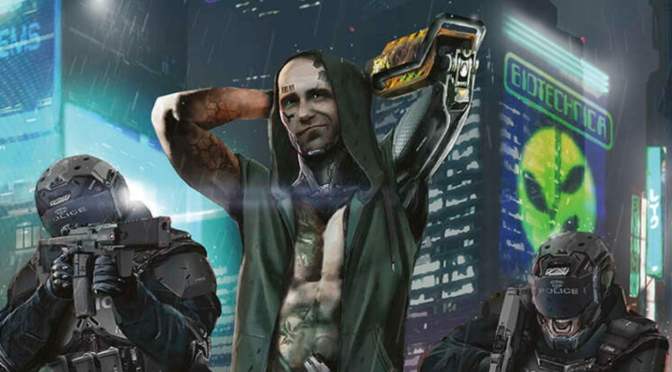
Cyberpunk Red has been going strong for around five years now. The game came out around the same time as the tie-in video game Cyberpunk 2077, and represented a return to form after 2005’s Cyberpunk v3 (and 2020 being over 30 years old). Now, R. Talsorian Games has kept the party going with continual Cyberpunk support both free (in the form of Monthly DLC) and for pay (in the form of the Interface Red collections as well as standalone supplements like Black Chrome). Single-Player Mode is the most recent standalone supplement, and your take on it will depend entirely on what you think a solo RPG is (or should be).

If you’re older than a certain age, when you think solo RPG you think something like Mythic GM Emulator, a set of rules that can act as a GM and let you play through modules or combats on your own. If you’re younger than a certain age (let’s say younger than me at least), your first thought of a solo RPG is probably more like a journaling game, or a hybrid narrative game like The Wretched. It’s important to state this because despite its 2025 release date Cyberpunk Red Single Player Mode is firmly the first of those two. There are no campaign framing tools, no narrative generation, and no character supplements. Cyberpunk Red Single Player Mode is built firmly on using an ‘oracle’ to answer questions which allow you to progress forward through your imagined narrative, and also provides tools to let you play out investigations, social interactions, combats, and netruns all on your lonesome. What it’s truly best at, though, is having a library of random tables which enable you to set up all sorts of premises, missions, and random encounters to make your Cyberpunk solo game more interesting. You may realize as I say this that random tables aren’t just for solo gaming. Not only is that true, it means that while I think Single Player Mode makes for an excellent GM aid and has some good rules additions…it just doesn’t work as an effective solo game.

Continue reading It shouldn’t have been called Single Player Mode

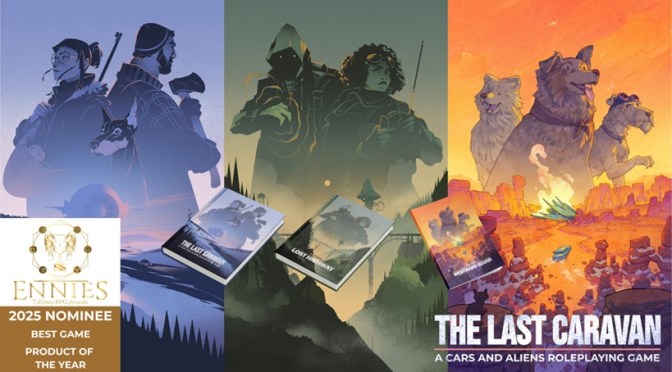
The Last Caravan – Con-Apocalyptic Road Trip

They came less than a year ago. The war was swift – and brutal.

Humans and aliens bombed each other to smithereens, and now both sides are licking their wounds. Mysterious new factions rise to join the struggle of the fallen titans. In this landscape of shifting allegiances, we may have to choose sides. Debris from the explosion of the aliens’ mothership has clouded the atmosphere, lowering the temperature and creating the coldest winter in a thousand years.
We find ourselves in a melancholy, wintry landscape — quiet, until it’s not. Egg-shaped alien structures thirty stories tall now squat, humming, over the cities they crushed. Xenofauna and lost invaders stalk the woods and highways. A war is brewing in the aching silence.

We are navigating the waking remnants of human and alien empires — and all we’ve got is a car, our fellow travelers, and the road.

It’s time to head west with The Last Caravan.

Continue reading The Last Caravan – Con-Apocalyptic Road Trip

Coriolis: The Great Dark Review

One small step for the Year Zero Engine, one giant leap for Coriolis…

Free League has been shepherding the Coriolis series for nearly a decade now. Originally published by Jarnringen, the original designers of Symbaroum, Coriolis was released in 2008 to much acclaim in Sweden. Free League first got on board creating additional material for the game, but ended up the stewards of the series, releasing their first version in 2016. Now, we get the newest edition, a ‘standalone sequel’ set 200 years after the events of Coriolis: The Third Horizon.

Coriolis won accolades for being a solidly original sci-fi setting, and The Great Dark carries on that legacy by managing to be different even from the version of the game that came before it. At the same time, Free League didn’t mess with the formula of the YZE mechanics too much; we’re staying closer to home with the version of the mechanics established in Mutant: Year Zero and Forbidden Lands than many other recent YZE games have. While I don’t think that The Great Dark is going to win over all existing Coriolis fans, I do think that its combination of strong premise and continued originality is going to help it make a case for itself, either on its own or sitting on the shelf next to all of your Third Horizon books.

Continue reading Coriolis: The Great Dark Review

HOME Review – Mechs, Monsters, and Mapmaking

“One year ago the Rift opened and the Kaiju attacked. It tore our cities apart, rampaging for days until we finally dropped the bomb. We killed the beast but lost so much in the process. We knew this was only the beginning so we built the Mechs: giant war machines, the pinnacle of human engineering, and our only hope for survival. The Rift is reponing. More Kaiju are coming, but this time will be different. Your Home depends on you. Are you ready, Pilot?”

This is HOME, the Mech x Kaiju Mapmaking RPG for 1-4 players from Deep Dark Games!

Continue reading HOME Review – Mechs, Monsters, and Mapmaking

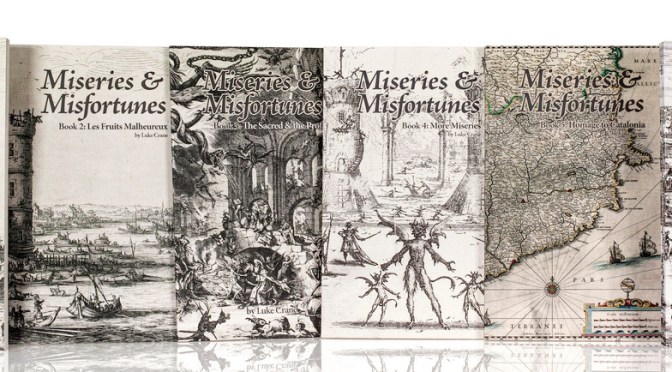
Miseries and Misfortunes: When D&D stands for Dauphins and Defamation

Luke Crane is best known as the designer of The Burning Wheel, an intensely detailed medieval fantasy/Tolkien RPG which aims for a very different fantasy experience than what you find in Dungeons and Dragons and its contemporaries. The Burning Wheel has more and more complex rules than D&D, but it’s also a game with a strong sense of time and place; Crane’s inspiration for the fantasy side of the game was Tolkien outright (which is not the case with D&D), and the rest of the setting was inspired by history nonfiction by the likes of Barbara Tuchman, Desmond Seward, and others. The result is a game heavily steeped in 12th-13th century medievalism, but with the historicity sanded off with some genericization and, oh right, wizards and elves and giant talking rats.

The next biggest non-licensed game from BWHQ (both Mouse Guard and Burning Empires are licensed) is Torchbearer, which is more than anything a direct shot at D&D. While it uses somewhat similar mechanics to Burning Wheel, it is much more focused on dungeon crawling, taking some of the more structured procedures of 0e and Basic D&D and extending them to everything, including not only the dungeons and wilderness exploration but also town visits and social interactions. Torchbearer is a distinct game from Burning Wheel, and while Burning Wheel is known for its complexity Torchbearer is known for being fiendishly difficult due to its constant Grind and aggressive resource management.

Luke Crane designed another game, more similar to Burning Wheel than the others in BWHQ’s portfolio. What’s truly strange about this game, though, is that it is a hack of Basic D&D. That in itself isn’t that weird, plenty of designers hack D&D for many purposes good and ill. What is weird, though, is that this hack of Basic D&D looks at the trajectory that Torchbearer plots from Burning Wheel and runs straight and fast in the opposite direction, aiming for more intrigue, more historical accuracy, and not a single dungeon to bother with. This game is called Miseries and Misfortunes.

Continue reading Miseries and Misfortunes: When D&D stands for Dauphins and Defamation

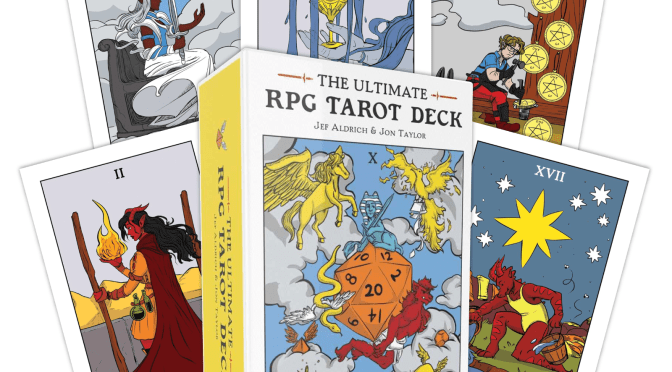
The Ultimate RPG Tarot Deck Review

The cards, the cards, the cards can tell, the past, the present, and the future as well… provided you can actually read them. Tarot decks are seeing increasing use in tabletop roleplaying game design, from pure oracles like in Tangled Blessings to full-on challenge resolution like in To Change. In many cases the games provide pretty good prompts and details for what a given card means, but I’ve often seen them limited to just the major arcana, or suggest the players can be inspired by the card’s art to help interpret things. For those unfamiliar with tarot (it’s me, I’m talking about myself), that can be a bit of a challenge. Enter the Ultimate RPG Tarot Deck from Jon Taylor and Jef Aldrich!

Continue reading The Ultimate RPG Tarot Deck Review

Ringmaster Review: A Circus Troupe Descended from the Queen

Royal clowns? Well, not quite. For The Queen has taken quite the journey since Jason first looked at it. It got itself a second edition, and moved from Evil Hat Productions to Darrington Press, true. From near the start, though, it offered an SRD and the Descended from the Queen moniker to allow others to use the mechanical framework, and as it turns out there a lot of games under that tent now. This time we’re dealing with a dark and supernatural version of the greatest show on earth, with Ringmaster from Pascal Godbout/Spotless Dice Games!

Continue reading Ringmaster Review: A Circus Troupe Descended from the Queen

Wandering Blades Review: Old School Tech, Wuxia Style

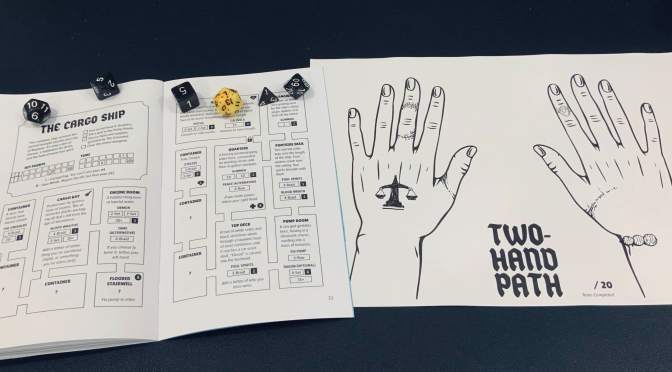
Highly skilled martial artists roam the lands seeking to redress wrongs, help the downtrodden, and free the innocent from oppression. Heroism, action, melodrama! These are the hallmarks of the wuxia genre, and when they show up in the tabletop sphere they tend to come with a pretty big set of rules and no small amount of actual magic. In this case, though, we have a game trying to use old school renaissance-style mechanics to enable wuxia genre conventions:  Wandering Blades!

Continue reading Wandering Blades Review: Old School Tech, Wuxia Style

QuestWorlds: Who wants a generic game?

Generic RPGs are designed to accomplish a goal that many say they want. The ability to write anything, make any genre fit together, and theoretically never have to learn another system again all sound great. The reality usually ends up being something different, though. The entire reasoning behind generic RPGs even being possible has forever been couched in very narrow assumptions about what an RPG actually is. Once you expand those assumptions a little bit, a generic game starts to look impossible.

QuestWorlds, originally called Hero Wars (and HeroQuest in between those two), is a game that came out of a post-TSR, pre-Forge era of the early 2000s much like the first edition of Fate. Both of these games have the same essential objective: build out a set of mechanics that can take any character on one side, any challenge on the other, and adjudicate that character standing up to that challenge regardless of the specifics. Add in some balancing rules for character creation and advancement, and you’ve got a game that’s ready for anything. Kind of. Both QuestWorlds and Fate make very similar disclaimers about only working with genres with capable and proactive heroes prevailing over larger-than-life challenges. The disempowerment of horror doesn’t really work, nor do the continuous drags of hunger, thirst, or wound management found in survival games. These generic games, and many generic games, quickly reveal themselves to be “roughly the way we think people play RPGs” games.

Continue reading QuestWorlds: Who wants a generic game?