Tag Archives: Review

World Ending Game – Saying Goodbye With Style

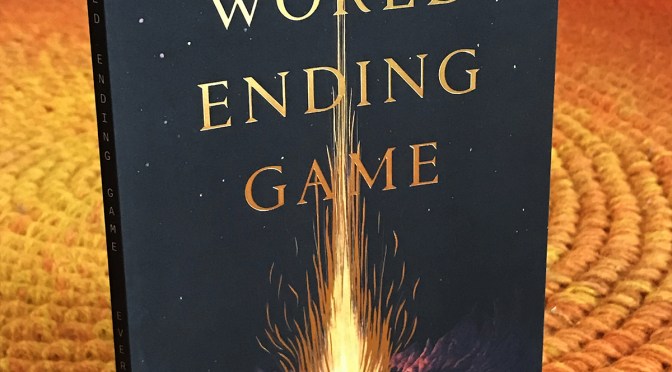
“Think about screenplays and films, or the final episode of a television show that you know will not be renewed. Think about saying goodbye to friends who are moving away. Think about the last day of summer vacation. Think about funerals. Think about the restaurant that closed all those years ago, and the noodles they used to serve. Think about the best birthday party you ever had. Think about putting off the last chapter of a book until tomorrow. Think about grief, and relief. Think about the end of a world. Think about the feeling of emerging from a movie theater into a dark parking lot, under the stars.” Longtime readers might recall I’ve written about saying goodbye to characters before, but that was largely in a ‘how to remember and treasure them’ way. The reasoning behind that article is, however, the same one that drew me to check out the subject of this one: the attachment to characters that we’ve created and a desire for closure as we leave them, and the snapshot of their lives that we played out, behind. This is a look at World Ending Game by Everest Pipkin.

Continue reading World Ending Game – Saying Goodbye With Style
Spooktacular Adventure Writing: Part 1

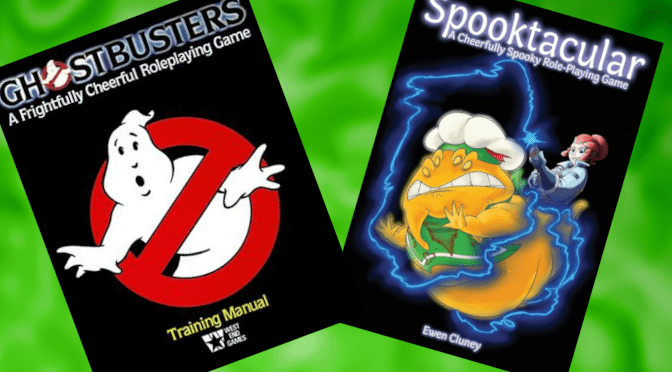
This is a vague sequel to the Maid RPG post published here recently. Spooktacular is a retroclone of the 80s Ghostbusters role-playing game written by Ewen Cluney, who not only translated Maid RPG but also wrote an original game, Kagegami High, that mixes Maid RPG‘s mechanics with the ones found in Ghostbusters.

I decided to write an original adventure for when I would eventually run Spooktacular for my players. This was a problem for me, because I live by the Mythbusters credo; if it’s worth doing, it’s worth overdoing.

Continue reading Spooktacular Adventure Writing: Part 1

Black Sword Hack and the evolving OSR

The Old School Renaissance is a microcosm within the RPG world. Although many (including myself) refer to the OSR as a whole, cohesive thing, the reality is that the movement is more the result of at least half a dozen origins that random-walked into game preferences which, to an outsider, look similar. The broad preference towards the genre establishment of Dungeons and Dragons (or at least Appendix N, if not the system itself) bounds the definitions we work with; other retroclones and revivals like Cepheus and RuneQuest aren’t included, even if they too are ‘old school’. No, the main thing that all vectors of the OSR have in common is that they are trying to recreate the time when the roleplaying game was new. And when RPGs were new, either literally or in the eyes of the designer, the new thing that they first touched was (almost always) D&D.

All OSR games are aiming for either D&D as it was, D&D as it could be, or D&D as it was supposed to be. D&D as it was is simple; Old School Essentials is a straight-up retroclone and proves that ‘Basic D&D without shitty layout and shitty editing’ is a winning recipe. It’s the best known and best selling retroclone, but the retroclone camp of the OSR is arguably the oldest (to the degree that OSR is a label we can trace it back to OSRIC). D&D as it could be is where we start getting a lot of the distillations; the rules in early editions were such a mess you barely used any of them, so clearly one could write a game only using those few rules we could actually make work. This is where Into the Odd comes in, this is arguably where The Black Hack comes in, and, if rules were in any way supposed to be primary in the game, this might be where Mork Borg would come in. This example shows setting and tone are a different topic here than ‘game’. D&D as it was supposed to be is a tough one, and there aren’t many games that really aim for this mark. Whitehack is the one that comes to mind for me, taking the length and complexity of the original booklets and turning that into something much more flexible and consistent.

Continue reading Black Sword Hack and the evolving OSR

Daggerheart Preview

Earlier this month, Darrington Press released the free playtest version of Daggerheart, their traditional fantasy RPG meant to go toe-to-toe with D&D. First with Pathfinder but now also with entries from MCDM and Kobold Press, we’re getting an awful lot of D&D-alikes, thanks to last year’s saga with the OGL. It’s now clear that a corporate game is a liability, so anyone making a livelihood in the gaming space is clearing out of the Halls of Hasbro. What makes Daggerheart, the entry from the Critical Role folks so special? I downloaded it for free, for one thing. In all seriousness Daggerheart is entering the public eye a little earlier than the MCDM RPG or Tales of the Valiant, both of which are currently fulfilling crowdfunding and doing any additional playtesting either contained to backers or within their own teams. The public playtest process is a great way to get a lot of feedback, and it’s worked well in the past; both 5e and the second edition of Pathfinder went through public playtesting.

It’s also caused some grief already. Darrington is somewhat in the crosshairs, between the moderate reception to their first game Candela Obscura and the relatively polarized fanbase that Critical Role has created by being the biggest voice in the room. Seems like a perfect time for someone like me to come in. I’m not the most impartial judge, given my growing disinterest in D&D or its cousins over the last five years, but I do understand what these games are trying to do. To that end, Daggerheart seems to have what it takes to grow a fanbase. It just needs to solve a few niggling issues with its own relationship to narrative mechanics first.

Continue reading Daggerheart Preview

Wildsea Review

In case you haven’t noticed, I’ve often thrown shade on the archetypal ‘dungeon fantasy’ setting. Cemented by Tolkien, popularized by Dungeons and Dragons, copied by everyone, the typical western medieval pastiche with dwarves and elves (and sometimes orcs and halflings) has so permeated fantasy fiction that we often give it a pass; it’s transcended cliché to become a trope. I’m still sick of it. That said, my experiences with settings that try to be aggressively ‘not’ the norm often fall into the trap of painting a new overlay on old tropes, falling into fantasy same-old same-old because there wasn’t enough worldbuilding done. I have, though, found a game with a setting so intensely its own thing (and so intensely weird as a result) that I backed it on Kickstarter, read it, and then made sure to play it before really collecting my thoughts.

The gorgeous book and art catches your eye, but what makes Wildsea unique in its worldbuilding vision is that there’s follow-through. The concept is outlandish: The world has been overrun by a veritable forest of massive trees, and your characters ‘sail’ across it on a ship that’s essentially a giant chainsaw. From this base concept comes many of the underlying setting assumptions, and they help the world feel cohesive even though it, at a high level, works very differently from our world. In an ocean of wood fire is catastrophic, so there is taboo against open flame. That affects how things are cooked, which in turn affects culture around food. The ‘spits’, settlements above the treetops, are threatened by the constantly growing and shifting flora, so impermanence is, once again, reflected through the whole culture. The game sticks the landing on creating something new by thinking through the core concept they present.

Continue reading Wildsea Review

Zine Month 2024 Round-Up

Lock your credit cards, hide your wallet, tell your banks to close early, because it’s February and that means a veritable deluge of new tabletop roleplaying game zines taking their shot at getting created with some crowdfunded help. Down the hall Aaron can be heard trying to keep his head above water with the first wave of ZineQuest projects on Kickstarter (there’s an alarming number of gargling sounds), but as has been tradition I’m taking a look beyond the white-green halls of the original ZQ to see what other excellent projects can be found in the wider Zine Month 2024.

Continue reading Zine Month 2024 Round-Up

Crowdfunding Carnival: February, 2024

Welcome to Crowdfunding Carnival for February! Uh oh…it’s February already? You know what that means…ZineQuest! This month I (mostly) put the big games aside and look at all the different zine campaigns that are coming up thanks to Kickstarter’s ZineQuest event. ZineQuest is now in its fifth year, and after some hiccups over the last two pertaining to both blockchains and scheduling, everything appears to be full speed ahead. Of course, this is a Kickstarter-specific event, and there is also a companion event, Zine Month. We’ll have coverage of some of those campaigns later on, but as these campaigns are all on Kickstarter, they’re all ZineQuest campaigns.

And as far as the great Zine agglomeration goes, Kickstarter is the place to be. Last I checked there over over 150 campaigns with the Zine Quest tag applied, and I’ve been able to pull out just about half of those as interesting little nuggets worth your attention. As that number is almost certainly going to increase, we’re going to have a second go-around of Crowdfunding Carnival in a couple weeks (that’s also where the five-year retrospective is going to go, in a slightly different form because it’ll be talking about ZineQuest from five years ago). For now though, check out a whole bunch of zines, as well as a couple more traditional big campaigns that happen to be running in February.

Continue reading Crowdfunding Carnival: February, 2024

Dragonbane Review

Fantasy is the most popular genre of role-playing game. Even if you don’t count the sheer volume of Dungeons and Dragons players, there are more titles that slot into the fantasy genre than any other. When reading and playing games, one could be excused for beginning to think that many of these fantasy titles are little different from each other; thanks to the early days of Dungeons and Dragons, many of the genre’s tropes are filtered through RPGs in frankly wild ways and that does mean we see a lot of the same basic structures in our fantasy games. Doesn’t seem to bother anyone at Free League Publishing, though. Apparently to them, the ideal number of fantasy games a single company should put out is a half dozen.

Needless to say, Free League’s reasoning for each fantasy game they release is different, and they also reap the benefit of a more stratified European gaming audience where the appetite for different, specific experiences is greater. In many cases, it’s also not hard to see that the genre has a lot of room for variety. Mork Borg and Forbidden Lands have very little to do with each other. That does make it a little interesting, though, when Free League acquires the IP for the grand-daddy of Swedish RPGs. As of 2021 they did make such an acquisition, and the result is out now in the form of Dragonbane.

Continue reading Dragonbane Review

A Glimpse Into The Unplugged Vault: Self Careless

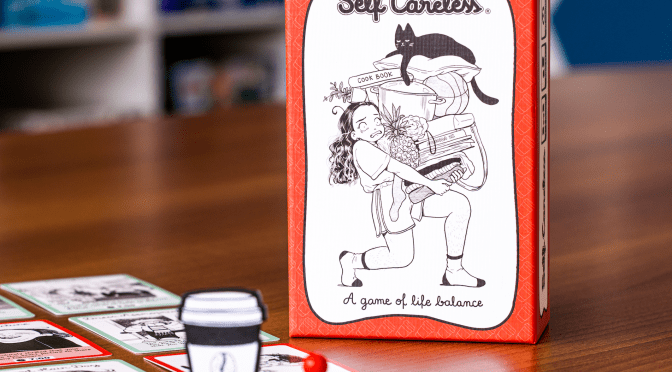
It’s your day off! Obviously you should be spending some time on Care for yourself, but then there are all these Chores to do that you won’t otherwise be able to take care of until who knows when. There are only so many hours of the day, so you’re going to have to plan things out – don’t do too many Chores so you actually get some rest, don’t spend so much time on self Care so that the Chores just pile up. Coffee will help! Now if only that darn cat would stop knocking over all the cups. This is Self Careless, the life balance game for 1-2 players from Jason Anarchy Games and Cassandra Calin!

Continue reading A Glimpse Into The Unplugged Vault: Self Careless

The Trouble With Reviewing RPGs

Usually we keep any mention of the Wider TTRPG Discourse to the Discussions section of the Weekend Update, but there’s an exception to everything. Supposedly Matt Colville said some things on a stream earlier this week? I’m sure he did, the man’s got a lot to talk about, he’s got a Kickstarter going on that I’m sure Aaron will talk more about in January’s Crowdfunding Carnival. Of course then the topic got sucked into the ouroboros of social media, starting with Twitter’s rotting alive husk, and do you think anyone is providing any links to said stream? No, of course not. Doesn’t matter, though, because The Discourse spins on, and its latest incarnation is, broadly, this:

Reviewing a game after reading it versus reviewing a game after playing it.

Oh. Oh wow. Are… are we The Discourse?

Continue reading The Trouble With Reviewing RPGs