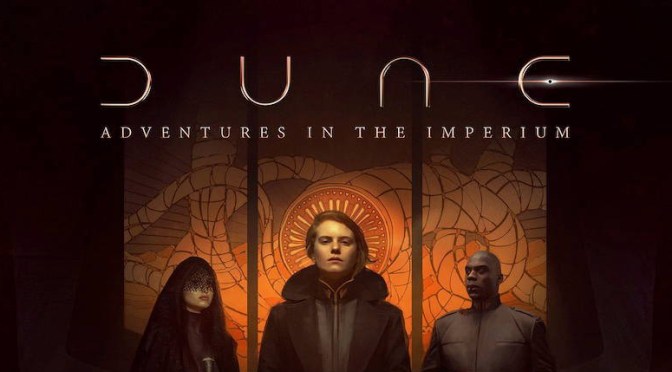
Frank Herbert’s Dune is high in the science fiction pantheon. The novel combined originality and prescience in a way that has continued to inspire readers over the last 55 years; it has also defied adaptation. Both film versions of Dune (prior to the upcoming 2021 movie) were beautiful failures in their own right, and the version that never happened, plotted by psychedelic filmmaker Alejandro Jodorowsky, was so ambitious that its lack of production still inspired a documentary. Dune’s RPG history is similarly troubled. Dune: Chronicles of the Imperium was designed by Last Unicorn Games and held up by licensing disputes. When Wizards of the Coast acquired Last Unicorn, they got permission to print any pending projects, and a 3000 copy print run of Chronicles of the Imperium was made. Apparently the entire run got scooped up on the con circuit and the game fell into obscurity after WotC scrapped further printing in favor of converting the whole thing to d20, which fortunately died on the vine in a new spate of licensing disputes. So, literally two decades later, Modiphius has the vaunted Dune license and has made good with Adventures in the Imperium, their latest 2d20 title.
Continue reading Dune: Adventures in the Imperium ReviewTag Archives: Review

Gravity RIP Review: Pro-Racing, Anti-Gravity
About five hundred years ago the galactic community of alien species known as the Myriad had known harmony for 80,000 years, and had no use for violence and no concept of capitalism. Then the humans showed up, and it turned out everyone liked the taste of both. Now that galactic society is more of a chaotic, disparate sprawl the only thing anyone can agree on is a love for humankind’s third gift: the anti-gravity RIP Drive, and the ability to stuff these interstellar engines into much smaller craft for use in planet-bound, high speed death races. This isn’t a sport, it’s a lifestyle. It’s a deathstyle, baby: it’s Luke Westaway’s sci-fi racing RPG, Gravity RIP!
Continue reading Gravity RIP Review: Pro-Racing, Anti-Gravity

Wanderhome Review
There are certain things one takes for granted in a role-playing game. I’m not talking about anything as concrete as attributes or skills or levels, I’m talking about exogenous conflict, which is so omnipresent in traditional RPGs (and most non-traditional RPGs as well) that it’s invisible. Well of course there are monsters to fight. Well of course you need to define a ‘need’ in Fiasco. Well of course there’s scarcity in your apocalypse. Like many people I took this for granted until I saw a game that completely stepped away from it. No, the war is over, no one fights. No, people are inherently good, there are no monsters. No, you will have hospitality in every place you visit. When I first read Wanderhome, this twisted my mind a little. How does one play a game with so little conflict? And then I created a character. And then I immediately got it.
Continue reading Wanderhome Review
Traveller: Drinaxian Companion Review
I’ve previously written about the The Pirates of Drinax, and I believe that it’s for good reason. It is one of my favorite published campaigns, and I would argue that it is the best I have ever seen in terms of being a true sandbox. It begins with a promise that the players are being brought in to take a miniscule star nation operating between two behemoths, and to make it an Empire in its own right and not only is it possible, it offers a chance to have the players take an active stance in the government that is formed. The campaign is not only flexible enough that it offers the ideas that players might want to spurn their patron and carve out a kingdom of their own, but it actively sets rules for how to go about it. There is a story seed for virtually every planet, for which there are multiple populating each of dozens of subsectors. You could likely make an entire campaign about dealing with the Pirate Lords of Theev, a group of politically insulated pirates that operate out of a planet is a surprisingly open secret. All of this is on top of a ten module progression of the campaign as players take a single ship and try to form a pirate flotilla.
And as much as I love it, I do not think I will ever run another session using the rules as written. So, it was with a bit of hesitation that I picked up the Drinaxian Companion. Yet, as a result, I have found my interest rekindled.

Mechasys Review: Mecha-sized Adventures in Genesys
Sometimes a tank or a fighter jet just won’t do the trick. Sometimes, the best way to deal with a problem is a big, stompy mecha. However, while life is finally returning to Genesys proper with EDGE Studios announcing their upcoming Twilight Imperium supplement, if you want to be jumping in the cockpit with the Narrative Dice System running the show you’ve been dealing with homegrown material. Now, though, there’s an offering on the Foundry itself which just might turn the tide of your own personal giant robot war. From mecha creation to pilot recruitment, lets head to the hangar to check out Mechasys from Studio 404 Games!
Continue reading Mechasys Review: Mecha-sized Adventures in Genesys
Over Arms Review
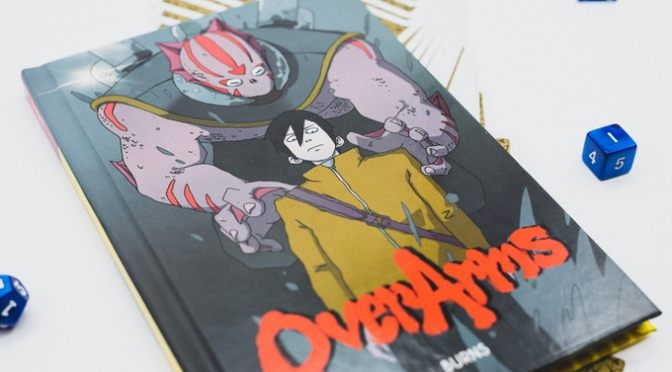
Every so often, I look at a game, and make an impulse purchase sight unseen. Sometimes it’s a follow up to a campaign that I have previously waxed eloquent about, others it is a supplement to a system that opens up rules for something I had envisioned, or has a high concept that is so unique that I can’t help but look. Other times, it is because it promises the ability to play in fictional works I love so much that I can’t help but churn out a cry of “Shut Up and Take My Money!” It’s the last of these that triggered an irresistible pull to Rookie Jet’s Over Arms.

Possible Worlds Kickstarter Review: An RPG Subscription Box
A light-hearted romance emulating dating sim video games/visual novels. Letter writing inspired by Harvest Moon, Stardew Valley, and Animal Crossing. A bond between a pilot and their AI-linked mech. A theatre performance covering up a heist. Building super-powered characters and settings. Trying to find unused wishes in a world where everyone gets three, and you’ve already used yours. Sounds like an RPG anthology, right? Not quite. These are the six games, the six Possible Worlds, featured in Tyler Crumrine’s RPG subscription box.
Continue reading Possible Worlds Kickstarter Review: An RPG Subscription Box
Star Trek Adventures In-Depth Review
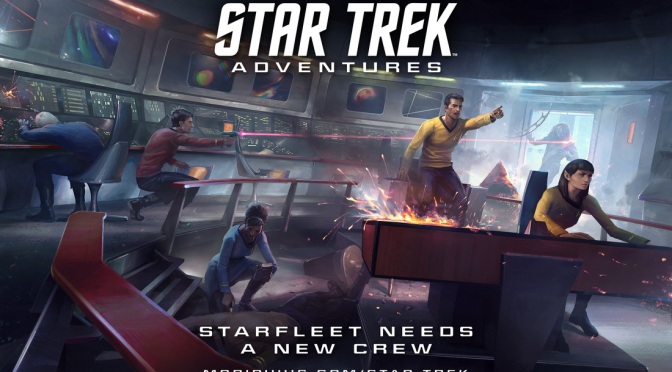
Gamemaster’s Log, Stardate 57252.7. It has been several months since the launch of the New Orleans-class starship U.S.S. Verrazzano, NCC-07302, from the Foggy Peak system. Since that time, I have seen her crew serve with distinction in accordance with the finest traditions of Starfleet. I have also seen them called before a board of Admirals to review their actions and directive violations, and while impressive the fact that no fewer than three starbases have had to be commissioned to deal with the discoveries from their missions is beginning to put a notable dent in the power requirements for the local sector’s industrial replicators. As the Verrazzano is currently away, responding to a distress call from a Vulcan Expeditionary Group, I have decided that this is a fine opportunity to review their so-called ‘Star Trek Adventures’ in-depth, to better understand how they have and will continue to boldly go where no one, not even the rest of Starfleet, has gone before.
System Split: Worlds Without Number and D&D Fifth Edition
It’s never been a better time to be a dungeon crawler. Dungeons and Dragons Fifth Edition and Pathfinder, two versions of the same underlying D&D ruleset, are bestsellers 1 and 2 in the RPG world, and have been for some time. Pathfinder is built for detail and breadth of options, while D&D’s Fifth Edition is built for accessibility and continuity with earlier versions and settings. They offer two versions of a fairly modern D&D experience, where GMs run story arc-based campaigns built around fighting monsters and exploring dungeons. Characters are treated like protagonists, and death is relatively rare. At the same time, we’ve seen a resurgence in “old-school” playstyles, usually represented within the D&D ecosystem by the OSR. Old-school games tend to have fewer rules, presenting challenges and decisions to the players rather than the characters. They tend to have weaker characters who aren’t treated like protagonists, and they need not be organized around a story.
There is a middle ground, though, and a new entrant in the middle ground has stormed into the DriveThruRPG sales charts. Worlds Without Number presents a dangerous old-school world, but uses rules innovations from later versions of D&D (and other role-playing games) to make the game more accessible and make the characters feel a bit more heroic. On top of all that, it provides tons of tools to help GMs run interesting game worlds with or without a driving story. Although many people will simply call Worlds Without Number an OSR game (and there are fair reasons for that), I think that it deserves to be examined against the current state of the art. That’s why this System Split pits Worlds Without Number against Dungeons and Dragons Fifth Edition.
Continue reading System Split: Worlds Without Number and D&D Fifth Edition
The Independents: Facing The Titan
I’m a fan of games with some heft to them. Rules and procedures are the elements of role-playing games which enable them to generate bigger, more interesting stories than the players could have come up with themselves. Unfortunately, rules-heavy and procedure-heavy games are stuck with a long history of taking up the mechanics of their wargame-based forebears without a great reason to do so. Rules and procedures can be so much more than physics engines and combat mechanics, after all. What if your game built out rules and procedures that were distinctly literary in origin? Imagine that the game not only traces out the course of your story, but also gives you procedures for establishing your own symbolism within the story. It’s quite possible that the game you’re imagining looks a lot like Nicolas ‘Gulix’ Ronvel’s Facing the Titan.

