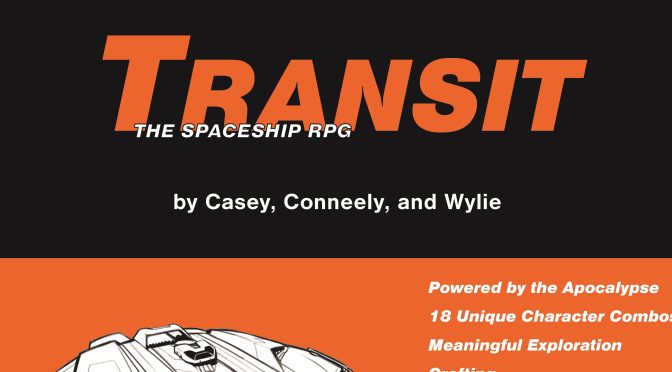
Travel between the stars is no longer science fiction, but instead reality. No longer confined to one measly system, ships now move across vast interstellar distances in the blink of an eye . .. but no biological mind can guide them. Artificial Intelligences have been created to inhabit these void-faring vessels, to guide them and lead their biological crews. Questions still remain, however. What’s out there in the darkness, waiting to be found? What is the true potential of the AI, and what will it mean for the galaxy? These questions are at the heart of TRANSIT: The Spaceship RPG, a Powered by the Apocalypse game about artificial intelligences, the starships they control, and their journeys across the galaxy from Fiddleback Productions!
Category Archives: Editorial
Reviews, opinions, and whatever else strikes our fancy!
Character Spelunking
Is your character really just you with a stat block? I bet you could get more out of your game if you let go of You and embrace your Character. Here are some techniques you can employ to help you bring your character to life at the table. It will take some effort, but you may find your escapism brought to another level once you get into it. While there are some practical tips in here, this is real mental and emotional work, more a deep cut than a skim.
Revisiting the D&D5e Artificer
When the Wayfinder’s Guide to Eberron first hit the digital shelves there was much rejoicing. We were getting to play in Keith Baker’s setting again without having to do everything from scratch ourselves, and a new front of creativity opened up on the DM’s Guild. As a living playtest, though, the WGtE had some glaring absences, and none was more obvious than the Artificer, the iconic class of the setting. Having gone through two cycles of Unearthed Arcana, going back almost to the beginning of UA, the Artificer had gone without any updates since 2017 . . . until yesterday! Grab your tools and lets get to it as we go feature by feature through the latest version of the class!
Troika Review
Imagine, if you will, that Douglas Adams and Terry Pratchett have returned from the dead. They both pile into a Ford Cortina and take a long drive across the American Southwest, pondering the nature of the fantasy genre. Once they arrive in California, they legally acquire several ounces of the finest cannabis sativa and hotbox the Cortina. Then they write an RPG. This, roughly speaking, seems to be what produced Troika, a delightfully simple and delightfully absurd game which recently published a second edition.
The Ultimate RPG Character Backstory Guide Review
So you’ve got yourself an RPG character all set to go – you’ve got the stats, and the skills, and the starting gear . . . except there’s something missing. Right now all you really have are the numbers, but where’s the story? The fact that you have an 18 in your Strength stat doesn’t contribute to the narrative . . . except that from Across A Crowded Tavern (Exercise #9) the figure in a shadowy cloak notices that you bear a tribute to your athletic prowess, like maybe a scar earned in a test of strength or a tattoo received in victory. Such are the kind of things that you might get to learn about your character when using the Ultimate RPG Character Backstory Guide by James D’Amato! Continue reading The Ultimate RPG Character Backstory Guide Review
Shadow of the Beanstalk Review
The day has come, and the second supplement for Fantasy Flight Games’ Genesys RPG is out! Shadow of the Beanstalk covers the Android setting, specifically focusing on New Angeles, the Beanstalk space elevator, and the Heinlein lunar colony. As an Android splatbook, the book works perfectly, giving a starting point for running games in the Android setting and tons of adversaries, locations, factions, and gear to flesh it out. If you look at the foreword, though, and at the Settings section of Genesys Core, it’s clear that this book is supposed to expand the Genesys toolkit to enable a wide range of science fiction settings. With three Star Wars games and the Worlds of Android book already in print, what does Shadow of the Beanstalk really provide to the Genesys ecosystem? Let’s take a look, chapter by chapter.
Advance Review: Shadow of the Century
A few years ago, on a truly crappy day, I had the saving grace of being introduced to an independent short film by the name of Kung Fury. For those unfamiliar, it was a wonderful bit of over the top, profane 80’s cheese: a Kung Fu Master/detective who is a lone wolf is forced to team up with his new partner Triceracop as they take on sinister transforming arcade machines/killer robots, Laser Raptors, and a Time Traveling Adolf Hitler…who wants to own the title of “Kung Fuhrer”. All complete with poor VCR tracking to boot.

(It’s a lot like this)
I say all this because I have found a new tabletop game to support any GM who looked at all this and went, “I would love to run something in here”: Shadow of the Century, written by Brian Engard, Stephen Blackmoore, and Morgan Ellis and published by Evil Hat Productions.
Technoir Review
Cyberpunk drew deeply from the well of hard-boiled fiction, often called noir after the genre’s commanding presence in film noir of the 40s and 50s. William Gibson was directly inspired by Raymond Chandler, wearing this influence on his sleeve in the original “Sprawl” trilogy of Neuromancer, Count Zero, and Mona Lisa Overdrive. These influences didn’t quite trickle down into the original Cyberpunk roleplaying games, though, with Cyberpunk 2020 and Shadowrun more inspired by the techie bombast of authors like Walter Jon Williams and John Shirley, and their big guns, big hovercraft, and “fight the power” plotlines. There is a game out there designed for playing hard-boiled Cyberpunk stories, though. Technoir was originally released in 2011 after being funded on Kickstarter in June of that year. Though the game was released, the Kickstarter went fallow, leaving stretch goals undelivered and the game mostly unsupported. As of the beginning of 2019, though, this has changed. Justin Alexander, best known for his site The Alexandrian has, through Dream Machine Productions, brought Technoir back from the dead. The game is once again in print, and the undelivered stretch goal “Morenoir” has been completed and is now available. With all this activity, now is a perfect time to take a deep dive into this interesting narrative ruleset.
Legend of the Five Rings: Emerald Empire Review
Simply knowing the rules for Legend of the Five Rings is not enough; even passing your gempukku and earning your place as a samurai in the Topaz Championship will not truly prepare you for the trials ahead. If one is to survive, even thrive, in the land of Rokugan then one must know Rokugan: its places, its people, its customs and history and spirits. So it is that Emerald Empire, the first major sourcebook for the Fantasy Flight Games’ edition of Legend of the Five Rings, has come into being. What’s actually within its pages? Is it worth getting yourself? I’m going through the book chapter by chapter to find out!
Continue reading Legend of the Five Rings: Emerald Empire Review
Bluebeard’s Bride: The Book of Mirrors Review
A son learning the truth about his father, a father his mother escaped from. A teacher alone on the cold school grounds, caught between a marriage offer and the street. A ‘patient’ confined to the halls of the insane, questioning her own mind. A showgirl trapped among the carnival’s tents as surely as the locked doors of a manor. A guard finding herself locked up with the prisoners instead of them being locked up with her. Bluebeard’s Bride is a game of feminine horror from Magpie Games, wherein the eponymous bride finds herself wandering her husband’s home, experiencing the horrors within, and facing a terrible choice. When the Bride looks into a shattered mirror, however, her image splits and warps into something new. Such is what happens in the latest supplement for Bluebeard’s Bride, the Book of Mirrors!
Continue reading Bluebeard’s Bride: The Book of Mirrors Review