
Some sort of horrible half-frozen tree creature reaches the kingdom’s castle after having attacked the lumber stores, clearly upset at our attempts at resource gathering. If the castle falls all will be lost, but there just aren’t enough defenders in place . . . suddenly, the beat of drums fills the air, and another pair of dwarfs come running from the forest the creature just tore through. In a flurry of axes and hammers the tree creature tumbles to the ground, slain, and the victorious dwarfs return to their homes . . . but the Ogre King just appeared on the walls at the edge of the kingdom, natural disasters begin to hamper our food and stone supplies, and we’ve got three weeks to go until spring. We’ll have to work together in order to survive the cold and the monsters in Dwar7s Winter from Vesuvius Media!
Tag Archives: Opinion

The Independents: Lancer
Things get lonely out here in the Long Rim, especially when you’re laying an ambush for the pirate who almost killed you a month ago. A white hot sun beats down on the black-glass face of my SSC METALMARK, but I’ve dimmed the cockpit displays and cranked the internal temperature controls way down. Gotta stay frosty.
Welcome to Lancer, a game of big robots, big guns, and big personalities. If you’ve ever wanted to fly through space tinkering with the parts of your mech and the hearts of your enemies, Lancer is the game for you. Continue reading The Independents: Lancer

A Glimpse Into PAX East: Clank! Legacy Acquisitions Inc. Upper Management Pack
Clank! A Deck-Building Adventure is all about going into a dungeon, acquiring some shiny artifacts, and escaping before the dragon can eat you . . . so it probably shouldn’t be too surprising that the adventuring company that’s known to acquire™ anything you ask for would eventually take an interest. In Fall 2019 we’ll see Clank! Legacy: Acquisitions Incorporated, a standalone version of the game where you’ll build your own Acq. Inc. franchise across several games of Clank! It seems that corporate wants to check things out first, though, because right now we’ve got the Acquisitions Incorporated Upper Management Pack expansion bringing Omin Dran, Jim Darkmagic, Viari, and Môrgæn into the dungeon!
Continue reading A Glimpse Into PAX East: Clank! Legacy Acquisitions Inc. Upper Management Pack

A Glimpse into PAX East: We’re Doomed!
Around a table in an opulent room, world leaders like myself scramble to gather the resources needed to build a rocket to escape the planet before it’s too late – and the influence they’ll need to get themselves a seat on said rocket. This has been made more difficult by the sudden robot uprising stealing resources, severely hampering the project. My own efforts to gather resources have been foiled by other leaders, who fear I am planning to nuke them to improve my odds . . . but now I’ve got free reign so that I can nuke the robots for them. The required amount is finally in my hands, the table waits for the nuclear fireball . . . . and I commit everything to the project instead, cementing my position as a Master Diplomat and earning a vast amount of influence. Looks like I’ll be waving from the rocket, and the rest will be dead losers, in We’re Doomed! from Breaking Games!
Kickstarter Wonk: April 2019
Spring has sprung! With it, the games are coming up through cracks in the pavement. There was a bumper crop of fresh ideas showing themselves on Kickstarter, and sadly only ten of them can fit in this month’s rundown. Whether you’re looking for old-school Swedish dungeon crawling, 1980s wizards, or a two player game about ‘The Chase’, there are ten solid games here to contemplate as the days get longer and warmer.

Changeling the Lost: Second Edition
The political kingmaker is the fairest of them all, with a designer suit, a killer intellect, and a smile that will make men follow her anywhere. She is a master of the boardroom and has a knack for deal making, even when the terms seem a bit, well, strange. If you agree to them in jest, you may be surprised when you are compelled to follow through. The bartender is a short man, barely noticeable behind the counter. He’s quick with a smile, and a drink, and is always willing to hear a gripe or a complaint, and offer a quick word of comfort to the concerned bar patron. What is odd is the number of filled shot glasses he keeps over the lintel as a marker. The private eye has streaks of grey throughout his raven black hair. His eyes are quick and dart to the sides wildly. His smile, while charming, seems to have a few too many teeth. He’s been following up on a number of abusive husband cases lately. It’s a bit odd how so many have seemed to disappear, but no body, no crime. It might seem as if all of these characters have nothing in common, were it not for their enemy: the beings who took them away to a far off land, and who may come to take them again. And for that, these Changelings will join together to stay alive.
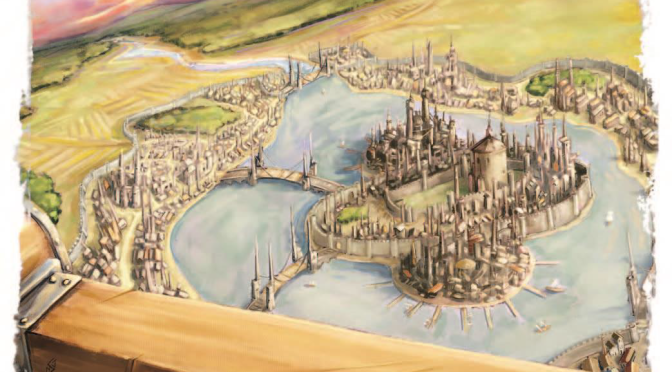
Eberron Random Events: Sharn and the Five Nations
The party is simply minding its own business on the streets of Aundair when they’re accosted by “Maestro Hennedy of Gault”. Seems this troubadour has decided he wants to witness your heroic deeds himself, and then make both you and himself famous with the resulting songs. It’s a nice opportunity . . . if he would just. Stop. Talking. And keep himself out of trouble. This is just one of the many encounters, run-ins, and occasions that your adventuring party could run in to with Eberron Random Events: Sharn and the Five Nations by Michael J Winegar!
Continue reading Eberron Random Events: Sharn and the Five Nations
“Every Game is Good with a Good GM!”
Tabletop RPG design is a young practice, and designers in every genre and format are learning more about how people play games as they go. There is a universal truth, though, that every gaming group is different, and when it comes to facilitated games (i.e. those with a GM), the people who run the game will make a huge difference in the overall experience. On the internet, though, a massive logical leap is often made, leading to a fallacious and all too familiar rallying cry: “Every Game is Good with a Good GM!” A technically true sentence, this phrase has no purpose in discussions of game design other than to shut down criticism.
System Hack: Cyberpunk Chimera Design Goals
Something funny happens when you spend a lot of time reading and reviewing games. At a certain point you reflect on all the games you’ve read and all the mechanics you’ve studied, and say to yourself “I bet I could design a game”. You see it a lot over here. Site founder Seamus is the co-author of the recently released Transit: The Spaceship RPG, and newest contributor Jason wrote Blessed Engines for the Emotional Mecha Jam. There’s design chops floating around in this blogger soup, and I suppose it should be no surprise that on the tails of the first System Hack, Genesys Mecha, I’d be throwing my hat into the ring.
Continue reading System Hack: Cyberpunk Chimera Design Goals

Level One Wonk: Narrative
That’s right, the Wonk is back in the building! Today we’re getting super wonky. While my last foray into RPG theory was an examination of an old universal theory, GNS, today I’m going to be looking at a narrower component of games, and a particular dichotomy which, after some examination, I realized shapes the core of how I want to play and run games, as well as what game systems I enjoy. I’m talking about narrative, but I’m not talking about whether a game is “narrative” or not. Rather, I’m going to talk about the two types of narrative which are generated in the course of playing an RPG: Prescriptive and Emergent narrative.
 Cannibal Halfling Gaming