We tend to look at new things here at Cannibal Halfling Gaming. Our mission of putting games and gamers together often takes the form of introducing something that might be unknown in front of someone who may be interested. But what about sharing new things to love about something you already love, something that provides ideas for play that had not been considered before? I didn’t know it when I first encountered it but these two volumes, Imperial Histories I & II, had been powerful influences on games I played and still remember fondly.
Continue reading Legend of the Five Rings: Imperials Histories Volume I & IICategory Archives: Editorial
Reviews, opinions, and whatever else strikes our fancy!
Curseborne: Onyx Path’s next dark world
Instead of coming up with some TTRPG pablum for an introduction, I’m going to cut right to the chase: At first I thought it was really weird that Onyx Path Publishing released Curseborne. If you don’t look too closely, the game appears to ape World of Darkness, an entire fork of which Onyx Path is the licensee. The five lineages are clearly aligned to Vampire (Hungry), Werewolf (Primal), Mage (Sorcerer), Demon (Outcasts), and Wraith (Dead). And even if the game is in fact different, why did Onyx Path decide to make their own supernatural horror game now?
Continue reading Curseborne: Onyx Path’s next dark world
Nine Years of Cannibal Halflings
Well, we’re leaving our enneadic era behind and heading into our tenth year. If you take OD&D as the starting point of the ‘modern TTRPG’ (although I’d recommend taking a deeper dive), that means we’ve been doing this for… ~17% of the medium’s lifespan? Which also means CHG has been active for longer than some editions of D&D?
Oh gods.
Well, let’s see what we did, and then look ahead to the final solar rotation of a decade of CHG.
Organizing an itch.io Bundle
I’ve organized five itch.io bundles. Four of them have already happened, and one of them is still live for a few more hours. Here are links to all of them1:
Continue reading Organizing an itch.io Bundle
The Endie Awards 2025 – Aaron Edition
This post is brought to you thanks to Lady Tabletop, who prompted folks to write about their own gaming experiences of the year and give out their own fun awards. Like Seamus I thought this was a neat idea, and was also glad (and relieved) that ‘The Endies’ weren’t trying to be yet another award given out because someone disagrees with the ENnies. Thinking back on the year and giving your own awards is more useful (and more fun!), anyway.
I had a much more constrained gaming year than Seamus in part because I had a very busy year; in the middle of this year my partner and I moved, which involved buying a condo, selling two condos, moving one person once and another person (and a cat) twice. In a way I’m surprised I got as much gaming in as I did, and also surprised I was able to write anything from May to August. Still, the difference in absolute number hides the point that Seamus made to me that, due to the number of campaigns I’m in and how often I run, I probably ran and played more sessions by absolute count than Seamus did.
Continue reading The Endie Awards 2025 – Aaron EditionThe Endie Awards 2025 – Seamus Edition
This post is brought to you thanks to Lady Tabletop, who prompted folks to write about their own gaming experiences of the year and give out their own fun awards. I like the idea a lot, and as it turns out I actually have a lot of games to mention and talk about and give accolades to. I still plan to write up my usual X Years of Cannibal Halflings on the 31st to look back on the year, but this seems like a fun idea that focuses more on the games than the writing about them. So, let’s see what I played, what I thought about them, and who won what!
My first corporate convention
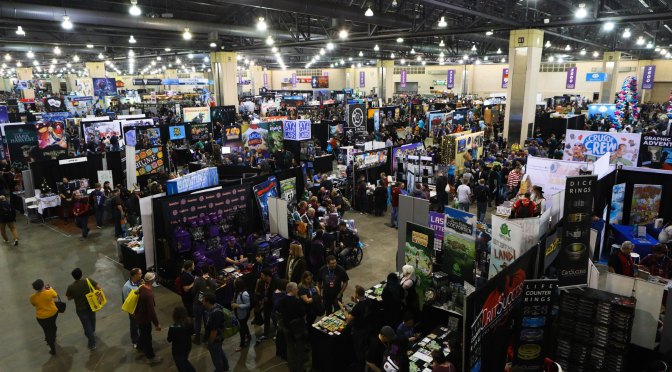
When it comes to nerd hobbies, the convention scene is bifurcated. There are local, volunteer-driven cons that put a lot of effort into building content from enthusiasts around the area. There are also the massive, national affairs that bring attention and revenue to their parents. Gaming cons moved quickly into the latter category, even if the initial efforts were modest; both GenCon and Origins came to prominence after their alignment with TSR and GAMA, respectively. And now there’s a massive leader in the corporate con sphere: Penny Arcade Expo, or PAX.
Continue reading My first corporate convention
Things to See at PAX Unplugged 2025
PAX Unplugged 2025 is this weekend! Which you probably already know, on account of clicking on this article while you’re on your way there or already in Philly. Alas, I won’t be there this time around. I hear tell some other Cannibal Halflings will be there, though, and I don’t have to be present to Know Things Worth Your Time. Let’s go over some games for you to buy, some games for you to play, and some interesting events to check out.
It shouldn’t have been called Single Player Mode
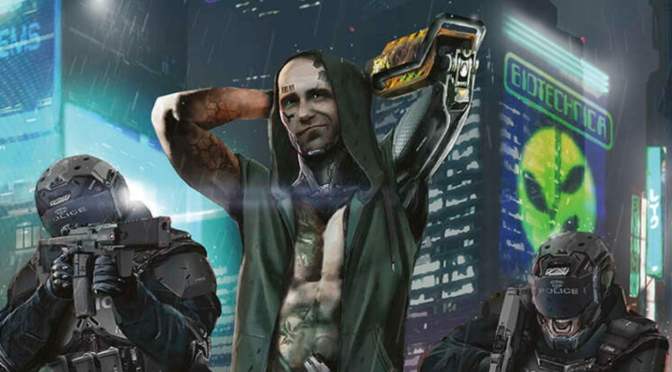
Cyberpunk Red has been going strong for around five years now. The game came out around the same time as the tie-in video game Cyberpunk 2077, and represented a return to form after 2005’s Cyberpunk v3 (and 2020 being over 30 years old). Now, R. Talsorian Games has kept the party going with continual Cyberpunk support both free (in the form of Monthly DLC) and for pay (in the form of the Interface Red collections as well as standalone supplements like Black Chrome). Single-Player Mode is the most recent standalone supplement, and your take on it will depend entirely on what you think a solo RPG is (or should be).
If you’re older than a certain age, when you think solo RPG you think something like Mythic GM Emulator, a set of rules that can act as a GM and let you play through modules or combats on your own. If you’re younger than a certain age (let’s say younger than me at least), your first thought of a solo RPG is probably more like a journaling game, or a hybrid narrative game like The Wretched. It’s important to state this because despite its 2025 release date Cyberpunk Red Single Player Mode is firmly the first of those two. There are no campaign framing tools, no narrative generation, and no character supplements. Cyberpunk Red Single Player Mode is built firmly on using an ‘oracle’ to answer questions which allow you to progress forward through your imagined narrative, and also provides tools to let you play out investigations, social interactions, combats, and netruns all on your lonesome. What it’s truly best at, though, is having a library of random tables which enable you to set up all sorts of premises, missions, and random encounters to make your Cyberpunk solo game more interesting. You may realize as I say this that random tables aren’t just for solo gaming. Not only is that true, it means that while I think Single Player Mode makes for an excellent GM aid and has some good rules additions…it just doesn’t work as an effective solo game.
Continue reading It shouldn’t have been called Single Player Mode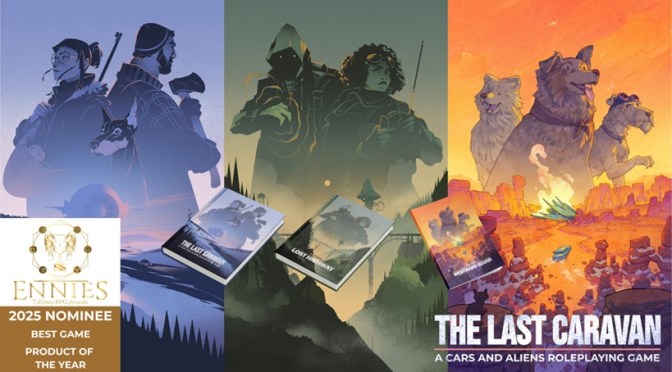
The Last Caravan – Con-Apocalyptic Road Trip
They came less than a year ago. The war was swift – and brutal.
Humans and aliens bombed each other to smithereens, and now both sides are licking their wounds. Mysterious new factions rise to join the struggle of the fallen titans. In this landscape of shifting allegiances, we may have to choose sides. Debris from the explosion of the aliens’ mothership has clouded the atmosphere, lowering the temperature and creating the coldest winter in a thousand years.
We find ourselves in a melancholy, wintry landscape — quiet, until it’s not. Egg-shaped alien structures thirty stories tall now squat, humming, over the cities they crushed. Xenofauna and lost invaders stalk the woods and highways. A war is brewing in the aching silence.
We are navigating the waking remnants of human and alien empires — and all we’ve got is a car, our fellow travelers, and the road.
It’s time to head west with The Last Caravan.
Continue reading The Last Caravan – Con-Apocalyptic Road Trip
 Cannibal Halfling Gaming