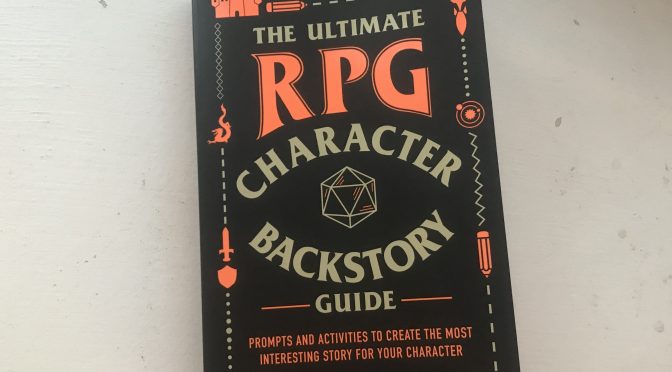
So you’ve got yourself an RPG character all set to go – you’ve got the stats, and the skills, and the starting gear . . . except there’s something missing. Right now all you really have are the numbers, but where’s the story? The fact that you have an 18 in your Strength stat doesn’t contribute to the narrative . . . except that from Across A Crowded Tavern (Exercise #9) the figure in a shadowy cloak notices that you bear a tribute to your athletic prowess, like maybe a scar earned in a test of strength or a tattoo received in victory. Such are the kind of things that you might get to learn about your character when using the Ultimate RPG Character Backstory Guide by James D’Amato! Continue reading The Ultimate RPG Character Backstory Guide Review
Tag Archives: Review
The Independents: The Quiet Year
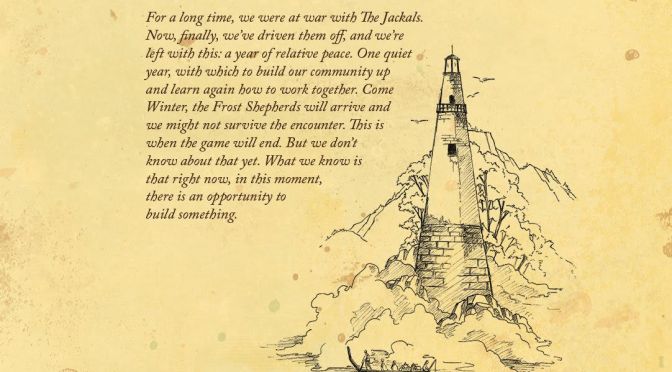
For a long time, we were at war with The Jackals. Now, finally, we’ve driven them off, and we’re left with this: a year of relative peace. One quiet year, with which to build our community up and learn again how to work together.
The opening words of The Quiet Year lay out the bones of a melancholy story. A community torn apart by war, a mysterious enemy gone but not destroyed, and the empty promise of a year of peace. No matter how desperately the community clings to survival, something awaits them on the horizon. Every hardship conquered pales in comparison to what is to come. When winter arrives, the Frost Shepherds shall also—and things will never be the same.
Shadow of the Beanstalk Review
The day has come, and the second supplement for Fantasy Flight Games’ Genesys RPG is out! Shadow of the Beanstalk covers the Android setting, specifically focusing on New Angeles, the Beanstalk space elevator, and the Heinlein lunar colony. As an Android splatbook, the book works perfectly, giving a starting point for running games in the Android setting and tons of adversaries, locations, factions, and gear to flesh it out. If you look at the foreword, though, and at the Settings section of Genesys Core, it’s clear that this book is supposed to expand the Genesys toolkit to enable a wide range of science fiction settings. With three Star Wars games and the Worlds of Android book already in print, what does Shadow of the Beanstalk really provide to the Genesys ecosystem? Let’s take a look, chapter by chapter.
The Independents: CAPERS
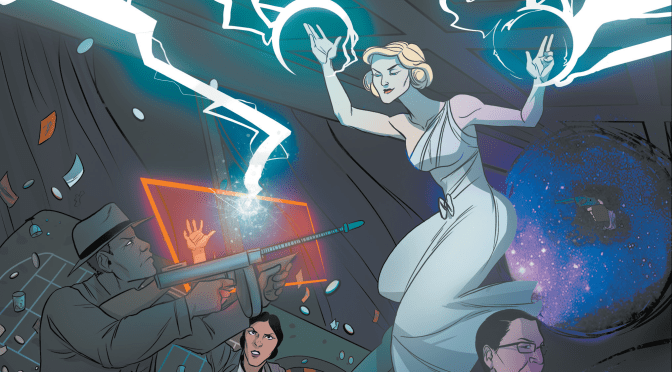
A Rolls-Royce Phantom peels around a corner, stray dollar bills from the sacks in the back fluttering out the open windows, as a pair of police cars howl in pursuit. A man in the rear seat leans out and chatters a string of bullets from his tommy gun at the coppers, but his shots go wide and the gun jams. Cursing, he leans back in to try and fix his weapon, yelling at the woman riding shotgun to handle it. She leans out her own window, raises a hand . . .and a beam of cold energy shoots out of it, creating an ice slick right in front of one of the police cars. The vehicle swerves, skids, and slams into a street lamp, but the second pursuit vehicle gets around it and draws closer. Suddenly, there’s a flash of energy from behind the windshield of the crashed car as one of its occupants steps through a dimensional gate and appears perched on the hood of the Phantom, shotgun in hand, demanding the gangsters pull over in the name of the law. It’s the 1920s. Alcohol is Prohibited, crime pays very well, the law does what it can. And, of course, there are superpowers. This is the BAMFsie-award-winning roleplaying game CAPERS from NerdBurger Games!
Advance Review: Shadow of the Century
A few years ago, on a truly crappy day, I had the saving grace of being introduced to an independent short film by the name of Kung Fury. For those unfamiliar, it was a wonderful bit of over the top, profane 80’s cheese: a Kung Fu Master/detective who is a lone wolf is forced to team up with his new partner Triceracop as they take on sinister transforming arcade machines/killer robots, Laser Raptors, and a Time Traveling Adolf Hitler…who wants to own the title of “Kung Fuhrer”. All complete with poor VCR tracking to boot.

(It’s a lot like this)
I say all this because I have found a new tabletop game to support any GM who looked at all this and went, “I would love to run something in here”: Shadow of the Century, written by Brian Engard, Stephen Blackmoore, and Morgan Ellis and published by Evil Hat Productions.
Technoir Review
Cyberpunk drew deeply from the well of hard-boiled fiction, often called noir after the genre’s commanding presence in film noir of the 40s and 50s. William Gibson was directly inspired by Raymond Chandler, wearing this influence on his sleeve in the original “Sprawl” trilogy of Neuromancer, Count Zero, and Mona Lisa Overdrive. These influences didn’t quite trickle down into the original Cyberpunk roleplaying games, though, with Cyberpunk 2020 and Shadowrun more inspired by the techie bombast of authors like Walter Jon Williams and John Shirley, and their big guns, big hovercraft, and “fight the power” plotlines. There is a game out there designed for playing hard-boiled Cyberpunk stories, though. Technoir was originally released in 2011 after being funded on Kickstarter in June of that year. Though the game was released, the Kickstarter went fallow, leaving stretch goals undelivered and the game mostly unsupported. As of the beginning of 2019, though, this has changed. Justin Alexander, best known for his site The Alexandrian has, through Dream Machine Productions, brought Technoir back from the dead. The game is once again in print, and the undelivered stretch goal “Morenoir” has been completed and is now available. With all this activity, now is a perfect time to take a deep dive into this interesting narrative ruleset.
Legend of the Five Rings: Emerald Empire Review
Simply knowing the rules for Legend of the Five Rings is not enough; even passing your gempukku and earning your place as a samurai in the Topaz Championship will not truly prepare you for the trials ahead. If one is to survive, even thrive, in the land of Rokugan then one must know Rokugan: its places, its people, its customs and history and spirits. So it is that Emerald Empire, the first major sourcebook for the Fantasy Flight Games’ edition of Legend of the Five Rings, has come into being. What’s actually within its pages? Is it worth getting yourself? I’m going through the book chapter by chapter to find out!
Continue reading Legend of the Five Rings: Emerald Empire Review
Bluebeard’s Bride: The Book of Mirrors Review
A son learning the truth about his father, a father his mother escaped from. A teacher alone on the cold school grounds, caught between a marriage offer and the street. A ‘patient’ confined to the halls of the insane, questioning her own mind. A showgirl trapped among the carnival’s tents as surely as the locked doors of a manor. A guard finding herself locked up with the prisoners instead of them being locked up with her. Bluebeard’s Bride is a game of feminine horror from Magpie Games, wherein the eponymous bride finds herself wandering her husband’s home, experiencing the horrors within, and facing a terrible choice. When the Bride looks into a shattered mirror, however, her image splits and warps into something new. Such is what happens in the latest supplement for Bluebeard’s Bride, the Book of Mirrors!
Continue reading Bluebeard’s Bride: The Book of Mirrors Review
The Independents: Lady Blackbird
Every game of Lady Blackbird starts in the same place: The cold iron brig of the Hand of Sorrow. Five rebellious heroes are trapped in the uncaring grip of the Empire, with aspirations of freedom alongside the far-off pirate king Uriah Flint. The premise is exciting, but the genius of this 2009 indie darling really begins to show when your players take control of the crew of The Owl. Will they talk their way out of imprisonment? Can they break out with force? Perhaps the predicament requires a more uncanny solution—teleportation, shapeshifting, or summoned lightning. No matter what the party does, their choices will send your story spinning off into The Wild Blue.
The Yellow King Review
When we typically think of supernatural horror and someone mentions a Mythos, they are almost always referring to HP Lovecraft’s Cthulhu Mythos, and all the assorted otherworldly monsters and non-Euclidean geometry that goes along with that. Fortunately, Lovecraft wasn’t the only author trying his hand at the weird and horrifying. Robert Chambers wrote a sequence of four stories, collected in a book entitled The King in Yellow. Taking place in two settings, contemporary (1895) Paris and an imagined future America, the stories of The King in Yellow center around a strange symbol, the Yellow Sign, a mysterious figure, the King in Yellow, and a written play with strange effects, also named The King in Yellow. Chambers’ stories are considered hallmarks of occult fiction, and even Lovecraft himself borrowed from Chambers’ work. As such, it only made sense that someone would give them an RPG treatment, much like the one bestowed upon Call of Cthulhu. Robin D. Laws wrote The Yellow King for Pelgrane Press using the GUMSHOE system, but gave special attention to Chambers’ style of mind-bending horror, and extended his worldbuilding a little bit. The Yellow King has not two but four unique settings included with the game, and each one has a slightly unique version of the game, tailored to the conflicts and conceits of the setting. What’s more, the game is set up to play a sprawling arc of weird fiction across all four.