Category Archives: Editorial

Basic Roleplaying Review

Back in the 1970s, a new role-playing game built a foundation that would stand for years to come, a foundation of accessibility, hackability, and ease of use. Am I talking about D&D? Absolutely not! I’m talking about RuneQuest, a game which, in 1978, not only became a quick second place finisher to D&D in the fantasy genre but also established many RPG conventions we still see today. In 1980, the RuneQuest second edition box included a little 16-page booklet titled Basic Role-Playing, and from there it was off to the races. Basic Role-Playing (later Basic Roleplaying, also called BRP) would form the basis of every game released by RuneQuest’s publisher, Chaosium. As that esteemed publication history includes none other than Call of Cthulhu, BRP is likely the bestselling house system in the history of role-playing games.

Thanks to RuneQuest and Call of Cthulhu, BRP forms the cornerstone of how gamers expect d100 systems to work. In short, your attributes and skills give you percentile values which are equal to the probability of rolling under them on a d100 roll. Look at your sheet, you know how likely you are to succeed at a baseline roll. In addition to BRP itself, this mode of d100 mechanics saw widespread adoption in games as varied as Warhammer Fantasy Roleplay and Eclipse Phase. Now, Chaosium is staking the future of BRP on its utility as a platform. The new edition of Basic Roleplaying is here, and it’s being marketed to game designers as much if not more than game masters.

Continue reading Basic Roleplaying Review
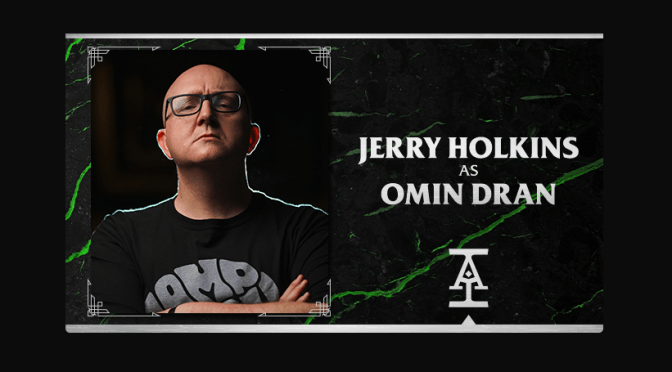
A Chat With Jerry Holkins At PAX East ’23

I sit down with Jerry Holkins of Penny Arcade, aka CEO Omin Dran of Acquisitions Incorporated, to talk about the primordial actual play experience , its history and changes, its official D&D book, and the ongoing Kickstarter for its second video series!

Thanks to Jerry for taking the time to talk with me! Musical notes yoinked from Sneaky Adventure by Kevin MacLeod
[License].

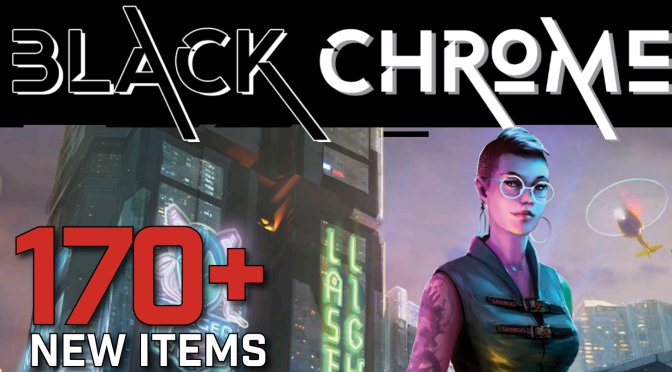
Cyberpunk RED: Black Chrome Review

We don’t review a lot of supplements here at Cannibal Halfling Gaming. From a pragmatic standpoint, there’s a lot less that a review can tell you about a supplement that will affect your purchasing decision than with a full game. For today’s subject, Black Chrome for Cyberpunk Red, that’s certainly true. We all knew Black Chrome would be the ‘stuff’ supplement, and even if there hadn’t been some grumbling about the ‘stuff’ or lack thereof in the core rules the ‘stuff’ supplement in a Cyberpunk game is almost always a must-buy, if only due to the association of the cyberpunk genre with gear porn. On the other hand, in some cases there’s a bit more to say about supplements. Cyberpunk Red is slowly working up to being a full-on RPG ecosystem just like Cyberpunk 2020 was; the earlier game had supplements from gear catalogs to corporate profiles to location gazetteers to big plot books like the Firestorm series. One consequence of this, perhaps an unintended one, is that Cyberpunk 2020 played quite differently when all the supplements were in play than when it was just the core book. While that’s neither unique to Cyberpunk nor particularly unexpected, it had a significant role in the reception of Cyberpunk Red, where the game in its early single book state was being judged against a Cyberpunk 2020 which already had literally dozens of supplements released. It stands to reason, then, that Black Chrome would be the first full-sized rules supplement for Cyberpunk Red. Black Chrome is an homage to the supplements which changed Cyberpunk 2020 the most and the fastest, the Chromebooks.

Continue reading Cyberpunk RED: Black Chrome Review

My First Complete Campaign

In January 2023 I crossed off a New Year’s Resolution: I completed a campaign I was running. It seems like a smaller accomplishment, considering that I’ve been gaming off and on for close to 20 years now, and my group is filled with veterans who have run at one point or another. But for me, this is the one time I managed not only to run a game, but had a story arc that was completed and brought to (by most accounts) a satisfying resolution.

There have been failures. Over the years, I have tried to run a variety of things, from Blades in the Dark to Star Wars. I even managed to get a few sessions of Traveller strung together. For a variety of reasons these failed to move past one-shots, never materialized, or just fell apart. This happens. Aaron has written about situations just like it.

So as I look back over the game that did succeed, it’s time to run a post-mortem to know what worked and what didn’t for when I get back in the saddle to run again. You know, after my sanity restores a bit.

Continue reading My First Complete Campaign

Rolemaster Unified Review

The OSR is a movement of nostalgia. Rather than seeking to actually emulate the way RPGs were played in the 1970s and 80s, the OSR is seeking to bottle the lightning of the first time you found a Player’s Handbook or Basic Set and just played, actual rules be damned. While the OSR as a movement is certainly informed by the cultural phenomenon of having the D&D red box show up in toy stores and in the hands of many kids and teens in the 1980s, the roleplaying hobby itself was already significantly more diverse than any one movement could capture. As an example, around the time that the OSR casts its rose-tinted glasses toward, there was a successful and long-lived game called Rolemaster.

Continue reading Rolemaster Unified Review

Most Games Don’t Matter

After graduating into one of the worst recessions the global economy had yet seen, I cut short a fruitless job search to go to grad school. I ended up with a Master’s Degree in Innovation Management, a field which sounds like it was made up by the Business School industry but yet taught me a lot. While invention is the act of creating something new, innovation is the act of deriving value from new things, from inventions. According to the World Economic Forum 1.7 million patents were granted in 2021, which is a huge number. But even setting aside things like filing the same patent in multiple countries, a small fraction of those patents represent anything like tangible value to society at large. While invention can happen with a bit of creativity and some work, innovation is significantly more dependent on exogenous factors, on what happens to the invention after it comes into being. RPG designers are like inventors in that way; many many people are designing, are inventing, but the vast majority of games will never make an impact on the market at large.

While there are certainly forces contributing to a greater stagnation of the RPG hobby (D&D comes to mind), the low ‘hit rate’ for new RPGs when it comes to moving the needle in the greater marketplace is largely structural, and unlikely to change in the long run. On the creator side, making an RPG is relatively easy, requiring significantly less money and specific skill than making video, digital games, or visual art, and often less time than writing long-form fiction. This means that the number of entrants into the market will be relatively high. On the consumer side, RPGs have higher switching costs than virtually any other form of media; a consumer needs to find a minimum of 2-4 friends to play with them, with a play time of two hours on the low side. Beyond that, when the presumed norm of the medium involves campaigns of literally dozens of four-plus hour sessions and understanding at least one densely-written rulebook, the perceived switching costs are significantly worse than the already high actual switching costs. These things combined to make the number of consumers in the market relatively low, and the number of games they will consume lower still.

Continue reading Most Games Don’t Matter

A Return to PAX Unplugged (2022 Quick Recap)

PAX Unplugged returned to Philadelphia this year, marking the fifth time the convention has taken place. I was fortunate enough to attend this year, making it the third year I’ve managed to go. Before I begin, I want to take a moment to thank the organizers for a few things: One, for continuing to choose Philadelphia as the site. I think that the area and community are an excellent fit with abundant transportation, housing, and food for a bunch of tabletop nerds, along with a city that prides itself on inclusivity. Philadelphia has gotten some bad press as of late, but I never felt anything but safe and welcome as I walked through, to, and from the event space.  Second, I want to thank them for the amount of logistics and cat wrangling it takes to get a group of tabletop gamers to do anything. My GMing has increased since my last visit to the convention, and with it so has my appreciation for the work that it takes to get this rolling each year. This year, the team made sure that getting through the door was about as pain free as possible despite requiring proof of vaccination along with the necessary ticketing and security checks for entry. So I absolutely want this convention to keep going. 

Continue reading A Return to PAX Unplugged (2022 Quick Recap)

Blade Runner Review

Cyberpunk is having its second wind. The genre of postmodern science fiction best defined as ‘high-tech, low-life” was born in the 1980s, first in film, then literature, then game. Though declared dead in 1991 after Neal Stephenson’s Snow Crash seemed to parody the genre as much as embody it, Cyberpunk came roaring back in the 2010s in the wake of Citizens United, Facebook, and the second tech boom. By the time Cyberpunk 2077 was released in 2020, the setting year of its RPG predecessor, the combination of 80s aesthetic being cool again and the continued specter of corporate overlords made the children of Gibson, Sterling, and Shiner seem all too relevant. Tabletop RPGs were no exception to the trend; in addition to Cyberpunk Red becoming the best-selling non-D&D RPG of the decade so far, many imitators cropped up from all over the game design map, some adhering well to Cyberpunk themes and others not so much.

Free League, a Swedish publisher of ever increasing significance in the last few years, has stepped into the Cyberpunk ring with a licensed title. This isn’t Free League’s first go at a licensed game, with Alien receiving broadly positive reviews, but like Alien Blade Runner is a property with a lot of history and high expectations attached. Based originally on Philip K Dick’s novel Do Androids Dream of Electric Sheep?, Blade Runner basically started the Cyberpunk genre when it was released in 1982. While William Gibson had started writing in what would become Cyberpunk a little earlier (Johnny Mnemonic was published in 1981), so influential was Blade Runner that he feared Neuromancer would be dismissed as a coattail-grab.

Continue reading Blade Runner Review

Avatar Legends Review

Magpie Games currently holds the record for the most funded tabletop RPG Kickstarter with Avatar Legends, its game set in the universe of Avatar: the Last Airbender and The Legend of Korra. The Kickstarter campaign earned nearly $10 million from over 80,000 backers, a truly staggering total that, when considering campaigns for specific RPG titles, has yet to be beat. Surely the completion of this game would be met with renewed interest and immense sales success, so we’ve been looking forward to the release- wait. I’m being told that the game was released before Halloween. Huh. Well, one would naturally assume that the release would see a second wind of- so apparently the PDF version on DriveThruRPG hasn’t sold more than 500 copies since coming out. Odd. Now, to be fair, the physical game isn’t yet available, and PDF fulfillments from those preorders don’t count among the numbers I’ve cited. Even so, the campaign sold nearly 8700 PDF-only rewards, so getting not quite to 5% of that number upon release is…worrying.

As many pointed out and grumbled about during the campaign, Avatar Legends is the largest licensed RPG Kickstarter as well as the largest RPG Kickstarter in general, and as such the buyers’ motivations are often a little different. Consider: around 2,800 people paid $50 for the pledge tier which got them a physical core book and PDF copies of everything else. However, over 39,000 people opted for the $75 tier which added all the physical stretch goals. Those physical stretch goals were one more book, dice, a cloth map, a card deck, a pack of journals, and a tile. Combine that with the tier level that gave the physical stretch goals in addition to a copy of the special edition core book, and the vast majority of backers paid for the doodads. And everything I have to say in this review will not take away from those doodads, I’m pretty sure.

Continue reading Avatar Legends Review