
Welcome to the Cannibal Halfling Weekend Update! Start your weekend with a chunk of RPG news from the past week. We have the week’s top sellers, industry news stories, and discussions from elsewhere online.
Tag Archives: D&D

Fantasy World Review
While Apocalypse World was the starting line for Powered by the Apocalypse, Dungeon World was what got the ruleset to really take off. By adapting the rules of the perennially popular Dungeons and Dragons as well as showing gamers what it looked like when Apocalypse World was hacked, Dungeon World not only moved significantly more copies than Apocalypse World but also kickstarted the popularity of PbtA in general. Now, years later, Dungeon World’s somewhat inartful mushing of Apocalypse World and D&D together is looked upon less fondly, given years of innovation and expansion of the PbtA ruleset. When you combine that with the checkered behavior of one of its authors, Dungeon World is a game that has sent many of its fans looking for a replacement.
Oddly, straight-up fantasy has not seen a lot of entrants into PbtA. There is Fellowship, but that is designed around a specific Tolkienesque sort of story. There is The Sword, The Crown, and the Unspeakable Power, but while that plays to Game of Thrones and popular dark fantasy themes, actually playing the game demands engaging in a unique and quite adversarial experience. No, the sort of fantasy romp typified by D&D but also offered in games like Forbidden Lands, RuneQuest, and even GURPS Dungeon Fantasy, is not really present to the same degree in PbtA as it is in other places. Maybe it’s the OSR attracting the sort of small press hackers and designers who want to write fantasy, or maybe Dungeon World’s shadow is too long. Either way, there’s a new fantasy PbtA game in town.
Continue reading Fantasy World Review
What GMs Want
Starting last year and continuing into this one, there have been stories about a “dungeon master shortage” in the TTRPG hobby, specifically meaning D&D Fifth Edition. D&D rocketed up in popularity in the last decade or so since Fifth Edition was first released, but that means that some of the game’s liabilities have finally caught up with it. D&D was never great on rules clarity, but Fifth Edition, while aiming for simplicity on the player side of things, finally and completely left the DM in the lurch as the rules for that side of the screen were either executed poorly or, in many cases, removed entirely. Given the edition’s rise in popularity, the demand for DMs has completely outstripped the pool of game veterans who cut their teeth on earlier editions and could use their experience to fill in the gaps left in the 5e Dungeon Master’s Guide.
While there is no acute GM shortage across the rest of the hobby, the travails of D&D have brought the game-running role back into focus. Many indie games over the last decade have eschewed having a single player take on running the game (called both GMless, implying no need for any facilitation, and GMful, implying there is still a need for facilitation but it is split amongst multiple players), but the traditional “one GM-many players” paradigm still rules the roost across the spectrum of popular RPG designs. As the D&D hobby is finding out quite painfully, if you’re singling out one player to take on more responsibility, you’ve got to help them out.
Continue reading What GMs WantWeekend Update: 8/19/2023
Welcome to the Cannibal Halfling Weekend Update! Start your weekend with a chunk of RPG news from the past week. We have the week’s top sellers, industry news stories, and discussions from elsewhere online.
Continue reading Weekend Update: 8/19/2023Weekend Update: 8/12/2023
Welcome to the Cannibal Halfling Weekend Update! Start your weekend with a chunk of RPG news from the past week. We have the week’s top sellers, industry news stories, and discussions from elsewhere online.
Continue reading Weekend Update: 8/12/2023
Adventures in Rokugan Review
This review is delayed, far from the “hot off the press” take that I had intended back some time ago. Instead this has been an article I have stewed on for some time. In 2020 there came an announcement that Edge Studios would be taking over RPG properties that had been held by Fantasy Flight, which includes two that I have written about extensively in the past: Star Wars and Legend of the Five Rings. Since the acquisition, the publishing has mainly been constrained to reprints of books in use and published already developed supplements that had been in the pipeline before the acquisition. It was a bit of a surprise to me that the first new material from this new studio was to take the setting of Rokugan and put it into the mechanics of 5th Edition Dungeons and Dragons.
My reaction to reading it at first was, to put it politely, visceral.
Candela Obscura Quickstart Review
This review doesn’t really matter.
This review doesn’t matter because there are four types of people who will click on this review when they see it, and none of them are looking for more information in order to form an opinion. You will have critters who’ve already decided they love Candela Obscura and want to see if I do too, and then critters who’ve already decided they hate Candela Obscura, think switching rulesets was pointless…and want to see if I do too. On the indie/OSR side, you have those who can’t stand Critical Role, and want to see if I’m going to bag on it, ranting as long as I did when I reviewed Root. You also have those who are just thankful that the largest Actual Play in the game is using something other than D&D, and have already decided it’s better. Ultimately, I don’t think my conclusion is going to satisfy any of these camps.
It’s fine.
Now, given my own biases from both years of experience in RPGs as well as other media (not to mention writing to a specific audience for a living), I find it hard to believe that anyone was expecting a conclusion other than ‘it’s fine’ for the first ground-up new game from Darrington Press. Just like nobody should have expected Tal’Dorei to be a Planescape or Spelljammer or other setting that really pushes on the conventions of the D&D genre, nobody should really have expected that a new game from Critical Role Productions would do anything other than nestle neatly into the range of genres already popularized in roleplaying, specifically nestling in next to another bestseller, Call of Cthulhu.
I’m starting the review in this way because, ultimately, the specifics of Candela Obscura aren’t nearly as interesting as the reactions they’ve elicited. On Twitter, the first reactions I saw were mostly from indie designers who seemed primed to hate it. Apparently everyone became an IP lawyer since the OGL kerfluffle, because there were people outright claiming that the game had plagiarized Blades in the Dark and was violating the terms of the Creative Commons license (in case it isn’t clear, this is untrue). On Reddit, I read a lot of confusion about the system, though it’s hard to tell from comments if this is just from newness and lack of context, or if it is actually confusing in play. And, of course, the first big review expressed disappointment at how much of a retread the whole thing is.
Continue reading Candela Obscura Quickstart Review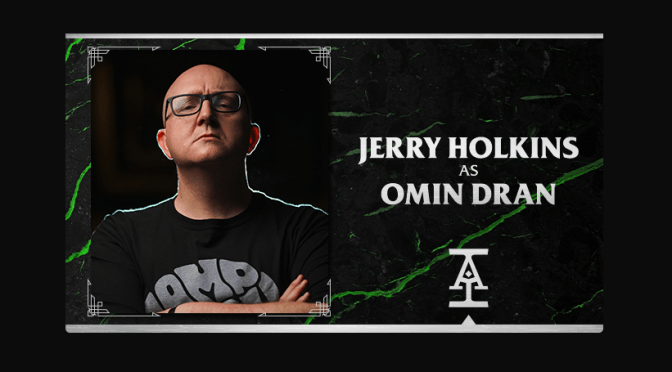
A Chat With Jerry Holkins At PAX East ’23
I sit down with Jerry Holkins of Penny Arcade, aka CEO Omin Dran of Acquisitions Incorporated, to talk about the primordial actual play experience , its history and changes, its official D&D book, and the ongoing Kickstarter for its second video series!
Thanks to Jerry for taking the time to talk with me! Musical notes yoinked from Sneaky Adventure by Kevin MacLeod
[License].
Weekend Update: 1/28/2023
Welcome to the Cannibal Halfling Weekend Update! Start your weekend with a chunk of RPG news from the past week. We have the week’s top sellers, industry news stories, and discussions from elsewhere online.
Continue reading Weekend Update: 1/28/2023Weekend Update: 1/21/2023
Welcome to the Cannibal Halfling Weekend Update! Start your weekend with a chunk of RPG news from the past week. We have the week’s top sellers, industry news stories, and discussions from elsewhere online.
Continue reading Weekend Update: 1/21/2023 Cannibal Halfling Gaming